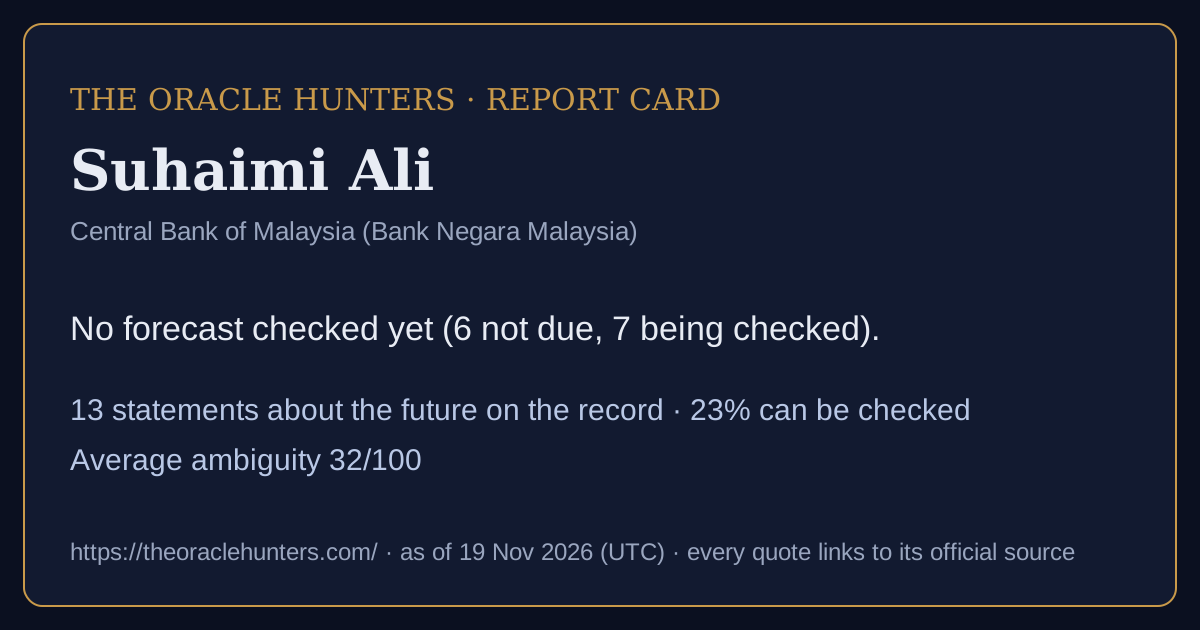
Suhaimi Ali
Central Bank of Malaysia (Bank Negara Malaysia)
Track record: No forecast checked yet (6 not due, 7 being checked).
13forecasts & commitments on the record
23%can be checked as stated
32average ambiguity (0-100)
0goalpost moves recorded
0confirmed U-turns
Timeline
came true partly did not not due / being checked / too vague
Calibration score: shown after 10 checked forecasts with a stated likelihood (now 0).
How they speak about the future: based on data 11, stated on authority 2.
Kinds of claim: forecast 13. · Download this report card as a picture
In the nine words
How to read this
Each box is one sentence a public figure or institution said about the future, word for word, with a link to the official text. Can be checked means it names what will happen, by when, and how likely - so it can be compared with official figures later. Too vague to check means it does not. Ambiguity (0-100) is how many different ways the sentence can be read. When the date passes, the forecast is compared with official data and marked came true, partly or did not come true. Labels judge the sentence, never the person. Full guide and glossary.On the record (13)
For industry players aspiring to drive greater market competition via digitalisation, the formal application window to carry digital takaful business will be open on 2 January 2025 until 31 December 2026.
As we reach the halfway mark of our Financial Sector Blueprint 2022-2026, it is timely that we reflect upon the factors that will sustain and further propel efforts to realise our vision for digital payments.
In fact, we could reach this milestone sometime this year.
At this rate, we are on track to meet our goal of 400 e-payment transactions per capita by 2026 much sooner than expected.
We expect efforts to enhance cross-border payments to remain in the spotlight in the foreseeable future and will continue to pick up momentum, especially as Malaysia takes on the ASEAN Chairmanship in 2025.
The framework for Digital Insurers and Takaful Operators (DITO), is also expected to be finalised by the first half of 2024, with aims to encourage wider participation from players in the insurance and takaful value-chain including providing clarity for emerging and innovative business models such as embedded takaful and takafulas-a-service.
Against this backdrop and align with this year's theme of "Tech Toward Sustainability: Empowering Resilient Ecosystem", I hope this summit will further catalyse efforts in leveraging the ever-expanding technology evolution towards enhancing the Islamic finance industry to be more competitive, inclusive, and sustainable.
The market size of Islamic fintech in the OIC countries is projected to grow at CAGR of 17.9 , relative 1 2 to global fintech growth rate at 13.5%, to reach USD179 billion by 2026 . 3
The fund has successfully channelled over USD 234 million towards 21 water and sanitation projects, with approximately 60% crowded in from commercial banks.
My remarks this morning will touch on three imperatives, namely: (a) industry partnerships, (b) blended finance, and (c) policy influence; that in my view will sharpen the role of DFIs in contributing to Malaysia's aspiration to achieving net zero GHG emission by as early as 2050.
Based on projections, climate inaction would cost the global economy USD 178 trillion over the next 50 years 2 .
By 2025, half of all employees will need reskilling.
The digital revolution is expected to increase our labour productivity by 30% and create up to 500,000 jobs by 2025.
Also said - not checkable as stated (12 newest)
Remarks about the future with no date, figure or likelihood that could be checked. They are kept on the record and shown here, but not scored.
Expanding the use of risk-sharing instruments such as mudarabah and musharakah will allow us to finance real economic activity more meaningfully.
As a central bank, we remain committed to supporting responsible innovation, enabling experimentation, and strengthening collaboration across industries, sectors, and borders.
Today's Conference and Workshop will be an important step to align our vision, including to work out what needs to be done going forward to realise the Open Finance vision.
Today's event is an important milestone in our Open Finance journey, as we seek to turn into reality the vision and aspiration we have to advance the development of an open data ecosystem for the financial sector as set out in the Financial Sector Blueprint 2022-2026.
Indeed, we will need a whole-of-system approach.
I imagine that there will be the sharing of diverse and enriching perspectives, including of the technical and commercial challenges that we will need to navigate and overcome.
Bank Negara Malaysia will also work closely with PayNet and the industry in delivering the intended vision for Open Finance by putting in place an enabling regulatory environment that will support the financial sector's state of readiness for Open Finance.
Flexibility, scalability and interoperability will also be key to futureproofing the platform to enable integration with AI and other data-driven innovations.
Before I conclude, may I remind ourselves that in implementing VBIT and MSS, the issues of skills and professionalism must be addressed.
At the same time, the industry should continue to work on introducing more costeffective innovative solutions that could empower the underserved segment.
We will continue to work closely with PayNet and the industry in this space to make this happen.
In the future, professionals are likely to collaborate with generative AI-"assistant" to transform fundamental processes, reengineer business collaborations and reduce risks.