Steve Reed
Department for Environment, Food & Rural Affairs · GBR
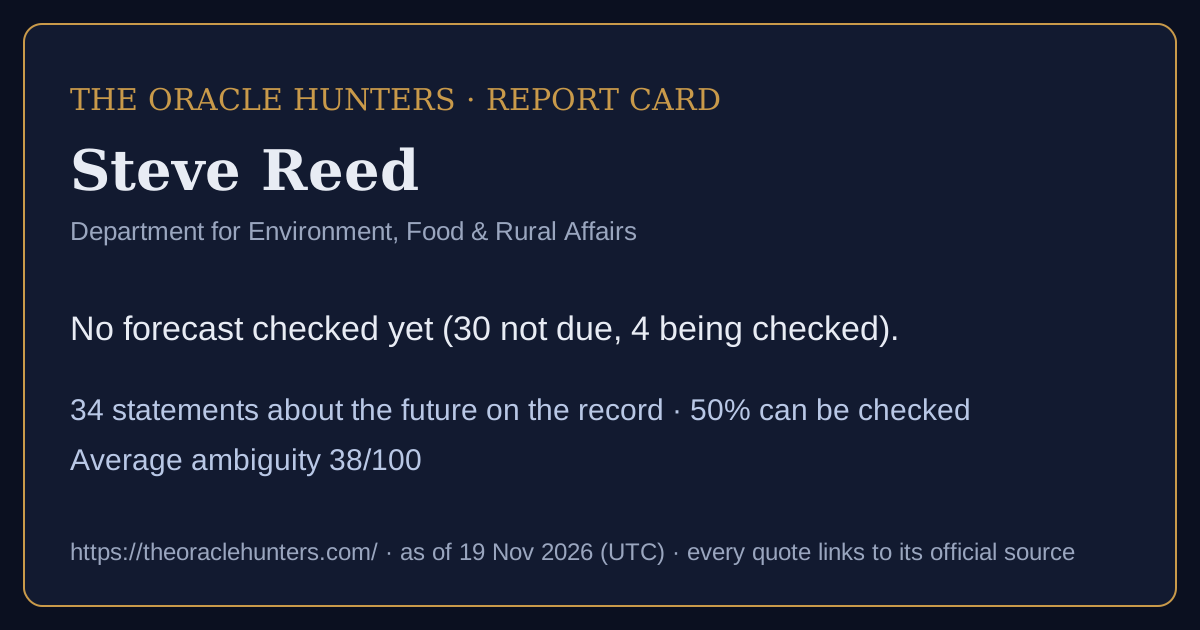
Track record: No forecast checked yet (30 not due, 4 being checked).
34forecasts & commitments on the record
50%can be checked as stated
38average ambiguity (0-100)
0goalpost moves recorded
0confirmed U-turns
Timeline
came true partly did not not due / being checked / too vague
Calibration score: shown after 10 checked forecasts with a stated likelihood (now 0).
How they speak about the future: stated on authority 17, based on data 17.
Kinds of claim: forecast 15, commitment 11, mixed claim 7, scenario (if… then) 1. · Download this report card as a picture
In the nine words
πρόγνωσιςInference from evidence13 · 38%προαναγγελίαPublic pre-announcement11 · 32%μαντείαInspired knowledge9 · 26%πρόνοιαPreparing for the future1 · 3%
How to read this
Each box is one sentence a public figure or institution said about the future, word for word, with a link to the official text. Can be checked means it names what will happen, by when, and how likely - so it can be compared with official figures later. Too vague to check means it does not. Ambiguity (0-100) is how many different ways the sentence can be read. When the date passes, the forecast is compared with official data and marked came true, partly or did not come true. Labels judge the sentence, never the person. Full guide and glossary.On the record (34)
A £61m Community Right to Buy Fund will let communities take control of much-loved local pubs, venues, and community centres if they face closure.
The Local Outcomes Framework set out those expectations in February, and the first results will be published later this year.
…and to support the delivery of more homes, we will make available £2.5 billion of low-interest loans to Private Registered Providers.
We are listening carefully to the sector’s feedback about deliverability and later this year we will publish guidance on quality regulations.
Through the new powers we’ve just taken, we will give the Mayor, who’s got a London-wide mandate, the ability to overrule important licensing decisions, so that hospitality venues can stay open, create jobs and provide for the millions who just want to go out and enjoy themselves.
Later this year we will publish guidance to make sure Neighbourhood Boards have our full support to use local suppliers and invest in local businesses.
We will be clear where responsibility lies, and we will hold to account those who fail to do their job that is expected of them.
We will explore further devolution as we work towards the Autumn Budget this year because we know it means better local services for our communities.
We will solve viability gaps, clear the BSR backlog, expand our New Homes Accelerator, and call in decisions which are not pro-growth.
The Office for Budget Responsibility have said that the planning reforms we’ve already announced will add £6.8 billion to the economy by 2029-30.
And in Hampshire, work’s begun on the Havant Thicket Reservoir, the first reservoir to be built in the South East since the 1970s and when it’s full, this will supply water to around 160,000 people and, during construction, it will generate more than £10 million a year to the South East economy, with construction jobs and apprenticeships.
Earlier this year, my colleague the Water Minister Emma Hardy and I toured the country to see how this investment will be spent.
This investment will make sure we can build 1.5 million homes this Parliament, construct major infrastructure projects to support the green energy transition, and power new industries such as data centres that can unlock the UK’s AI potential.
It will build and upgrade infrastructure in every region of the country - cutting sewage in half by 2030 and cleaning up our rivers, lakes and seas.
Funding for farmers through the Environmental Land Management schemes will increase by 150 per cent to £2 billion by 2029.
This afternoon, my colleague Emma Hardy has told the same conference that the UK will introduce legislation this year to ratify the Global Oceans Treaty so we are part of the first group of nations coming together to protect biodiversity in the seas beyond national jurisdictions.
The National Trust’s new strategy to 2035 that will be pivotal in helping us restore nature.
Our reforms are giving them the confidence to invest £10 billion pounds in the UK’s recycling infrastructure over the next decade, creating over 21 thousand jobs right across the country.
And a standardised, national approach to household recycling – paper, card, plastic, glass, metals and food waste – will be introduced next year so everyone understands more clearly what they can recycle and how they recycle it.
Packaging Extended Producer Responsibility will begin later this year, incentivising businesses to remove unnecessary packaging and make their products more recyclable and refillable.
And this April, we will appoint the business-led organisation that will launch the UK’s first Deposit Management Scheme for drinks containers starting in 2027.
To strengthen our approach and protect your profits, the Home Secretary Yvette Cooper will lay the legislation this year to better protect agricultural equipment like all-terrain vehicles, by requiring immobilisers and forensic marking as standard.
But I want to be clear, we will never lower our food standards in trade agreements.
Using the most sophisticated land use data ever published, we will boost food production, protect the best agricultural land, restore our natural world and drive economic growth.
It will work hand in hand with our housing and our energy plans, so we can meet our ambitious housing targets and achieve Clean Power by 2030, without jeopardising food production or nature.
We’re investing £2.4 billion pounds to build and maintain flood defences, with a further £50 million pounds for internal drainage boards; our Floods Resilience Taskforce will ensure better coordination between government and frontline agencies; and we’re reviewing the existing flood funding formula to speed up new flood schemes and make sure funding goes where it’s most needed.
I can today confirm we will introduce secondary legislation to Parliament by the end of March, unlocking new precision breeding technology that will allow farmers to grow crops that are more nutritious, resistant to pests and disease, resilient to climate change and benefit the environment.
We will expand global trade opportunities, like increasing access for UK pork exports to China worth an additional £80 million pounds a year.
And we will protect farms, rural homes and businesses for the longer term with £2.4 billion to rebuild our crumbling flood defences, currently in their worst condition on record.
This government will reform the sector so we can invest in our waterways, boost economic growth, and clean up our polluted rivers.
We will pioneer solutions through agri-tech, such as using satellite data and AI to apply fertilisers more precisely, and in Precision Breeding, such as higher yielding crops that could reduce the need for fertilisers that run into our rivers.
We will ensure the framework that underpins our water sector delivers long-term stability, with clear, achievable targets that reflect the needs of customers and the environment at a catchment, regional and national scale, as well as enabling housing delivery and supporting the government’s growth mission.
We have a target to reduce the amount of water used per person by 20% by 2038, and we will help consumers make more efficient water choices to achieve this, including working towards a Mandatory Water Efficiency Label for products, and working with regulators and industry on the rollout of smart meters to enable faster leak detection and repairs.
We will support farmers to strengthen Britain’s food security and boost rural growth with a new deal for farmers, cutting energy bills, ending trade deals that undermine environmental and welfare standards, and buying more British produce with the public purse.
Also said - not checkable as stated (12 newest)
Remarks about the future with no date, figure or likelihood that could be checked. They are kept on the record and shown here, but not scored.
We will reform how we procure to bring in more small, community-led providers, focused on outcomes and social value.
But most exciting of all, it’s local people who will take the decisions about how that money gets spent, because it’s local people who know best what needs to change in their own area.
I make no apologies for being ambitious about this – we will complete reorganisation within this Parliament because we need devolution to happen at pace so we can rebalance wealth, power and opportunity across our country.
And we will publish and consult on new Best Value guidance.
And through the Social Housing Bill, we will protect our critical social housing stock by reforming the right to buy scheme, so that homes are not sold off more quickly than they can be replaced.
Through the Social Housing Resident Panel, we will continue to listen to residents directly as we develop and implement this policy.
That work includes the Small Sites Aggregator, which has been developed jointly with many people in this room and which I am proud to say we will be rolling out across the country following the current pilot.
In addition to this, we are supporting new and innovative financing of social housing, like the Small Sites Aggregator, which will forge new partnerships to build homes for social rent.
And third, we will empower service users relative to service providers so decisions and public services become more directly accountable and responsive to people’s real needs.
Liverpool, South Yorkshire and the North East will pioneer new approaches in education, the arts, and flood management, and we will extend those powers to other regions as we learn what works best.
But decisions about how that money is spent will be taken by local people not by politicians, because local people know best what needs to change in their own area.
Learning from this we will use models of co-production and citizen empowerment to give people a real say over the day-to-day decisions and public services that profoundly affect their lives.