Stephen S Poloz
Bank of Canada
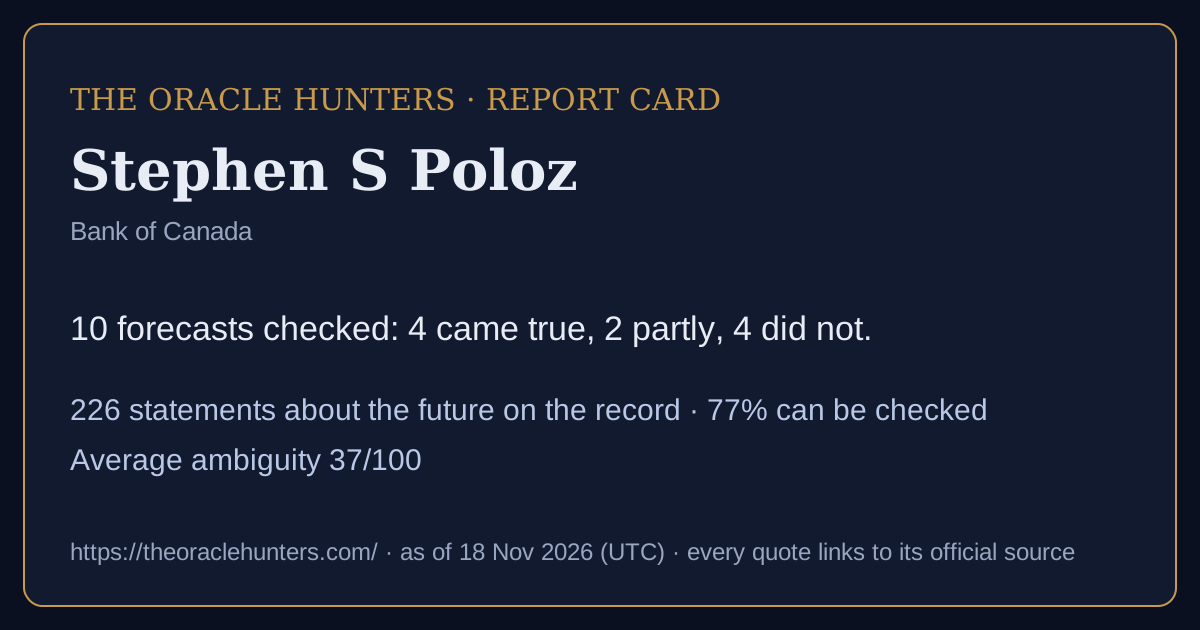
Track record: 10 forecasts checked: 4 came true, 2 partly, 4 did not.
226forecasts & commitments on the record
77%can be checked as stated
37average ambiguity (0-100)
0goalpost moves recorded
0confirmed U-turns
Timeline
came true partly did not not due / being checked / too vague
Calibration score: shown after 10 checked forecasts with a stated likelihood (now 9).
How they speak about the future: based on data 165, stated on authority 37, educated guess 24.
Kinds of claim: forecast 157, mixed claim 29, scenario (if… then) 22, commitment 18. · Download this report card as a picture
In the nine words
πρόγνωσιςInference from evidence160 · 71%πρόνοιαPreparing for the future22 · 10%μαντείαInspired knowledge19 · 8%προαναγγελίαPublic pre-announcement18 · 8%εἰκασίαConjecture6 · 3%πρόβλεψιςSeeing the signs1 · 0%
How to read this
Each box is one sentence a public figure or institution said about the future, word for word, with a link to the official text. Can be checked means it names what will happen, by when, and how likely - so it can be compared with official figures later. Too vague to check means it does not. Ambiguity (0-100) is how many different ways the sentence can be read. When the date passes, the forecast is compared with official data and marked came true, partly or did not come true. Labels judge the sentence, never the person. Full guide and glossary.Checked
So, in the MPR, we marked down our forecast for economic growth this year to 1.2 per cent, and we project growth of near 2 per cent for both 2020 and 2021.
Did not come true. Said: economic growth around 2% in 2020. Official figure for Canada: -5.0% (World Bank open data). Missed. Off by 7.0 points. official data · checked 14 Nov 2026 · automatic check against official data (rules v3)
This results in a modest reduction in our forecast for inflation for 2019, but we expect to be back at 2 per cent by the end of this year.
Came true. Said: inflation at the end of the year around 2% in 2019. Official figure for Canada: 2.2% (BIS consumer prices (December, year on year)). On target. Off by 0.2 points. official data · checked 17 Nov 2026 · automatic check against official data (rules v4)
Our forecast now shows inflation rising modestly above 2 per cent due to temporary factors, and then easing back to about 2 per cent during 2019.
Came true. Said: inflation around 2% in 2019. Official figure for Canada: 1.9% (World Bank open data). On target. Off by 0.1 points. official data · checked 14 Nov 2026 · automatic check against official data (rules v3)
All told, we forecast that the economy will expand by 3.1 per cent this year, before slowing to 2.1 per cent in 2018.
Partly came true. Said: economic growth around 2.1% in 2018. Official figure for Canada: 2.7% (World Bank open data). Close: outside the margin, but within one more half point. Off by 0.6 points. official data · checked 14 Nov 2026 · automatic check against official data (rules v3)
We are now projecting real GDP growth of 1.7 per cent this year, 2.3 per cent next year and 2 per cent in 2018.
Partly came true. Said: economic growth around 2% in 2018. Official figure for Canada: 2.7% (World Bank open data). Close: outside the margin, but within one more half point. Off by 0.7 points. official data · checked 14 Nov 2026 · automatic check against official data (rules v3)
This projected growth profile gets us back on track to absorb our excess capacity around the end of 2016, at which time inflation will settle sustainably at 2 per cent.
Came true. Said: inflation at the end of the year around 2% in 2016. Official figure for Canada: 1.5% (BIS consumer prices (December, year on year)). On target. Off by 0.5 points. official data · checked 17 Nov 2026 · automatic check against official data (rules v4)
In Canada, real GDP growth is expected to average about 2 ½ per cent in 2014 and 2015 before easing to around 2 per cent.
Did not come true. Said: economic growth around 2% in 2015. Official figure for Canada: 0.6% (World Bank open data). Missed. Off by 1.4 points. official data · checked 14 Nov 2026 · automatic check against official data (rules v3)
- -Real GDP growth is projected to increase from 1.6 per cent this year to 2.3 per cent next year and 2.6 per cent in 2015.
Did not come true. Said: economic growth around 2.6% in 2015. Official figure for Canada: 0.6% (World Bank open data). Missed. Off by 1.9 points. official data · checked 14 Nov 2026 · automatic check against official data (rules v3)
- Real GDP growth is projected to increase from 1.6 per cent this year to 2.3 per cent next year and 2.6 per cent in 2015.
Did not come true. Said: economic growth around 2.6% in 2015. Official figure for Canada: 0.6% (World Bank open data). Missed. Off by 1.9 points. official data · checked 14 Nov 2026 · automatic check against official data (rules v3)
- Annual GDP growth is projected to average 1.8 per cent in 2013 and 2.7 per cent in both 2014 and 2015, supported by very accommodative financial conditions.
Came true. Said: economic growth around 2.7% in 2014. Official figure for Canada: 2.9% (World Bank open data). On target. Off by 0.2 points. official data · checked 14 Nov 2026 · automatic check against official data (rules v3)
On the record (226)
However, if negotiations were to deteriorate or be resolved in a way that would obstruct trade, economic activity would likely be worse than in the base case, providing a downside risk to growth.
But it is clear that the events of this year will be a massive test for everyone's policy-making ability.
If we were to misjudge the balance of deflationary and inflationary forces during the recovery, the economy could pick up too much steam and inflation could rise.
It tells people that the Bank will work as hard as it can to get the economy stabilized and back on track, so as to prevent inflation from falling significantly below target for an extended period.
If we failed to do our job, increased liquidity demands could instead lead to a contraction of credit availability, with obvious consequences for individuals and the economy.
We decided to increase the Bank's participation in the government's treasury bill auctions to 40 percent of each new issue, and to underscore that our program of purchasing at least $5 billion per week of Government of Canada bonds in the secondary market could be increased at any time, should market conditions warrant it.
This means that investors, firms and households expect that the Bank will act to help return the economy to capacity and bring about stable, 2 percent inflation.
In this regard, Governing Council will be watching closely to see if the recent slowdown in growth is more persistent than forecast.
The Bank's outlook is for a rebound in growth to about 1.3 percent in the first quarter and a pickup to about 2 percent after that.
At the time, we were forecasting economic growth for 2019 of close to 2 percent, and some saw this as far too optimistic.
This loss will likely be permanent, even if growth resumes from that lower level.
But a lot of damage has been done; this year, we estimate that global GDP will be around 1 percent lower than it would have been without the trade conflict.
A third area of focus for the Bank in 2020 will be to assess the economic and financial impact of digitalization.
Another important area for the Bank next year will be to continue to embed financial stability linkages in our monetary policy framework.
Given this backdrop, a veritable smorgasbord of work will be going on at the Bank in 2020.
We will have more to say about this early in 2020.
We will then make a recommendation to the government and hold discussions that will lead to the next formal agreement on the framework in 2021.
That is why in 2020, we will conduct an open, public consultation process on our website to gather input from Canadians across the country.
Furthermore, our situation differs from many other countries in that inflation is at our 2 percent target today and projected to remain very close to target, despite the presence of modest excess supply.
In today's updated projections, we are forecasting both exports and business investment to contract in the second half of this year and to recover only moderately in the next two years.
In considering the appropriate path for monetary policy, we will be monitoring the extent to which the global slowdown spreads beyond manufacturing and investment.
However, as we said in our recent Monetary Policy Report , we expect economic growth to pick up later this year.
If institutions can use the information to show how solid their mortgages are, they could lower their funding costs, no matter how they obtain their funding.
The final details will be put in place later this year.
Simple math tells you that of all those five-year mortgages, roughly 20 per cent will be renewed every year.
But when those investment levels stop falling, Canada's growth will pick up again, even if oil sector investment does not, because other areas of growth will come to dominate the data.
In sum, the Canadian economy is currently facing some headwinds, but there is good reason to believe that the economy will accelerate in the second half of this year.
Our analysis suggests that the combined impact of adjusted spending plans announced to date would lead to a downward revision for our growth outlook of about 0.2 percentage points in 2020.
So, in the MPR, we marked down our forecast for economic growth this year to 1.2 per cent, and we project growth of near 2 per cent for both 2020 and 2021.
Did not come true. Said: economic growth around 2% in 2020. Official figure for Canada: -5.0% (World Bank open data). Missed. Off by 7.0 points. official data · checked 14 Nov 2026 · automatic check against official data (rules v3)
But, when those investment levels stop falling, Canada's growth will pick up, even if oil sector investment does not, as other areas of growth come to dominate the data.
For both investment and exports, then, we have reason to expect more growth in the second half of 2019.
However, the lowering of projected government spending in Ontario is sufficient to more than offset all of these, so that fiscal policy now represents a net downward revision to our growth outlook for 2020, of about 0.2 percentage points.
That sounds good, but inflation would also be higher-it would be close to the top of our 1-3 per cent target range, and very likely would be heading even higher.
As we head toward 2021, we will keep working hard on deepening our understanding of the power-and the limitations-of monetary policy.
As we said at the Bank's most recent interest rate announcement, we judge that we will need to move our policy rate up into a neutral range over time, to a point where it is not stimulating or constraining economic growth.
We will make our next recommendation in 2021.
Between now and 2021, when we next renew our inflation-control agreement with the government, we will be doing indepth research and wide-ranging consultations on alternative policy frameworks.
The trade war is already having negative consequences globally and these will continue to grow if the situation is not resolved, especially if it escalates.
At the global level, the job of bringing supply back in line with demand is falling to OPEC, so it remains to be seen if oil prices will remain as weak as they have been.
This trend is likely to continue as we are seeing renewed weakness in global oil prices, which are about 25 per cent lower than in October.
Our forecast is for global growth of 3.4 per cent in 2019-the same figure we had in October-but this is a material moderation from 3.7 per cent in 2018.
Our estimates, as shown in Chart 1 of the MPR, show that US private sector economic growth has been slowing since early 2018 and will continue to slow this year.
This results in a modest reduction in our forecast for inflation for 2019, but we expect to be back at 2 per cent by the end of this year.
Came true. Said: inflation at the end of the year around 2% in 2019. Official figure for Canada: 2.2% (BIS consumer prices (December, year on year)). On target. Off by 0.2 points. official data · checked 17 Nov 2026 · automatic check against official data (rules v4)
I would note that our forecasts were already calling for a moderation of economic growth in 2019-20, but this would only bring us to a sustainable growth track and would not be cause for concern.
We will continue to gauge the impact of higher interest rates on consumption and housing, and monitor global trade policy developments.
However, our outlook remains that the US economy will moderate to a more sustainable pace next year and into 2020 and that inflation expectations remain well anchored.
Meanwhile, we project that inflation will continue to move back toward the 2 per cent midpoint of our target range, after having peaked in the summer.
We project the economy will continue to operate close to its capacity limits, with annual growth around 2 per cent over the next couple of years.
We forecast that global growth will moderate from about 3¾ per cent this year to 3½ per cent next year, with the US strength expected to ease back by 2020.
In particular, we will continue to take into account how the economy is adjusting to higher interest rates, given the elevated level of household debt, and whether strong consumer confidence builds on solid job and income growth and leads to greater-than-expected consumption.
Showing the newest 50 - the ledger has all 226.
Also said - not checkable as stated (12 newest)
Remarks about the future with no date, figure or likelihood that could be checked. They are kept on the record and shown here, but not scored.
Governing Council agrees that the policy interest rate will need to rise to a neutral stance in order to achieve the inflation target.
The pandemic is an example of Knightian uncertainty that will also force us to reconsider many fundamental ideas about how our economy can and should function.
They will have to deal with all the unknowns surrounding the restart of shuttered sectors, the reconstruction of broken value chains, the unwinding of emergency measures and the unpredictable behaviour of consumers and business leaders.
Because of all the interdependencies, we have to guard against the possibility of persistent problems with the model, which can lead to a biased projection and monetary policy errors.
This makes it even harder to make a point forecast for economic activity because, to do so, you must analyze both the shock and the fiscal response and how they interact.
Certainly, we will need to monitor and adjust for any structural damage judgmentally.
We have not forgotten about financial vulnerabilities-we will put more weight on them in our risk management framework once we are confident that our primary objective will be met.
We know this will not stimulate economic growth right now while the stores are closed.
These moves were based on analysis of the factors we could measure immediately-mainly the likely fallout on the economy from the collapse in oil prices, as well as the immediate effects of measures to contain the novel coronavirus.
This preliminary analysis indicated that cutting rates all the way to the effective lower bound was the best contribution the Bank could make to stabilizing the economy and complementing the government's efforts.
In the past few days, Governing Council's deliberations focused mainly on what additional actions the Bank could take to achieve this goal.
We will count on our public health authorities to give us good advice and contain the situation in due course.