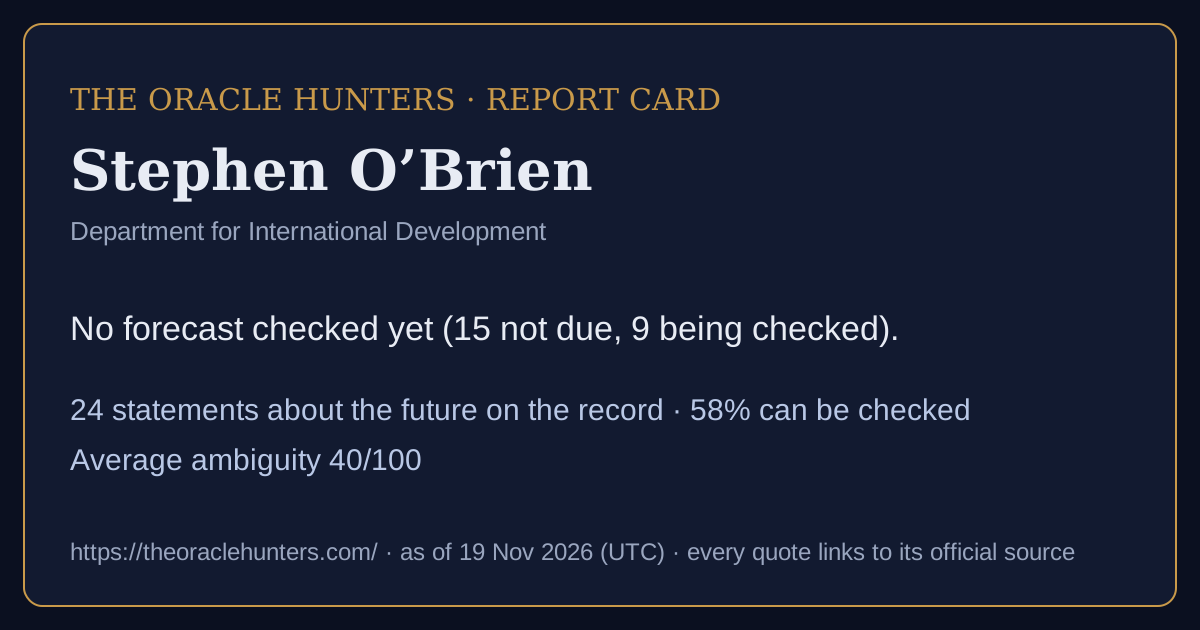
Stephen O’Brien
Department for International Development · GBR
Track record: No forecast checked yet (15 not due, 9 being checked).
24forecasts & commitments on the record
58%can be checked as stated
40average ambiguity (0-100)
0goalpost moves recorded
0confirmed U-turns
Timeline
came true partly did not not due / being checked / too vague
Calibration score: shown after 10 checked forecasts with a stated likelihood (now 0).
How they speak about the future: based on data 14, stated on authority 8, educated guess 2.
Kinds of claim: forecast 14, mixed claim 4, commitment 4, scenario (if… then) 2. · Download this report card as a picture
In the nine words
πρόγνωσιςInference from evidence14 · 58%προαναγγελίαPublic pre-announcement4 · 17%μαντείαInspired knowledge4 · 17%πρόνοιαPreparing for the future2 · 8%
How to read this
Each box is one sentence a public figure or institution said about the future, word for word, with a link to the official text. Can be checked means it names what will happen, by when, and how likely - so it can be compared with official figures later. Too vague to check means it does not. Ambiguity (0-100) is how many different ways the sentence can be read. When the date passes, the forecast is compared with official data and marked came true, partly or did not come true. Labels judge the sentence, never the person. Full guide and glossary.On the record (24)
On the part of the British government, I can say that if you can build the ground-breaking partnerships required to support green growth and curb the impact of palm oil as a driver of deforestation, then the UK will endeavour to use its climate finance to support you to go that extra mile.
A new EU Timber Regulation, strongly supported by the UK, will make first sale in Europe and the UK of illegally logged timber a crime from March 2013.
That’s why the government has allocated £2.9 billion to a new International Climate Fund, which we will invest to help protect millions of poor people from droughts, floods and other extreme weather events; assist poor countries develop in ways that avoid or reduce harmful greenhouse gas emissions; and help to protect the world’s forests and the livelihoods of 1.2 billion …
Providing pregnant women living with HIV with antiretroviral prevention and treatment reduces the risk of a child being born with the virus to less than 5%–and just as importantly keeps their mothers alive to raise them.
At current prices this will enable UNFPA to procure at least 13.5 million female condoms.
That is why I am delighted today to be able to announce that the UK Government will be providing an additional £5 million to the United Nations Population Fund (UNFPA) Global Programme to Enhance Reproductive Health Commodity Security.
And third - we will not shy away from talking about population - about global population growth and its impacts on development.
If we do not work harder and put renewed emphasis on reproductive health, especially family planning - if we don’t invest in better and more accessible family planning services - then some people argue that the higher UN projection of around 11 billion people by 2050 begins to look like the more realistic number.
That’s just one of the reasons why this government has pledged to vaccinate over 80 million children over the next few years.
Almost all - 99% - of this growth will occur in the high fertility developing countries.
But we will also be championing the importance of global population growth and ensuring it is recognised in discussions on development in an open, honest and constructive way.
This will make a massive difference to the lives of 14.5 million of the poorest women between now and 2015.
And secondly, we will not shy away from talking about population - about global population growth and its impacts.
The first clinical trial to test multiple new TB drugs was launched in November 2010 and the preliminary results are expected later this year.
We will continue to focus on both HIV and TB, and on strengthening the underlying health systems in order to improve the way health services diagnose and treat illnesses, including TB and TB-HIV.
This year, of all years, will give us the opportunity to demonstrate how forests matter - domestically and internationally.
Or as Kofi Annan’s Africa Progress Panel said this year: “Good governance and accountability will determine Africa’s future.
Progress against these targets will be reviewed at a UN General Assembly special session in June next year.
We have also put women and children’s health at the heart of our international development agenda and we expect that our Commitments made on women and children’s health will contribute to the survival of at least 50,000 more women in pregnancy and childbirth and 250,000 newborn babies and to provide 10 million more couples with access to comprehensive family planning.
Later this year we will publish a summary of responses of all the feedback submitted.
As part of the Spending Review announcement, the Chancellor set out how we will spend 0.7% of our Gross National Income on overseas aid from 2013, helping the billion people in the world who live in extreme poverty.
An increase of 35% - but even this rate of growth assumes a significant fall in the global fertility rate - and that will only be achieved if we meet the unmet demand for family planning.
We have promised to enshrine in law Britain’s commitment to spend 0.7% of GNI on overseas aid from 2013 - and we are taking a good look at just what that will look like.
If global action is not taken it will be impossible to limit the global temperature rise to two degrees celsius above pre-industrial levels and avoid potentially catastrophic climate change.
Also said - not checkable as stated (12 newest)
Remarks about the future with no date, figure or likelihood that could be checked. They are kept on the record and shown here, but not scored.
- We are now preparing comprehensive anti-corruption strategies for all DFID priority countries which set out how we will assess, respond and implement action to address corruption and ensure the effectiveness of UK assistance.
We have undertaken to produce strategies in respect of all 28 of DFID’s partner countries by the end of January 2013.
While in Indonesia, the Prime Minister emphasised that the UK will work closely with businesses in pursuit of these goals: to source and produce sustainable timber and palm oil and to tackle the wasteful and inefficient practices that are driving deforestation.
My colleagues in the Department for Environment, Food and Rural Affairs (Defra) have already started working with industry on a voluntary basis to increase sustainable private and public sector sourcing of tropical commodities, and we will use this forum to consider how to move this agenda forward further and faster in tandem with industry.
Avoiding dangerous climate change will be harder if we don’t halt deforestation.
But I can tell you now that I and Caroline Spelman both agree that one of the most important outcomes at Rio+20 could and should be around the private sector - because the private sector is the engine of growth.
I hope we will use Rio+20 as a means to articulate those credible, high-impact ideas together, and, more importantly, implement lasting solutions.
At Rio+20, we will need to recognise this wide range of actors, and bring them in.
Credible, high-impact ideas will need to be brought to the table if we are to protect the future of young Ms Suzuki, who made that powerful speech in 1992.
Ladies and Gentlemen, I am delighted to be here with you this afternoon to discuss the UK Government’s priorities for the forthcoming Earth Summit in June next year.
It can determine the whether a business will fail or thrive, and the employment prospects for hundreds of people.
But thirdly, we must also recognise that particular vulnerable groups at higher risk of pregnancy and infection, such as adolescent girls, women living with HIV, and sex workers, may also need tailored services.