Stephen Lovegrove
Department of Energy & Climate Change · GBR
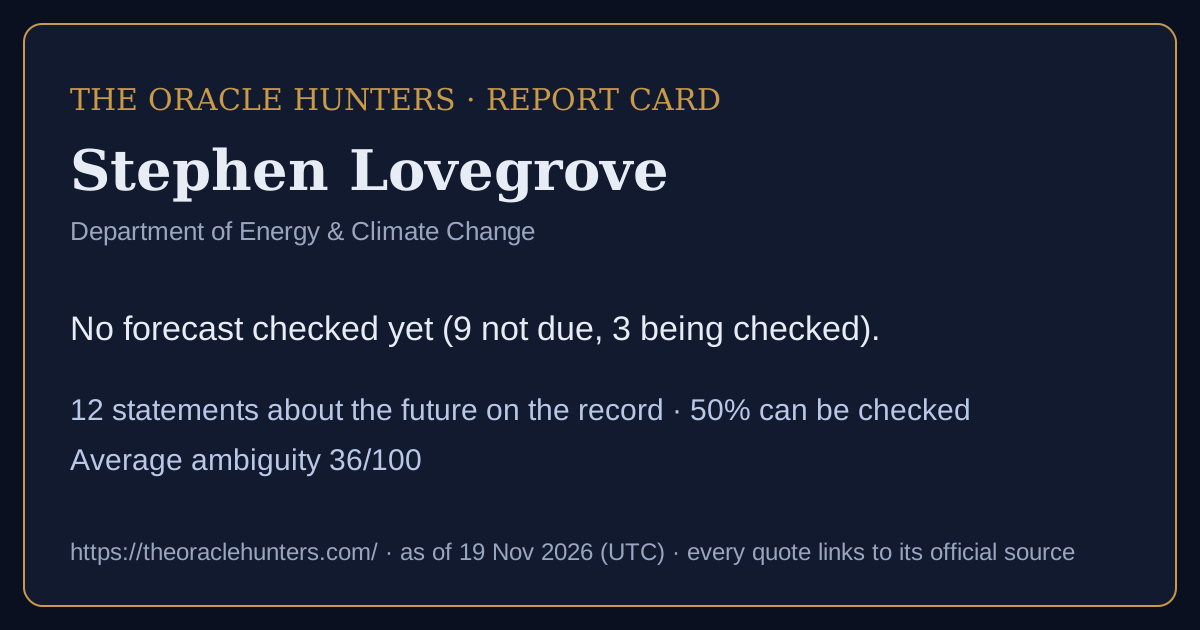
Track record: No forecast checked yet (9 not due, 3 being checked).
12forecasts & commitments on the record
50%can be checked as stated
36average ambiguity (0-100)
0goalpost moves recorded
0confirmed U-turns
Timeline
came true partly did not not due / being checked / too vague
Calibration score: shown after 10 checked forecasts with a stated likelihood (now 0).
How they speak about the future: based on data 8, stated on authority 4.
Kinds of claim: forecast 7, mixed claim 3, commitment 2. · Download this report card as a picture
In the nine words
πρόγνωσιςInference from evidence8 · 67%προαναγγελίαPublic pre-announcement2 · 17%μαντείαInspired knowledge2 · 17%
How to read this
Each box is one sentence a public figure or institution said about the future, word for word, with a link to the official text. Can be checked means it names what will happen, by when, and how likely - so it can be compared with official figures later. Too vague to check means it does not. Ambiguity (0-100) is how many different ways the sentence can be read. When the date passes, the forecast is compared with official data and marked came true, partly or did not come true. Labels judge the sentence, never the person. Full guide and glossary.On the record (12)
And we will continue to hold Russia to account for its destabilising actions as an international community.
There is so much plastic waste in our seas that by 2050 plastic may outweigh fish in the ocean.
Australia will become the seventh, representing a significant commitment to peace and stability in the region, mirroring our own defence settlement, which saw a 10% uplift in spending agreed last year.
And we will need to work closely with nations less familiar to us, at least in that guise: for example, Russia, China and Iran are all deeply invested in a stable Afghanistan.
The UK will spend 2.3% of GDP on defence this year which will cement our place as the largest defence spender in Europe.
We will be doing this as we leave the EU, but co-operation with our many and long-standing European partners will remain as important as ever.
And if we are flexible in how we aim to hit it a 50% target, it will be cost-effective too - contributing to growth and maintaining competitiveness.
Up to £110bn of investment this decade (that’s nearly 1 trillion Krone) will drive the deployment of low carbon technologies like wind, nuclear and Carbon Capture and Storage.
A 50% target is ambitious for 2030, but a strong 2030 target will cement EU leadership, and resonate with the industries and governments around the world that we need if we are to turn European leadership into global action.
It is important for the EU to lay the foundations for a binding global climate agreement in 2015, when our French colleagues will host the UN climate conference.
So this year we have launched a new market framework for energy efficiency – The Green Deal - that will act as a single point of advice for consumers.
By the end of Carbon Budget 4 – in 2027 – the UK’s energy system will be substantially different to today’s – with more-efficient houses, a significantly decarbonised electricity grid and a more-competitive market – supported by smarter grids and smart meters – that better serves consumers.
Also said - not checkable as stated (12 newest)
Remarks about the future with no date, figure or likelihood that could be checked. They are kept on the record and shown here, but not scored.
And at the Non-Proliferation Treaty Review Conference in August, we will stress the importance of Russia respecting its obligations under the NPT, in both deed and word.
We will work with all States Parties at the forthcoming Review Conference to strengthen the treaty as the irreplaceable foundation and framework for our common efforts.
Further integrated arms control will need to extend across several interlinked and overlapping categories of proliferation.
Second, we need to look at new weapons systems or technologies that only the most powerful states could develop and that threaten to upset the strategic balance.
We must also remain vigilant as technological development means that some of this second category could – over time – shift into the first.
I have no doubt that if we work together we will be more secure, more prosperous and more confident in the health of our people and our planet.
UNCLOS, freedom of navigation and the marine environment might seem like issues that should only be of concern to academics and policy experts.
In doing so, we will defend UNCLOS – deterring and countering hostile activity.
It is in creating such coalitions of the willing and by staying at the forefront of technological advance that we will be able to promote and defend an open international order.
The UK will not stand by while the marine environment is threatened and UNCLOS undermined.
We will soon host COP26 to ensure that we move ahead in tackling the universal threat posed by climate change.
And - let us be clear - our geographic proximity means that we will continue to face many of the same threats to our security.