Stephen I Miran
Federal Reserve · USA
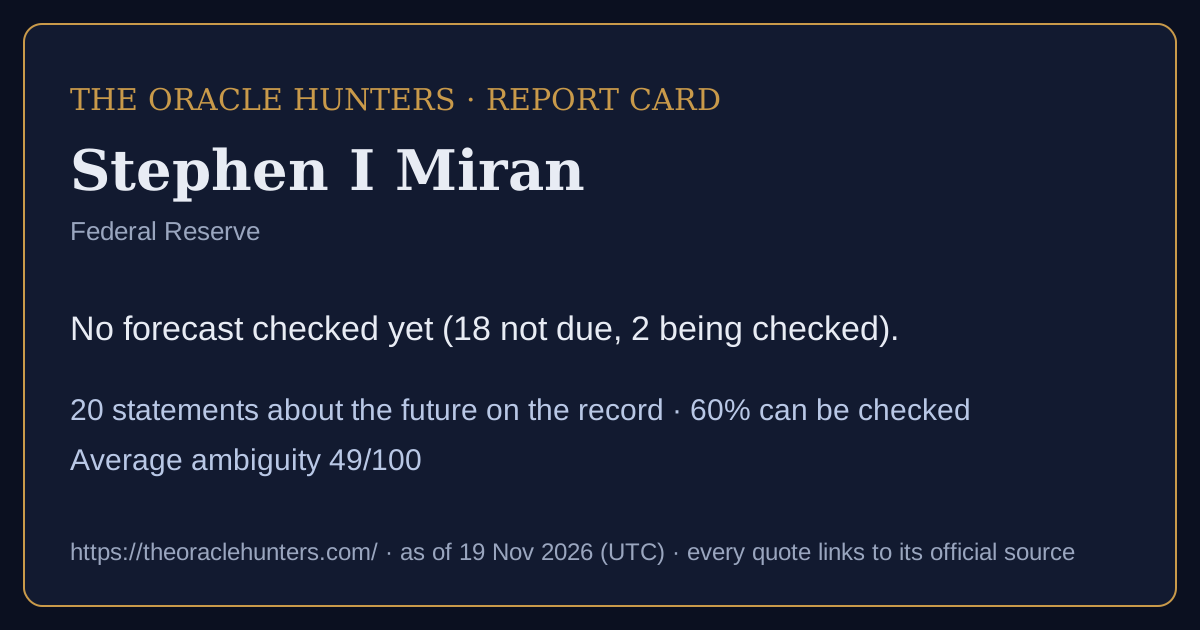
Track record: No forecast checked yet (18 not due, 2 being checked).
20forecasts & commitments on the record
60%can be checked as stated
49average ambiguity (0-100)
0goalpost moves recorded
0confirmed U-turns
Timeline
came true partly did not not due / being checked / too vague
Calibration score: shown after 10 checked forecasts with a stated likelihood (now 0).
How they speak about the future: based on data 16, educated guess 3, stated on authority 1.
Kinds of claim: forecast 15, mixed claim 3, scenario (if… then) 2. · Download this report card as a picture
In the nine words
πρόγνωσιςInference from evidence14 · 70%πρόνοιαPreparing for the future2 · 10%εἰκασίαConjecture2 · 10%μαντείαInspired knowledge1 · 5%πρόβλεψιςSeeing the signs1 · 5%
How to read this
Each box is one sentence a public figure or institution said about the future, word for word, with a link to the official text. Can be checked means it names what will happen, by when, and how likely - so it can be compared with official figures later. Too vague to check means it does not. Ambiguity (0-100) is how many different ways the sentence can be read. When the date passes, the forecast is compared with official data and marked came true, partly or did not come true. Labels judge the sentence, never the person. Full guide and glossary.On the record (20)
If actual output falls below potential output, there is slack in the economy that could be accommodated by looser monetary policy.
If the average deregulatory action removes 25.6 restrictions from the CFR, which was the average through July 1 of this year, then 61,542 restrictions will be removed per year.
On balance, I believe the substantial deregulation that has occurred in 2025 will continue over at least the next three years and be a large positive shock to productivity that will put downward pressure on prices.
Among other deregulatory efforts is the current U.S. Administration's "one-in-ten-out policy" revoking 10 old regulations for every new one adopted.11 Based on the pace of the Administration's deregulatory efforts in the first part of 2025, I estimate that 30 percent of the regulatory restrictions in the Code of Federal Regulations will be eliminated by 2030, though this may prove an …
If they take none of it on margin, and are able to pass through the entirety of the incidence to consumers, the effect will be about 0.4 percent.
The risks to my forecast are if shelter inflation picks up again, or if core goods inflation remains well above 2 percent.
Attention to supply chain security and resilience—which predates this year's tariffs—may mean higher core goods inflation for a longer period, though perhaps not this high.
Under that scenario, last year's core goods inflation was "too low" and now it is "too high"; perhaps next year it will be "too low" again.
If r* is lower, policy rates should also be lower than they would otherwise be to support a healthy economy.
More bullish stablecoin-uptake forecasts on the order of $4 trillion would double the size of this effect, making it about 60 percent the size of the original global saving glut.
An additional $2 trillion of foreign demand for dollar assets by the end of the decade would, all else equal, increase the current account deficit by roughly 1.2 percentage points of GDP over this period.
As I mentioned earlier, projections indicate between $1 trillion to $3 trillion of growth in stablecoins over the next several years.
The inter-quartile range of private-sector estimates compiled by Federal Reserve staff roughly projects stablecoin uptake reaching between $1 trillion and $3 trillion by the end of the decade.
In 2024, work by Marina Azzimonti and Vincenzo Quadrini estimated that if stablecoins are in widespread use and fully backed by U.S. securities, it could put as much as 40 basis points of downward pressure on interest rates.6
The Congressional Budget Office estimates tariff revenue could reduce the federal budget deficit by over $380 billion per year over the coming decade.10 This is a significant swing in the supply–demand balance for loanable funds, as national borrowing declines by a comparable amount.
So, the expected decline in U.S. population growth equates to a nearly 0.4 percentage point drop in the neutral fed funds rate.9
While the effect would likely normalize over time, this reduced level of population growth is also consistent with zero net immigration in 2026 and 2027.
Already in the first half of this year, roughly 1.5 million of these immigrants have left the country, according to the Current Population Survey, though this number may be an overestimate due to nonresponse issues.8 Assuming some overcounting, it is plausible to me that 2 million illegal immigrants will have exited the country by year-end, thereby reducing annual population growth …
This implies a roughly 0.3 percentage point decline in total PCE inflation; by early 2028, I expect that effect to grow to a 0.4 percentage point decline.
Rents for all tenants will fall toward this low rate as people moving or renewing leases sign at current market rates, and I expect CPI rent inflation will decline from its current level of roughly 3.5 percent to below 1.5 percent in 2027.
Also said - not checkable as stated (12 newest)
Remarks about the future with no date, figure or likelihood that could be checked. They are kept on the record and shown here, but not scored.
Each of those steps is likely to have some costs and benefits and will have to be duly studied and calibrated.
This system allows the Fed to control short-term interest rates primarily by setting rates at which it will participate in the market, or administered rates.
Some of the options, like destigmatizing repo operations, the discount window and daylight overdraft credit, or conducting temporary open market operations, will also improve the state of the world in a scarce reserves regime.
The most important thing we can do will be to go slowly.
The Fed's removal or provision of interest rate risk to the public will therefore affect the private sector's willingness to take financial risk overall.
It is therefore likely that a resumption of balance sheet reduction warrants additional reductions in the federal funds rate relative to baseline projections.
An existing homebuilder building one more house may be marginal, but for a new entrant to build it, they would have to invest in vast compliance infrastructure.
As McLaughlin notes, we will soon get the Fall 2025 Unified Agenda, which will allow me to update this calculation.
In other words, goods for which China would have to absorb a greater share of the tariff cost drop from the sample, while goods for which China could push through tariff costs to importers remain in the sample, violating identification restrictions.
As former Bank of England Governor, Mervyn King, and economist, John Kay, urged in Radical Uncertainty, pretending we have more knowledge than possible will stymie our understanding of reality.14 Shedding that hubris will help us reach a clearer understanding of the dynamics and make better decisions.
My goal in today's remarks is to share the core principles that will help guide my decision making in this area, including how regulation affects the Fed's balance sheet as well as current efforts to reform bank leverage requirements.
For example, the FOMC recently announced that maturing agency mortgage-backed securities will be replaced with Treasury bills in the Fed's portfolio, and the Board voted to rescind the Fed's climate guidance.