Stephen Grenville
Reserve Bank of Australia
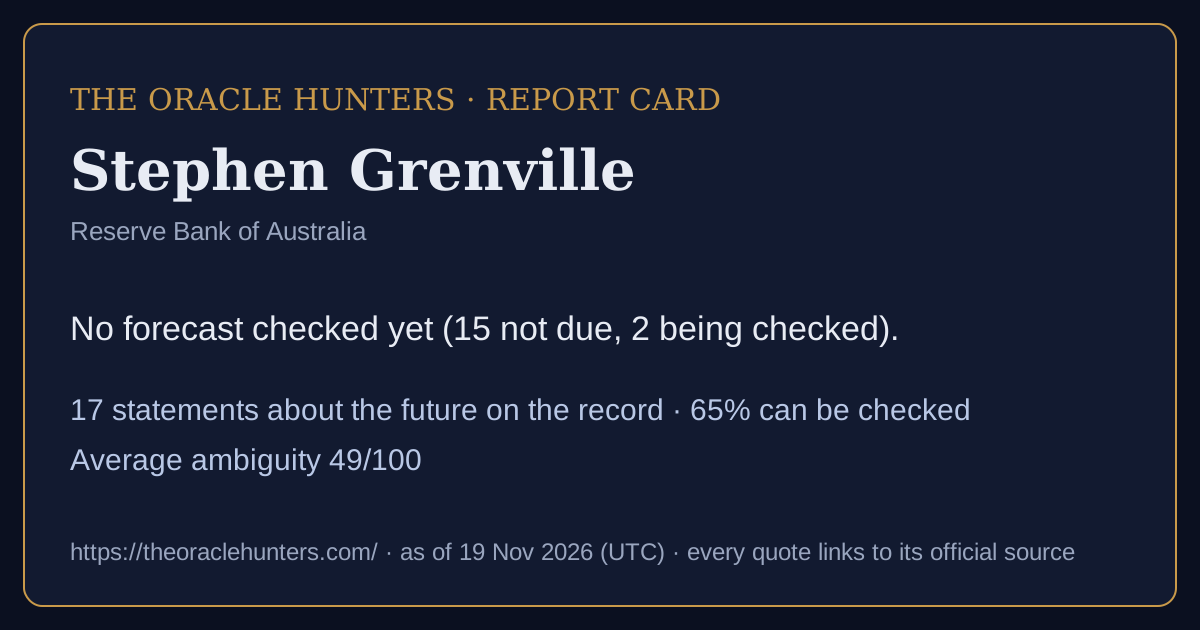
Track record: No forecast checked yet (15 not due, 2 being checked).
17forecasts & commitments on the record
65%can be checked as stated
49average ambiguity (0-100)
0goalpost moves recorded
0confirmed U-turns
Timeline
came true partly did not not due / being checked / too vague
Calibration score: shown after 10 checked forecasts with a stated likelihood (now 0).
How they speak about the future: educated guess 9, based on data 8.
Kinds of claim: scenario (if… then) 7, mixed claim 6, forecast 4. · Download this report card as a picture
In the nine words
πρόνοιαPreparing for the future7 · 41%πρόγνωσιςInference from evidence7 · 41%εἰκασίαConjecture3 · 18%
How to read this
Each box is one sentence a public figure or institution said about the future, word for word, with a link to the official text. Can be checked means it names what will happen, by when, and how likely - so it can be compared with official figures later. Too vague to check means it does not. Ambiguity (0-100) is how many different ways the sentence can be read. When the date passes, the forecast is compared with official data and marked came true, partly or did not come true. Labels judge the sentence, never the person. Full guide and glossary.On the record (17)
If the cycle could be smoothed, all would be well in the best of worlds, with inflation under control and growth as good as it could be;
The extraordinary period of growth experienced by America has been a powerful force for good in the world at large, and if America slows sharply and stays slow (which the earlier discussion of the imbalances there would suggest has to be more than a mere possibility), then, as one of my colleagues said recently, it would be hard for Australia …
Could the economy have successfully negotiated the period of robust growth, and rising inflation, in the first half of 2000, in the face of strong downward pressure on the exchange rate, with interest rates maintained at 43/4 per cent?
If these numbers are realistic, the portfolio balance model would suggest that the exchange rate has to appreciate initially by some 30% (and will appear seriously and persistently uncompetitive for trade in goods and services), before depreciating by 3% per year over the following decade.
It may be possible to argue that an economy will work best if wages (or domestic prices) are growing at a particular constant rate, and this is properly the main focus of stability.
The most graphic measure of how big they are is to remind you that in 1996 Thailand received capital inflows equal to 13 per cent of its GDP - an inflow which no country could have absorbed easily.
It is true that when an exchange rate goes down, this will be expansionary on an economy and if nothing else has happened , then interest rates will need to be higher.
Unless private sector creditors pay some price when things go wrong (either in terms of delayed repayment or some kind of 'hair-cut'), then the market will not make the correct risk assessments, nor will capital be allocated in the right way and, most serious of all, we will get repeats of these enormous and disruptive influxes of capital, with the …
One suggestion (quoted by Greenspan (1999)) is that countries should hold foreign exchange reserves equal to all the short-term debt which is going to fall due over the next year.
Current account deficits may have been too large, but these countries are now running surpluses: Thailand has gone from a deficit of 8 per cent of GDP to the prospect of a surplus, this year, of 4 per cent of GDP.
But those who are confident that this private non-bank borrowing will be a smooth, well-informed process might contemplate just how quickly private investors changed from wide-eyed enthusiasm to gloomy disillusionment, and how slow the international credit agencies were to see the impending problems.
- if the market does not believe that high interest rates will be sustained, then there is no encouragement to capital inflows (and, in fact, the market may think that the exchange rate will fall further when the unsustainable interest rates are lowered);
After the crisis (which involved an almost 50 per cent fall in the exchange rate), one might have gained the impression from contemporary analysis that, if only Mexico had published accurate figures of its foreign exchange reserves in a timely way during 1994, the crisis would have been averted or at least greatly lessened.
It also needs to be able to handle big swings in perceived company profitability, because we know that a project which is performing well in an environment of 8 per cent growth can turn into a loser when growth slows.
If a project has to pass the scrutiny of a bank which will hold the loan on its balance sheet, there is still no guarantee of success, but maybe the chances are improved.
If the actual rate of growth exceeds the long-term potential, sooner or later pressure comes on resources and inflation will be the result.
The critical issue here is that even though inflation rose and fell over the course of the cycle, price expectations did not move -- even when inflation was running at 5 per cent, the community at large expected it would soon be back to its normal lower pace.
Also said - not checkable as stated (12 newest)
Remarks about the future with no date, figure or likelihood that could be checked. They are kept on the record and shown here, but not scored.
Rules to govern global relationships will generally need to be on a uniform multinational basis, but this does not preclude the need for important regional input, in order to ensure the applicability of the universal rules to all countries.
It does not seem true, for example, that tax rates will have to become uniform across countries.
If an issue is important, then it probably needs to be discussed in a variety of forums, each of which will bring different insights to bear.
If we can define what we are trying to achieve with regional co-operation, then we will be in a better position to determine the nature of the regional groupings needed to achieve this.
So we should not be surprised to see, for example, Finance Ministers meeting together separately from Central Bankers, and then, separately, the two will meet collectively.
This does not mean that all the participants have to be at the same stage of development, but it probably does mean that they should be travelling along much the same path, albeit at different distances and speeds along that path.
- /Gb7 the close working relationship between the central bank and the government might be illustrated by quoting H C Coombs' 1 endorsement of the Montagu Norman view 'that a central bank should be like a good wife.
But looking at the experience of Japan during the 1980s (and perhaps the United States more recently), it might be asked whether monetary policy should do more to directly influence asset prices which (in the case of Japan) were a central cause of financial instability and the subsequent decade-long stagnation.
- /Gb7 low interest rates were widely regarded as a 'good thing', perhaps because the number of borrowers was greater than the number of rentiers, but more probably because we thought that growth and investment were in themselves good things, and that these would be encouraged by low, stable interest rates.
Monetarism may well have provided some kind of 'heat-shield' which, for example, helped the Americans get inflation down in the Volcker deflation period of 1979-1983.
- /Gb7 it addresses the issue of the political decision-making process, and its proclivity to be diverted by biases which will be inflationary in the long run.
It may seem improbable that a sector accounting for only 5 per cent of the economy should bulk so large in this story.