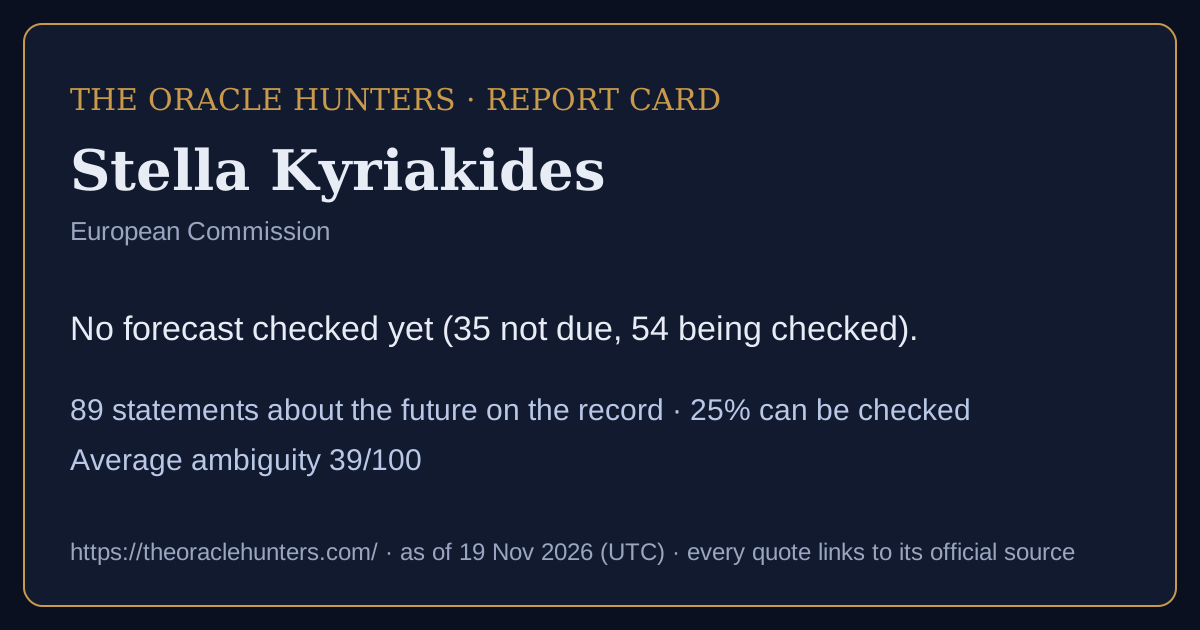
Stella Kyriakides
European Commission · EU
Track record: No forecast checked yet (35 not due, 54 being checked).
89forecasts & commitments on the record
25%can be checked as stated
39average ambiguity (0-100)
0goalpost moves recorded
0confirmed U-turns
Timeline
came true partly did not not due / being checked / too vague
Calibration score: shown after 10 checked forecasts with a stated likelihood (now 0).
How they speak about the future: based on data 59, stated on authority 28, educated guess 2.
Kinds of claim: forecast 47, mixed claim 34, commitment 6, scenario (if… then) 2. · Download this report card as a picture
In the nine words
πρόγνωσιςInference from evidence54 · 61%μαντείαInspired knowledge26 · 29%προαναγγελίαPublic pre-announcement6 · 7%πρόνοιαPreparing for the future2 · 2%πρόβλεψιςSeeing the signs1 · 1%
How to read this
Each box is one sentence a public figure or institution said about the future, word for word, with a link to the official text. Can be checked means it names what will happen, by when, and how likely - so it can be compared with official figures later. Too vague to check means it does not. Ambiguity (0-100) is how many different ways the sentence can be read. When the date passes, the forecast is compared with official data and marked came true, partly or did not come true. Labels judge the sentence, never the person. Full guide and glossary.On the record (89)
The theme chosen for this year's conference could not be more fitting: United Against Cancer: Forging New Frontiers.
For example, we will contribute to WHO Europe's work to implement its Roadmap on AMR for the WHO European Region 2023–2030.
For instance, next year we are going to launch the European Partnership on One Health AMR.
We will help Member States in every way possible by launching a joint action funded with 20 million euros from the EU4Health programme to support its implementation.
It is expected that by 2050, 10 million people will die prematurely every year because of it.
More than €45 million under the Cypriot Recovery and Resilience plan will help upgrade Cyprus' state hospitals and make them more energy efficient.
The World Health Organisation expects that between 2030 and 2050, climate change will cause 250,000 more deaths worldwide per year.
This year we are launching a Joint Action with Member States to support improving the European Cancer Information System, and I will strongly encourage them to also address metastatic cancer through this action.
This year, a Joint Action will start work to implement this Recommendation, and we are pleased to see many small Member States taking part.
Next month we will launch a “Critical Medicines Alliance” – which will contribute to coordinated action at EU level to prevent shortages of medicines.
I need to share with you that I am particularly concerned about the risk of shortages of certain high-risk in vitro diagnostic devices, for which the transition period will end in May 2025.
On the future for fur farming in Europe, the Commission will provide our response next month.
Furthermore, we will be able to better assess the Plan's impact from a study into its implementation, expected in mid-2024.
France will invest approximately 2 billion euros in the deployment of the State information systems, shared medical records, improved interoperability and security, and a one-stop shop for all digital services for healthcare professionals.
Our Health Data Space will bring together the health data of 430 million citizens, making the EU a global leader in data-driven technologies.
Team Europe is investing EUR 1.1 billion to boost vaccine and medicine production in Africa, on which colleagues will expand on further during today's discussion.
The international conference on a “Global Wastewater Surveillance System for Public Health'” to be held next month – with many of you as partners - will chart a vision for a global consortium dedicated to this issue.
We will therefore put 30 million euros into helping people affected by Russia's war of aggression against Ukraine.
Already this year the Commission will allocate 11 million euros to support Member States in promoting mental health across policies.
We will provide significant funding to the Member States to roll it out, with over 810 million Euros.
To support the uptake of high standard and quality-assured diagnosis and treatment, work has started to establish an EU Network linking National Comprehensive Cancer Centres by 2025 which will boost collaboration among Member States, reducing inequalities and improving cancer care.
We have started the work to establish the first EU Network of Comprehensive Cancer Centres by 2025 – and with it, we will improve the quality of cancer care for everyone.
These initiatives will contribute to the creation of a Tobacco Free Generation by 2040 as well as increase the uptake of Hepatitis B and HPV vaccination.
Later this year, a Prevention Package will be presented, including a proposal to update the 2009 Council Recommendation on smoke-free environments and a proposal for a Council Recommendation on vaccine-preventable cancers.
On the veterinary side, the legislation on veterinary medicinal products and medicated feed will help meet the Farm to Fork Strategy target of halving overall EU sales of antimicrobials used for farmed animals and in aquaculture by 2030.
We are very strongly committed to working towards a successful outcome of negotiations by May of next year.
Later this year, we will be hosting a meeting of the Transatlantic Task Force on Antimicrobial Resistance – TATFAR - to step up our work in this area.
That means that we conclude, by May 2024, a robust and legally binding pandemic agreement and complementary amendments to the International Health Regulations.
In our view, we should use the World Health Assembly and the September High Level Meeting on Pandemic Preparedness and Response at UNGA to promote these three key aspects: strong multilateralism with the WHO at its core, comprehensive pandemic rules by May 2024, and filling gaps in global governance in a coherent fashion.
Fifth, our reform will help to address the “silent pandemic” of antimicrobial resistance, which is already taking 35,000 lives in the EU every year, costing around €1.5 billion to our healthcare systems.
The legislative framework for sustainable food systems is expected later this year.
Later this year, we will also propose an ambitious and balanced package of proposals to modernise the EU's animal welfare legislation.
At the end of this year, we will have established the Advisory Committee for public health emergencies that will also include civil society, doctors and nurses.
Additionally, a major funding project of almost 30 million euro has been launched with the Red Cross to support the mental health of displaced Ukrainian people as they struggle with the impact of the unjustified Russian war of aggression on their lives.
High-risk devices will get a new deadline of 2027 and medium- and low-risk devices are valid until 2028, under certain conditions.
We will provide over EUR 810 million on top of the EUR 12 billion that Member States have already earmarked under the Recovery and Resilience Facility for investments in digital health and secondary use of health data.
After the Summer, we will be presenting a new recommendation on vaccine preventable cancers, as well as measures to achieve smoke-free environments to help deliver our target of a tobacco-free Generation by 2024.
If needed, HERA could step in and coordinate on behalf of Member States the joint procurement of medical countermeasures, as we have done during the COVID pandemic, as well as organise matchmaking events between industry actors in order to help increase production.
To this end, we will do our part and next year we will propose EU-wide food waste reduction targets.
We will remain constructive in order to move forward with this important file.
In order to promote innovation, a pilot project will be launched early next year to offer scientific advice from the expert panels on medical devices to manufacturers.
Provided you agree, this targeted amendment will be on your table beginning of next year.
Thirdly, we suggest removing the so-called sell-off date of May 2025 to prevent safe medical devices already on the market from having to be discarded.
Devices covered by around 23 000 certificates issued under the previous Directives have not yet transitioned to that Regulation and will expire by 26 May 2024 at the latest.
I have informed the Ministers that I fully support them in their desire to modify the agreement and have announced that we will convene a Steering Board meeting at political level early in 2023, with the companies present to discuss the way forward.
2023 will be a crucial year for our work on mental health, it is the year when we will propose the first ever EU comprehensive approach on mental health.
The proposal for a Nature Restoration Law under the Biodiversity Strategy will help restore degraded ecosystems across the EU, including on agricultural land, and will reverse the decline of pollinators by 2030.
In May 2024, the transitional period of the Medical Device Regulation will come to an end.
As of next month, all health security pillars of the European Health Union will be in force.
Diabetes is one of the greatest health challenges of modern times – and this challenge will continue to increase unless we take concrete action and unless we work together.
Showing the newest 50 - the ledger has all 89.
Also said - not checkable as stated (12 newest)
Remarks about the future with no date, figure or likelihood that could be checked. They are kept on the record and shown here, but not scored.
We are determined to continue down this path because we know that the alarming reality is that cancer cases are predicted to rise significantly by 2040.
Patients need to be heard and feel safe when discussing their mental health.
Patient voices must necessarily be heard, if we want to build the resilient and people-centred health systems we seek.
We will continue our financial support for this initiative, and urge others to contribute.
The Quadripartite will also update the Global Action Plan, to ensure a One Health approach.
At EU level, there is for now no need to consider a declaration of a Public Health Emergency in the EU.
Over the coming months, you will examine the proposal in detail, building common understanding on very important and often challenging topics around the protection of animals.
We will work closely with the Council and the Parliament to help deliver it.
We need to work with Member States to increase vaccination levels and fight misinformation to ensure that citizens have the necessary protection to deal with cervical cancer and other cancers caused by HPV and Hepatitis B.
In ending, I would like to once again thank the Belgian Presidency for the excellent results they have delivered, and keeping health at the top of the political agenda, where it should be.
For instance, we will support your work on electronic vaccination registries; on reducing obstacles to uptake; and on using evidence-based awareness-raising campaigns.
The Council Recommendation on vaccine-preventable cancers that you will be adopting today, was proposed by the Commission in January as one of our key actions on prevention under Europe's Beating Cancer Plan.