Stanley Fischer
Central bank (via BIS)
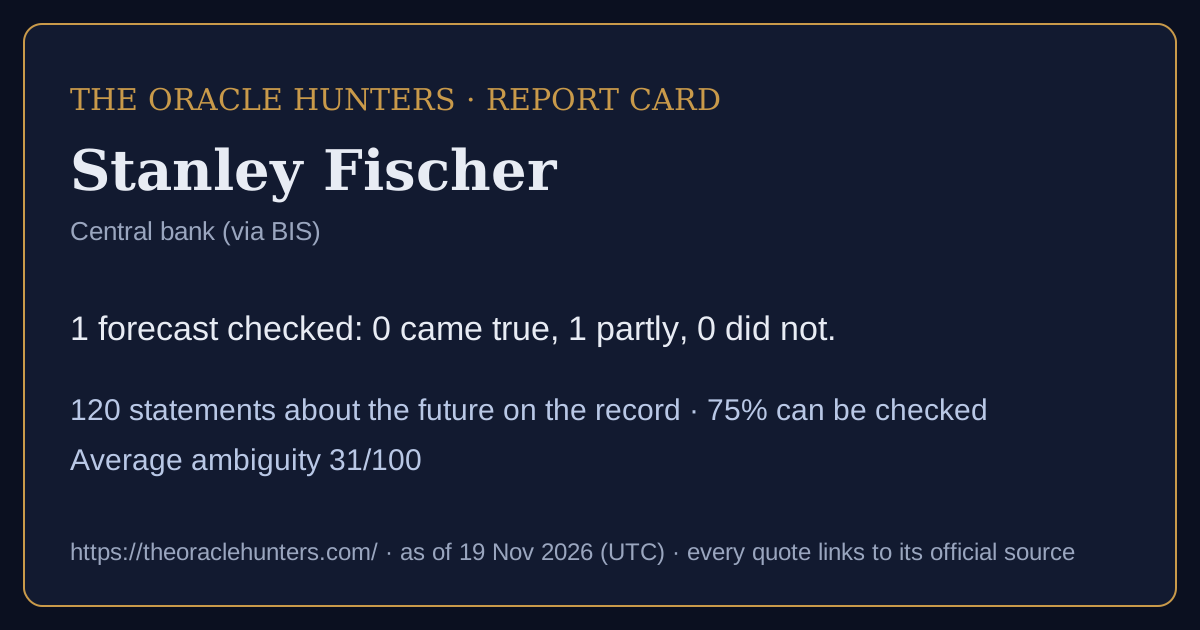
Track record: 1 forecast checked: 0 came true, 1 partly, 0 did not.
120forecasts & commitments on the record
75%can be checked as stated
31average ambiguity (0-100)
0goalpost moves recorded
0confirmed U-turns
Timeline
came true partly did not not due / being checked / too vague
Calibration score: shown after 10 checked forecasts with a stated likelihood (now 1).
How they speak about the future: based on data 81, educated guess 24, stated on authority 15.
Kinds of claim: forecast 67, mixed claim 34, scenario (if… then) 17, commitment 2. · Download this report card as a picture
In the nine words
πρόγνωσιςInference from evidence77 · 64%πρόνοιαPreparing for the future16 · 13%μαντείαInspired knowledge12 · 10%εἰκασίαConjecture10 · 8%φρόνησιςPractical wisdom2 · 2%προαναγγελίαPublic pre-announcement2 · 2%πρόβλεψιςSeeing the signs1 · 1%
How to read this
Each box is one sentence a public figure or institution said about the future, word for word, with a link to the official text. Can be checked means it names what will happen, by when, and how likely - so it can be compared with official figures later. Too vague to check means it does not. Ambiguity (0-100) is how many different ways the sentence can be read. When the date passes, the forecast is compared with official data and marked came true, partly or did not come true. Labels judge the sentence, never the person. Full guide and glossary.Checked
Current forecasts are that the economy will grow by about 5 percent this year again.
Partly came true. Said: economic growth around 5% in 2006. Official figure for Israel: 5.6% (World Bank open data). Close: outside the margin, but within one more half point. Off by 0.6 points. official data · checked 14 Nov 2026 · automatic check against official data (rules v3)
On the record (120)
From the perspective of the FOMC, even in the heart of the crisis, in January 2009, the central tendency of the Committee members' projections for longer-run U.S. growth was between 2-1/2and 3 percent.
Possibly, productivity could continue to rise in line with its long-term historical average. 9 After all, as the experience of the 1990s shows, productivity cycles are extremely difficult to predict and, even considering the slowdown of the past decade, U.S. total factor productivity growth fluctuated around 1-1/2 percent in the postwar period.
Over the past decade, U.S. total factor productivity growth declined to 1percent, which some argue may represent the real norm for the U.S. economy. 8 In this view, the long period of rapid productivity growth
At our June meeting this year, these projections had fallen to between roughly 2 and 2-1/4 percent.
This global average reflects a forecast of steady improvement in the performance of output in the advanced economies where growth averaged less than 1percent during the initial phase of the recovery to an expected 2-1/2 percent by 2015.
For example, based on recent IMF data from the World Economic Outlook, which uses purchasing power parity weights, world growth averaged 3percent during the first four years of the recovery and as of July was expected to be 3.4 percent this year. 1 The IMF expects global growth to reach 4 percent next year - a rate about equal to …
The government deficit grew in 2012 by 4.2 percent, and in order to reinstate control over the budget, the government recently decided on important measures to reduce the deficit in the coming years.
When we reach 60 percent, government expenditure will begin to grow in line with the growth in GDP according to the current formulation of the rule.
If the government sticks to its budget constraints, which are the expenditure rule, the taxes it has in place, and the deficit target of 3 percent of GDP, it will have an expansionary budget, or approximately a neutral budget.
If we must increase defense expenditures because it is vital to the future of the country, as some people claim, we will need to pay for it, through an increase in taxes.
In any case, Europe is in a recession; over the next year we'll probably see slightly better growth than we were expecting to have in the second half of 2013.
If we raise the interest rate just to deal with housing prices, it will cause an appreciation in the shekel and a slowdown in economic growth.
If the economy enters a recession, the deficit will begin at the 2012 level and will grow from there.
In addition, in order to meet the deficit target, we believe that it will be necessary to increase receipts by about NIS 6 billion, or about 0.6 percent of GDP.
This year, the Bank of Israel expects growth of 3.8 percent, with a significant part of that - about 1 percent - expected as a result of natural gas starting to flow from the Tamar field.
If we raise the interest rate in Israel sharply above global interest rates, we will be flooded by capital inflow from abroad, which will affect the appreciation of the exchange rate.
We must remember that even if the government does this, there will still be a significant increase in government expenditure for 2013.
However, the law also takes into account expenditure on debt repayments, which were very high in 2012 and are expected to be lower in 2013.
I feel very uneasy with this kind of deficit in the current situation, since if the economy enters a recession - a scenario which we must take into account - the deficit will grow, and it will be harder to deal with it.
According to this estimation by the Bank of Israel, the deficit in the coming year will apparently be 3.5 percent, and will reach a level of 2 percent only in the year 2020.
Therefore, the Government will need to close a gap of more than NIS 12 billion in 2013.
At the beginning of 2013, the Government will operate based on the 1/12 rule due to the fact that the budget has not yet been approved.
The Government will therefore need to reduce the level of planned expenditure, and we obviously must remember that there will still be an increase of about 5 percent in expenses in 2013 over 2012, due to inflation adjustments.
- A: The short term argument is that all the tax reductions of the past decade, and those of this crisis, will expire on December 31 of this year.
## Q: If the next government misses its budgetary forecast, and the deficit continues to be above target, that means you, or your successor, will have to take action to rebalance, to maintain the equilibrium.
## Q: Is it fair to say that after 2015 we will not have heard the last from you?
The deficit for this year, which is supposed to be 2 percent, will be around 4.2 percent.
And it's known that they have to cut about NIS 15 billion out of planned expenditure, and they possibly will also have to raise taxes a bit more than they have so far…that's a huge budgetary problem.
A: The economy is doing well in most respects, and we're predicting growth for next year of about 3 percent, which until the European economies started declining we thought we might do better than that, we're not sure about that now.
## Changes in Growth Forecasts for 2011-2012
The trends in the current account are changing: after growing accustomed to a surplus in the last few years, we now expect the current account to be more or less balanced next year.
The President presented a program, amounting to some 3 percent of GDP, to support economic growth, but despite that program growth is still expected to be low.
* Bank of Israel forecast for 2011 and 2012.
The slowdown in Europe so far has been relatively moderate, but the problems are expected to affect growth mainly in 2012, when growth in the eurozone is expected to be only 1 percent.
In this context we must point out that for two years we have been stating in the Bank of Israel Annual Report that from 2013 the various fiscal rules are inconsistent with each other, as the planned tax reductions are not consistent with the planned path of an increase in expenditure and reduction in the deficit - growth of close …
If we find that real-estate prices are continuing to rise rapidly, we will have to take additional measures.
This economy, with its dynamism and creativity, could grow much faster if we were to achieve peace with our neighbors - and there are of course much better reasons than economic growth to hope and work for peace with our neighbors.
In making it the government will have to weigh the benefits of maintaining government programs in a variety of areas, including education, against the benefits of cutting taxes.
But if growth is slower, the government will have to decide whether to cut the growth rate of government spending, or rather forgo some of the planned tax rate decreases, or to do some of both.
Without wishing to take a stand on that issue, it is plausible to argue that if the Fed had been charged with responsibility not only for inflation and growth, but also macroprudential stability, it might have raised its interest rate more rapidly.
1 Among other indicators, IMF forecasts of growth for 2009 have stabilized, and their forecasts for all regions for growth in 2010 have begun to increase.
At last year's Symposium, "Maintaining Stability in a Changing Financial System", I had the privilege of delivering the concluding remarks of the conference, and ended with the forecast: "But if the authorities in the U.S. and abroad move rapidly and well to stabilize the financial situation, growth could be beginning to resume by the time we meet here again next …
We are following the procedure for joining the OECD, and expect to become members this year.
suggest starting with the 6.5 percent of GDP deficit this year and 5 percent next year, to make it very clear that the path is a downward one.
Nevertheless, nearly all forecasters expect inflation in 2009 to be below 2 percent, and we do not intend to react to one month's index, especially if it affected by seasonality.
In order to prevent the deficit reaching above 6.5 percent this year and 5 percent next year, expenditure must be reduced.
On the other hand, if every bank takes into account that even slight easing of its credit policy in its marginal decisions will make the economy grow faster, this will retrospectively justify their decision.
Thus, if all banks significantly tighten their credit policy the economy will grow more slowly, thereby retrospectively justifying the step they took.
It would not be advisable to allow the deficit to rise much beyond that, because our ability to embark on an expansionary fiscal policy is very limited - our debt/GDP ratio is high, and the interest that the government would have to pay would rise significantly if its increased its borrowing.
The Bank's program to buy foreign currency will continue until the forex reserves reach the level considered appropriate under the current circumstances - between $40 billion and $44 billion.
Showing the newest 50 - the ledger has all 120.
Also said - not checkable as stated (12 newest)
Remarks about the future with no date, figure or likelihood that could be checked. They are kept on the record and shown here, but not scored.
However, in the long term, we will benefit from it, and it will have positive ramifications in various areas.
In this context, it is important to implement a policy that will increase the labor force participation rate of these two sectors, and we are witness to important initiatives in the area of academic education, mainly among the ultraOrthodox sector.
It is possible that in another few decades, we will reach the conclusion that controlling owners are not necessary for banks.
We must continue to provide ourselves with defense, but the allocation of more money to defense is not the only solution.
By the beginning of 2015 interest rates should possibly begin to rise.
However, if we don't get the budget straightened now, it will be very difficult to do so later, and we will find ourselves doing things that are inconvenient and inefficient.
If a financial institution goes bankrupt, the bondholders will and should share in the losses.
Rather in thinking through how a system will operate in a crisis, you need to take into account the likelihood of facing such choices, and you need to do everything you can in designing the system to keep that likelihood very small.
In a crisis, central bankers (and no doubt other policymakers) will often find themselves deciding to implement policy actions that they never thought they would have to undertake and these are frequently policy actions that they would prefer not to have to undertake.
During and after the Great Depression, many central bankers and economists concluded that monetary policy could not be used to stimulate economic activity in a situation in which the interest rate was essentially zero, as it was in the United States during the 1930s - a situation that later became known as the liquidity trap.
I do this with some trepidation, since it is possible that there will later be an eleventh lesson: that given that it took fifty years for the profession to develop its current understanding of the monetary policy transmission mechanism during the Great Depression, just two and a half years after the Lehmann Brothers bankruptcy is too early to be drawing …
Further, by operating in longer-term assets, as in QE2, the central bank can affect longerterm interest rates, which may have an additional impact on the private sector's demand for longer-term assets, including mortgages and corporate investment.