Soledad Núñez
Bank of Spain
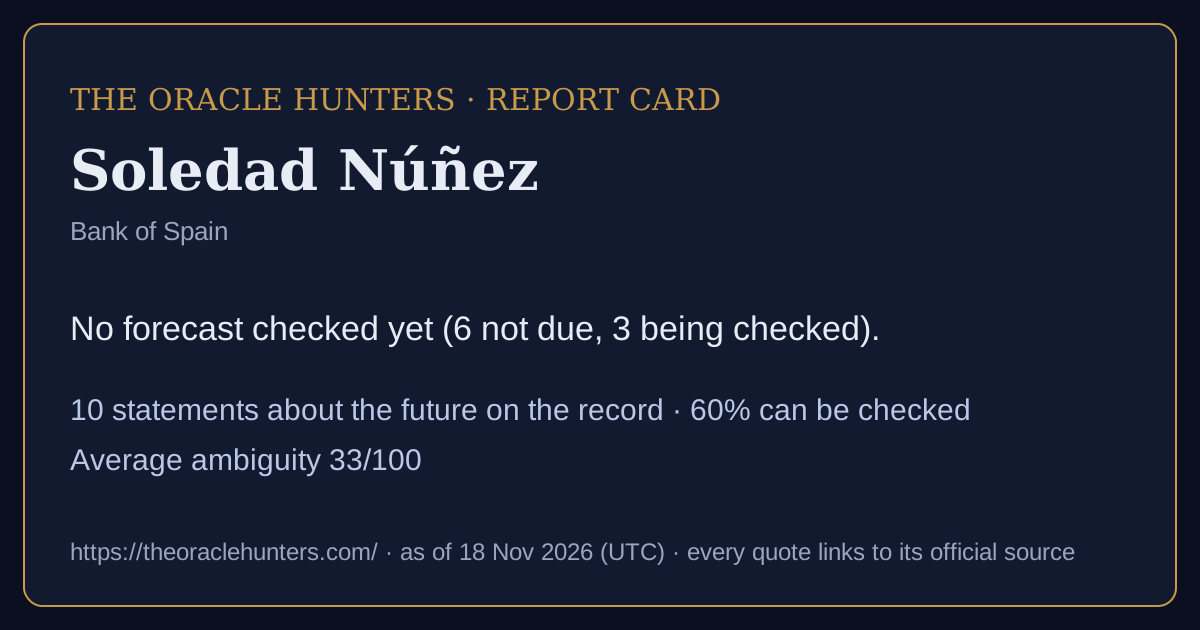
Track record: No forecast checked yet (6 not due, 3 being checked).
10forecasts & commitments on the record
60%can be checked as stated
33average ambiguity (0-100)
0goalpost moves recorded
0confirmed U-turns
Timeline
came true partly did not not due / being checked / too vague
Calibration score: shown after 10 checked forecasts with a stated likelihood (now 0).
How they speak about the future: stated on authority 5, based on data 4, educated guess 1.
Kinds of claim: forecast 5, mixed claim 2, call for action 2, commitment 1. · Download this report card as a picture
In the nine words
πρόγνωσιςInference from evidence4 · 40%πρόνοιαPreparing for the future2 · 20%μαντείαInspired knowledge2 · 20%εἰκασίαConjecture1 · 10%προαναγγελίαPublic pre-announcement1 · 10%
How to read this
Each box is one sentence a public figure or institution said about the future, word for word, with a link to the official text. Can be checked means it names what will happen, by when, and how likely - so it can be compared with official figures later. Too vague to check means it does not. Ambiguity (0-100) is how many different ways the sentence can be read. When the date passes, the forecast is compared with official data and marked came true, partly or did not come true. Labels judge the sentence, never the person. Full guide and glossary.On the record (10)
This widening gap has meant that households will have to allocate a significantly higher proportion of their net income if they wish to purchase or rent a home.
We have also seen the adoption of the immediate transfer regulation for the euro area from early 2025, which will be implemented gradually until 2027.
However, AI management entails relevant risks that must be monitored, from the misuse or bias of models, their lack of explainability or the increase in cyber-attacks.
Banks' use of technology and artificial intelligence will have to be prudently managed, as they increase operational risk, owing to possible system failures or cyberattacks.
Moreover, all other items, including fee and commission income, operating costs and bank levy costs, are expected to stabilise this year.
This means that, a priori, we do not expect to see significant growth in credit volumes this year.
Accordingly, as we will see later, in terms of profitability it will be important that this growth in credit volumes consolidates.
According to a recent study by Funcas, 80.8% of internet users in 2024 had used electronic banking in the last three months, up from 60.5% in 2019; 8 by 2030, this figure is expected to reach 95%.
This year we expect that as inflation stabilises around 2.5% 6 and interest rates decline, the financial burden on households and firms will ease.
This must be considered in context, as house prices rose sharply (by 11.3%) in 2024 4 and no significant changes in trend are expected in the short term.
Also said - not checkable as stated (12 newest)
Remarks about the future with no date, figure or likelihood that could be checked. They are kept on the record and shown here, but not scored.
Rising prices also push these groups towards more affordable areas, which may affect the territorial distribution of the population.
This phenomenon may lead to productivity losses by making it harder for workers with specific skills to respond to firms' demand in more economically buoyant areas, where housing prices tend to be high.
An increase in households' housing cost burden may weigh on consumption in the event of economic shocks.
The effects transmitted through these channels may limit long-term economic growth and are compounded by the adverse impact on activity and productivity caused by reduced labour mobility stemming from housing affordability difficulties.
This risk is particularly relevant in areas where supply is inelastic, since direct demand-side support measures could be passed through to market prices, further increasing them.
Throughout the day, we will hear several presentations addressing both climate change mitigation and adaptation.
This requires embracing a long-term vision, as Mark Carney, former Governor of the Bank of England, reminded us with his idea of the 'tragedy of the horizon,' ensuring that today's decisions reflect the risks and opportunities that will unfold over the coming decades.
Moreover, the distinction between local and national impacts is crucial: while a flood or storm may devastate a specific region's productive capacity, employment, or credit conditions, the aggregate national effect may appear smaller-masking deep localized damage and financial-sector stress concentrated in the affected areas.
At the same time, a key part of this effort involves deepening our understanding of how physical climate risks will shape economic activity in the years to come and evaluating the credibility of transition plans.
More than ever, we must remain committed to advancing climate action, strengthening international cooperation, and accelerating the transition to a resilient, sustainable future.
And for central banks and supervisors, this reality poses a fundamental challenge: we must ensure that the financial system remains resilient in the face of climate-related shocks.
The Banco de España will decide within the established timeframe whether to adopt these guidelines and will formally notify the European Banking Authority.