Simon M Potter
Federal Reserve Bank of New York
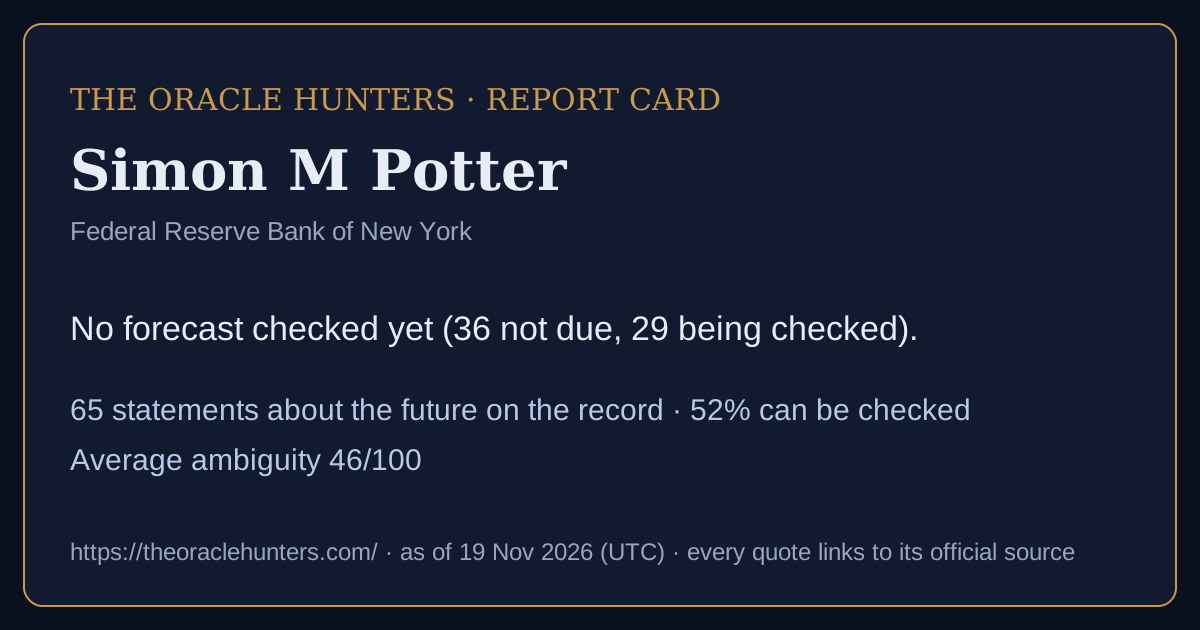
Track record: No forecast checked yet (36 not due, 29 being checked).
65forecasts & commitments on the record
52%can be checked as stated
46average ambiguity (0-100)
0goalpost moves recorded
0confirmed U-turns
Timeline
came true partly did not not due / being checked / too vague
Calibration score: shown after 10 checked forecasts with a stated likelihood (now 0).
How they speak about the future: based on data 46, educated guess 14, stated on authority 5.
Kinds of claim: forecast 39, scenario (if… then) 16, mixed claim 9, commitment 1. · Download this report card as a picture
In the nine words
πρόγνωσιςInference from evidence41 · 63%πρόνοιαPreparing for the future16 · 25%μαντείαInspired knowledge4 · 6%εἰκασίαConjecture3 · 5%προαναγγελίαPublic pre-announcement1 · 2%
How to read this
Each box is one sentence a public figure or institution said about the future, word for word, with a link to the official text. Can be checked means it names what will happen, by when, and how likely - so it can be compared with official figures later. Too vague to check means it does not. Ambiguity (0-100) is how many different ways the sentence can be read. When the date passes, the forecast is compared with official data and marked came true, partly or did not come true. Labels judge the sentence, never the person. Full guide and glossary.On the record (65)
The current estimate from this model is a 23.6 percent chance that the U.S. economy will be in an NBER-defined recession in January 2020. 11
In the future, mortgage principal repayments, which are sensitive to various factors, especially long-term interest rates, could conceivably rise above the level of the cap, particularly if interest rates were to decline.
The lighter bars in Figure 5 show the projected cash flows through the end of next year.
For example, in our July/August 2018 Desk surveys, only 33 percent of respondents who provided expectations for this spread expected it to narrow to two basis points or less by year end.
As the portfolio shrinks and the level of reserve balances declines, how will we know if we are transitioning from an environment characterized by abundant reserves to one characterized by scarce reserves? 18 To address this question and understand how the level of reserves is related to short-term interest rates, we need to review some fundamentals.
As you can see from Figure 8, market participants expect that the domestic securities portfolio could contain roughly $700 billion in agency MBS on average in 2025.
These small value purchases are concentrated in newly issued agency MBS in the To-Be-Announced (TBA) market, which is expected to undergo changes next year due to the FHFA's Single Security Initiative and the introduction of Uniform MBS (UMBS).
To begin with, if we were closing in on the 'steep' part, I might have expected to see more above-IOR lending in the unsecured overnight markets, as at least some banks each day found themselves short of reserves and had to borrow them from another bank.
This could be true if, for example, the balance sheet costs of the marginal borrower in overnight money markets were upward sloping with respect to that bank's balance sheet size.
It is important to remember that mortgage principal repayments are uncertain; are sensitive to various factors, particularly long-term interest rates; and could conceivably rise above the level of the cap in the future, particularly if interest rates were to decline.
As shown in Figure 14, the Desk estimates that U.S.-dollar cross-border bank loans to non-U.S. residents that could be directly or indirectly impacted by U.S.-dollar LIBOR-the sum of the three columns in the panel-total about $8 trillion, a significant portion of which is in developing economies.
Based on current projections, principal payments on the Federal Reserve's holdings of agency MBS would likely be lower than the monthly cap on redemptions that will be in effect beginning in the fall of this year.
The estimates for 2025 indicate an expectation that reserves will decline substantially, but still remain many orders of magnitude above their precrisis level.
| Expected Average in 2025* | 600 | 2,200 | 200 | 100 | 300 |
She suggests that whenever possible, influencing short-term interest rates should be the Fed's primary policy lever, but that enhanced forward rate guidance and asset purchases should be considered again if that conventional tool reaches its limit, as would be the case if a future economic downturn drove short-term rates back to the zero lower bound.
For agency M BS and agency debt, the initial monthly cap is $4 billion and will increase in steps of $4 billion at three-month intervals over twelve months until it reaches $20 billion per month.
The ECB just announced it will extend its bond purchasing program but scale back the pace of purchases starting next year.
In the event policymakers contemplate asset purchases again in the future, they should be able to undertake them with confidence that balance sheet expansion will not compromise the Fed's ability to effectively implement monetary policy when the time comes to lift rates from the zero lower bound.
The extent (if any) of any such decline in deposit activity on deposit and loan pricing will likely depend on a variety of factors, including the extent to which the decline comes from wholesale institutional deposit activity motivated by interest rate arbitrage.
As can be seen, balance sheet normalization started slightly earlier than expected, both in rate terms - it began with the federal funds rate at 1.16 percent - and, more notably, in terms of the absolute date.
of the expected level of the federal funds rate at the end of 2017 for dealers and for buy-side firms; these two track each other closely.
- For example, if repo rates fell relative to other rates, we might see more take-up at our ON RRP operations, or if foreign exchange swap rates were to rise further, we might see greater use of the official dollar auctions conducted by foreign central banks that are part of the standing swap network. 37
The U.S. intermediate holding company (IHC) operations of foreign banking organizations including their broker-dealers will also be subject to the leverage ratio requirements starting on January 1, 2018.
The SLR is effective January 1, 2018 with public disclosure requirement in effect starting in January 1, 2015, and will apply only to 'advanced approaches banking organizations' That are defined as those with at least $250 billion in total consolidated assets or at least $10 billion in consolidated on-balance sheet foreign exposures.
The Bank of England (BoE) currently sets the Bank Rate at 25 basis points and is currently purchasing £60 billion in gilts over a 6-month period; the A sset Purchase Facility will have £435 billion in gilts when the purchase round ends in February 2017.
As can be seen in Figure 7, market estimates of when the SOMA portfolio will start to normalize have moved out from the end 2015 to the middle of 2018 or even later.
39 This dispersion implies that random samples of small size (less than one thousand) will exhibit variability even if the underlying population distribution of inflation expectations remains constant.
The top two panels of Slide 12 compare the market-implied federal funds path for year-end 2016, 2017, and 2018 with the surveyed modal path projections, averaged across respondents. 51 It is clear that the modal forecasts are much higher than market-implied rates, especially for 2017 and 2018, when the gap is larger than 100 basis points.
In the end, unemployment was 6.7 percent by the end of 2013, and the year-end 2014 level of the SOMA portfolio reached $4.25 trillion: a $1.1 trillion change relative to June 2013.
For example, the 'mode' for policy rate projections could be the mode across all paths that the federal funds rate could follow from 2016 to 2018.
For example, there are five FOMC meetings remaining this year, so the 'most likely' meeting could be one with 21 percent probability.
Since 1989, the Bank of Italy's Survey of Household Income and Wealth has used this question format to ask households about their expected labor or pension earnings in the next year.
Also, if assets under management in prime funds were to decline sharply, this could possibly lead to less efficient transmission of monetary policy.
Further, if banks can acquire funds in the wholesale market at rates below IOR, then competition for these funds will bid up these rates close to that paid on reserves.
At this point, you might have a question: from late 2008 to late 2015, the federal funds rate traded well within the FOMC's target range of zero to 25 basis points.22 Shouldn't this have been conclusive evidence as to the ability of the operational framework to provide sufficient control of interest rates?
We will need to think about the composition and structure of our balance sheet on both the asset and liability sides. 19 This consideration will be important should large-scale asset purchases (LSAPs) become a more standard tool for central banks, which could happen if lower levels of equilibrium real rates imply an increasing frequency of very low overnight rates.
Policy normalization will need to proceed in a different way than it did in Japan in the mid-2000s if most of the additional assets, and the reserve balance liabilities created as a byproduct of their acquisition, remain on the central bank's balance sheet until they mature in the far future.
The spot market, which accounted for about 40 percent of trading activity in 2013, is used by private nonfinancial entities to trade goods and services or to invest in foreign businesses, while banks may use it to engage in cross-border lending and asset managers may use it to purchase financial assets or take positions based on their economic and financial …
Importantly, we will likely not know the level of support that proximity to the zero lower bound has provided to money market rates until we start to move away from it.
Under a set of baseline assumptions from the end of 2014, the level of reserves is projected to fall below $1 trillion in early 2019 and to reach its steady state in late 2020 (Figure 1). 11
The Congressional Budget Office currently projects such additional borrowing to average $61 billion annually over the next ten years.
14 If the total amount of bids received in an operation is less than or equal to the $300 billion size limit, awards will be made at the fixed offering rate.
This could happen if banks shift the composition of their assets to accommodate the increase in reserves, and in doing so are pushed away from their optimal balance sheet composition.
Even if bank assets do not increase, an increase in reserves could create distortions that raise balance sheet costs.
However, if the total amount of bids received exceeds the overall operation size limit, the $300 billion in ON RRPs will be allocated through a single-price auction using interest rates that counterparties submit with their bids.
However, if the total amount of bids received exceeds the overall operation size limit, the $300 billion in ON RRPs will be allocated through a single-price auction using interest rates that counterparties now include with their bids.
If the total amount of bids received in an operation is less than or equal to the $300 billion size limit, awards will be made at a fixed offering rate.
Theoretically, if all money market participants had access to deposits earning the IOER rate, the IOER rate should set a minimum rate - or floor, so to speak - on short-term interest rates, as there would be no incentive for institutions to make loans to any institution at a lower rate.
## Figure 1: Primary Dealers' Average Forecast Distribution about the Size of the SOMA Portfolio at the End of 2014
In fiscal year 2013, the OMB estimates that the net effect of direct loan accounts on Treasury's borrowing needs will be about $175 billion.
Showing the newest 50 - the ledger has all 65.
Also said - not checkable as stated (12 newest)
Remarks about the future with no date, figure or likelihood that could be checked. They are kept on the record and shown here, but not scored.
So then the question we should be asking ourselves is how could we have arrived at a clearer focus on the relevant forces before the Great Recession?
What should we change about our mindsets and practices to improve the chances that we "notice it" next time, whenever that may be? 3
Without active assessment and reassessment, we're prone to hindsight bias and the belief that we will surely see it coming next time.
The Federal Reserve and the broader economics and financial community have, of course, had to face similarly humbling shortcomings in our failure to forecast the Great Recession, despite the numerous signals that were available to forecasters and policymakers prior to 2008.
On this issue, it is useful to recall a quote from an unusual source on economic forecasting, the Queen of the United Kingdom, who in November 2008 asked, "Why did nobody notice it?" We should not treat this as a rhetorical question.
But, more importantly, I am confident that the Federal Reserve has the capacity to ensure that it will continue to achieve its goals, such as through another technical adjustment, should such action seem appropriate.
Additionally, prime funds offering shares to institutional investors may no longer price such shares with fixed NA Vs; instead, they must price their shares at the market value of the underlying securities, much like standard mutual funds.
I will then examine how the central bank could complement regulation and supervision in mitigating these risks by providing overnight moneylike assets, with a focus on changes in the Federal Reserve's liabilities in recent years.
Of course, since investors are aware of the central bank's unique ability to quickly supply safe and money-like assets in non-normal times, their incentives to monitor risks in normal times may be reduced.
In particular, the Liquidity Coverage Ratio (LCR) reduces the likelihood of runs by forcing banks to hold highly liquid assets against expected future cash outflows. 11,12
In addition to the safety of storing gold with another central bank, through the practice of earmarking central banks could settle accounts with one another without the need to physically deliver gold bullion.
We quite realise your position and its happening, and, knowing that mistakes may arise even in the best regulated families, the incident must be looked upon as closed.' 6