Shri Swaminathan J
Reserve Bank of India
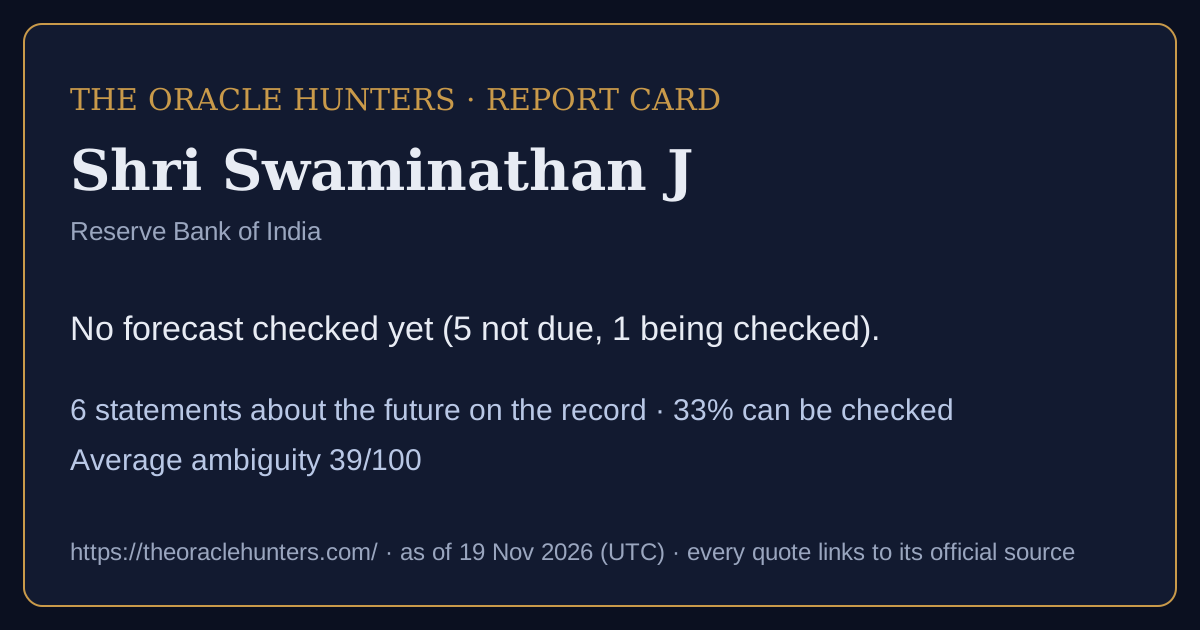
Track record: No forecast checked yet (5 not due, 1 being checked).
6forecasts & commitments on the record
33%can be checked as stated
39average ambiguity (0-100)
0goalpost moves recorded
0confirmed U-turns
Timeline
came true partly did not not due / being checked / too vague
Calibration score: shown after 10 checked forecasts with a stated likelihood (now 0).
How they speak about the future: based on data 4, educated guess 2.
Kinds of claim: forecast 3, scenario (if… then) 2, mixed claim 1. · Download this report card as a picture
In the nine words
How to read this
Each box is one sentence a public figure or institution said about the future, word for word, with a link to the official text. Can be checked means it names what will happen, by when, and how likely - so it can be compared with official figures later. Too vague to check means it does not. Ambiguity (0-100) is how many different ways the sentence can be read. When the date passes, the forecast is compared with official data and marked came true, partly or did not come true. Labels judge the sentence, never the person. Full guide and glossary.On the record (6)
If AI helps widen opportunity, improve access, strengthen prudence, protect customers and deepen trust, then it will have served a noble purpose.
If we align capital with capability, innovation with safeguards, and inclusion with wellbeing, the aspiration of 2047 will steadily become a lived reality for millions.
India of 2047 will not be shaped only by technology or capital.
If we stay true to these basics, more first time loan customers will graduate to larger formal credit, and the quality of growth will rise across states and segments.
As you may be aware, the Reserve Bank of India is celebrating 90 years of its foundation this year.
The global sustainable finance market is expected to grow from USD 3.6 trillion in 2021 to USD 23 trillion by 2031°, and in India, sustainable finance has gained significant momentum in recent years as awareness of the need for sustainable development has grown.
Also said - not checkable as stated (12 newest)
Remarks about the future with no date, figure or likelihood that could be checked. They are kept on the record and shown here, but not scored.
While grievance resolution may not always be instantaneous, institutions must continuously strive to reduce delays and make the process simpler, more transparent and more responsive.
The question before the Internal Ombudsman should therefore not be confined to asking, "Was the procedure followed?" Equally important are the larger questions:
Equally important is the need to move beyond individual complaint resolution to institutional learning.
It is equally important that the Internal Ombudsman should feel empowered and have the institutional space to present independent assessments.
Equally important, complaint management systems should be designed to prevent complaints from inadvertently bypassing the Internal Ombudsman process due to classification issues or process deficiencies.
The Internal Ombudsman framework represents a simple but important principle-that every regulated entity should have the ability and the willingness to resolve customer grievances fairly within the institution itself.
Against that backdrop, banking resilience may seem like a quieter subject.
Central banks are sometimes seen as cautious voices in otherwise optimistic times, expected to ask difficult questions just when the party appears to be going well .
During an upswing, collateral values look adequate, projected cash flows appear reasonable, and optimism becomes embedded in credit appraisal.
A project exposure, restructuring decision, collateral valuation or sectoral concentration may look manageable for one bank.
Credit, payments, customer acquisition, underwriting, servicing and technology support may involve banks, NBFCs, fintech entities, payment systems, lending service providers and third-party technology partners.
The next phase of banking resilience will be less about addressing known balance sheet stress and more about managing complexity and uncertainty.