Shell
Institution - official statements with no named speaker · GBR
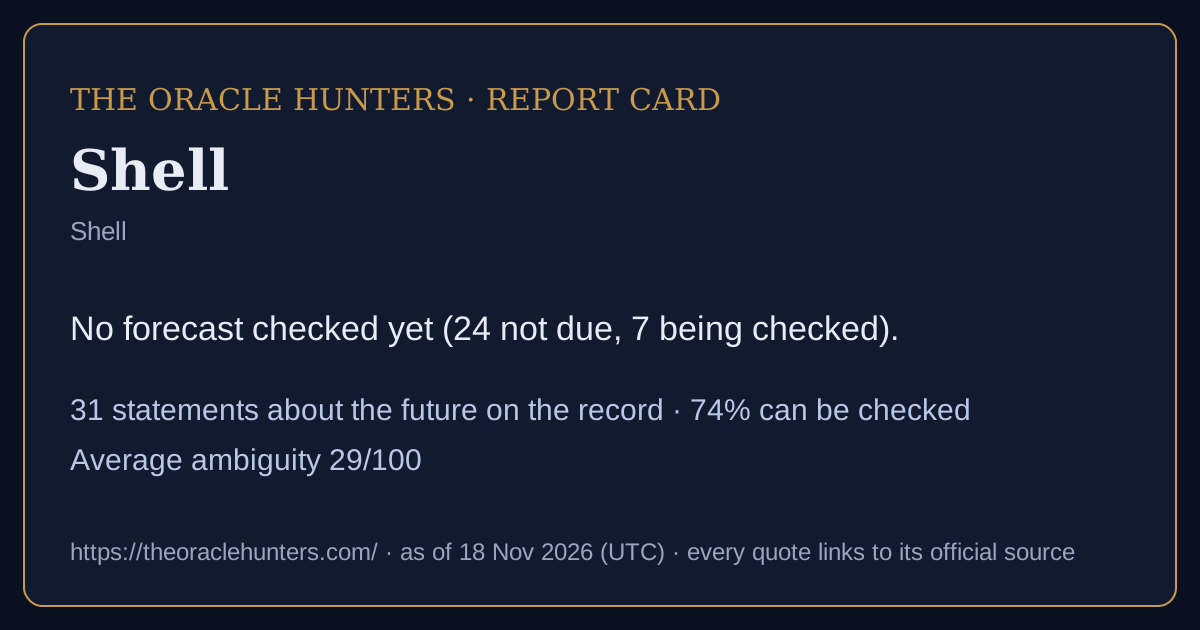
Track record: No forecast checked yet (24 not due, 7 being checked).
31forecasts & commitments on the record
74%can be checked as stated
29average ambiguity (0-100)
0goalpost moves recorded
0confirmed U-turns
Timeline
came true partly did not not due / being checked / too vague
Calibration score: shown after 10 checked forecasts with a stated likelihood (now 0).
How they speak about the future: based on data 31.
Kinds of claim: forecast 16, mixed claim 14, commitment 1. · Download this report card as a picture
In the nine words
How to read this
Each box is one sentence a public figure or institution said about the future, word for word, with a link to the official text. Can be checked means it names what will happen, by when, and how likely - so it can be compared with official figures later. Too vague to check means it does not. Ambiguity (0-100) is how many different ways the sentence can be read. When the date passes, the forecast is compared with official data and marked came true, partly or did not come true. Labels judge the sentence, never the person. Full guide and glossary.On the record (31)
However, if society is not net zero in 2050, as of today, there would be significant risk that Shell may not meet this target.
In the period 2026-2028, we expect to meet our delivery commitments with an estimated 70% coming from PD, 5% through the delivery of gas that becomes available to us from paying royalties in cash, and 25% from the development of PUD and other new projects and purchases.
We also maintain an $8 billion committed credit facility with initial maturity in 2030, however extension options may take final maturity to 2032.
We are on track to achieve our target to grow normalised free cash flow per share* by more than 10% per year [C] through to 2030, underpinned by the growth we expect from our Integrated Gas and LNG, Upstream and Marketing businesses, as well as the steps we are taking to turn around underperforming capital investment.
Furthermore, we will continue to reduce structural costs, targeting $5--7 billion in cumulative savings by the end of 2028 compared with 2022.
We will also grow top- line production across our combined Upstream and Integrated Gas business by 1% per year [A] to 2030, sustaining our 1.4 million barrels per day of liquids production to 2030 with increasingly lower carbon intensity.
We will: Grow our integrated gas and LNG business Grow LNG sales 4--5% (CAGR) per year through to 2030 [A].
By the end of 2024, we had achieved 60% of our target to halve Scope 1 and 2 emissions from our operations by 2030, compared with 2016 levels.
In the period 2025-2027, we expect to meet our delivery commitments for almost all the areas in which they are carried, with an estimated 74% coming from PD, 4% through the delivery of gas that becomes available to us from paying royalties in cash, and 22% from the development of PUD as well as other new projects and purchases.
The Surat Gas Project Phase 2 is expected to contribute around 22,400 barrels of oil equivalent per day (or 130 million standard cubic feet per day) at peak production and first gas is expected in 2026.
LNG deliveries are expected to start in 2028. ○ In August 2024, Arrow Energy, an incorporated joint venture between Shell (50%) and PetroChina (50%), announced the sanction of Phase 2 of Arrow Energy's Surat Gas Project in Queensland, Australia.
We will also grow production across our combined Upstream and Integrated Gas business by 1% a year to 2030, sustaining our 1.4 million barrels a day of liquids production with increasingly lower carbon intensity.
In liquefied natural gas (LNG), we will reinforce our leadership position by growing sales 4--5% a year through to 2030.
1 The existing shareholder authorities to buy back shares granted at the Company's 2024 Annual General Meeting will expire at the earlier of the close of business on August 20, 2025, and the end of the date of the Company's 2025 Annual General Meeting.
It is intended that, subject to market conditions, the programme will be completed prior to the Company’s Q4 2024 results announcement, scheduled for January 30, 2025.
We will increase capacity for our LNG portfolio by around 11 million tonnes per year in the second half of the decade – that is an annual increase of more than a quarter of our current capacity.
In August, our unmanned solar- and wind-powered platform in the Timi gas field (Shell interest 75%) delivered first gas and we will continue to explore this concept.
As we increase our LNG activities, we will continue work on reducing our methane emissions to near-zero by 2030.
For example, in May 2021, the District Court in The Hague, the Netherlands, ruled that by end 2030, Shell must reduce its aggregate net Scope 1, 2 and 3 emissions by 45%, compared with 2019 levels.
We will invest around $40 billion in leading Integrated Gas and advantaged Upstream assets over 2023-2025.
In support of a balanced energy transition, between 2023 and 2025, we will invest around $35 billion in Downstream and Renewables and Energy Solutions.
By the end of the year, China had imported about 15 million tonnes less LNG year-on-year, ceding the title of the world's biggest LNG importer back to Japan.
Asia is expected to be the main engine of growth in 2023 and 2024, whereas Europe, North America and South America are expected to see very low growth.
We will continue to target shareholder distributions with a hard floor of 20%, and the option of more than 30%, of our cash flow from operations, subject to Board approval.
However, if society is not net zero in 2050 as of today, there would significant risk that Shell may not meet this target.
Rosmari-Marjoram is designed to produce 800 million standard cubic feet of gas per day and is expected to start production in 2026.
For example, in May 2021, the District Court in The Hague, Netherlands, ruled that, by 2030, Shell must reduce, from its consolidated subsidiaries, its Scope 1 net emissions by 45% from its 2019 levels and use its best efforts to reduce its Scope 2 and Scope 3 net emissions by 45% from its 2019 levels.
·LNG liquefaction volumes are expected to be between 8.8 and 9.2 million
During 2015 Shell issued $15.0 billion of debt under the US shelf registration, and $5.2 billion of debt under the European medium-term
evaluation of technical challenges, it has decided to exit the joint development of the Bab sour gas reservoirs (Shell interest 40%) with ADNOC in the emirate of Abu Dhabi, United Arab Emirates, and to stop further joint work on the project.
Construction work is planned to start in 2016, subject to permit approvals, with completion expected by the end of 2018.