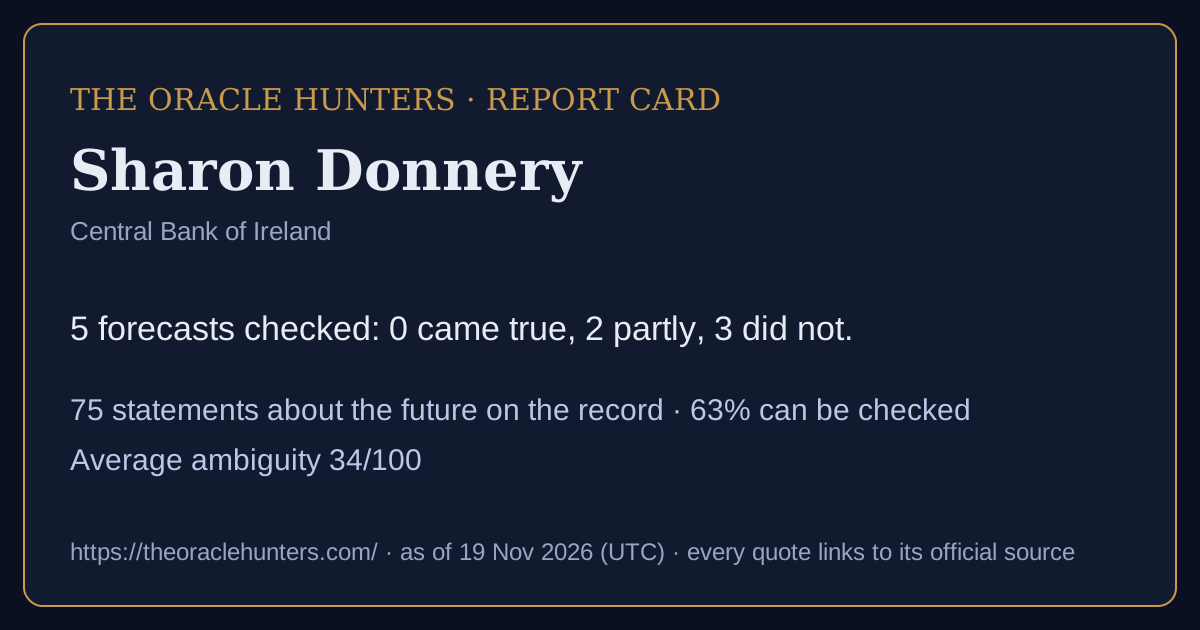
Sharon Donnery
Central Bank of Ireland
Track record: 5 forecasts checked: 0 came true, 2 partly, 3 did not.
75forecasts & commitments on the record
63%can be checked as stated
34average ambiguity (0-100)
0goalpost moves recorded
0confirmed U-turns
Timeline
came true partly did not not due / being checked / too vague
Calibration score: shown after 10 checked forecasts with a stated likelihood (now 4).
How they speak about the future: based on data 60, stated on authority 9, educated guess 6.
Kinds of claim: forecast 58, scenario (if… then) 8, mixed claim 8, commitment 1. · Download this report card as a picture
In the nine words
πρόγνωσιςInference from evidence57 · 76%μαντείαInspired knowledge8 · 11%πρόνοιαPreparing for the future8 · 11%προαναγγελίαPublic pre-announcement1 · 1%φρόνησιςPractical wisdom1 · 1%
How to read this
Each box is one sentence a public figure or institution said about the future, word for word, with a link to the official text. Can be checked means it names what will happen, by when, and how likely - so it can be compared with official figures later. Too vague to check means it does not. Ambiguity (0-100) is how many different ways the sentence can be read. When the date passes, the forecast is compared with official data and marked came true, partly or did not come true. Labels judge the sentence, never the person. Full guide and glossary.Checked
- 3 Inflation is projected to moderate to 2.8 per cent in 2023 and 2.1 per cent in 2024. 3
Did not come true. Said: inflation around 2.8% in 2023. Official figure for Ireland: 6.3% (World Bank open data). Missed. Off by 3.5 points. official data · checked 14 Nov 2026 · automatic check against official data (rules v3)
Headline inflation is projected to average 6.5 per cent this year, reflecting particularly high energy price inflation. 3
Did not come true. Said: inflation around 6.5% in 2022. Official figure for Ireland: 7.8% (World Bank open data). Missed. Off by 1.3 points. official data · checked 14 Nov 2026 · automatic check against official data (rules v3)
These projections foresee annual real GDP increasing by 1.1% in 2019, 1.6% in 2020 and 1.5% in 2021.
Did not come true. Said: economic growth around 1.6% in 2020. Official figure for Ireland: 7.2% (World Bank open data). Missed. Off by 5.5 points. official data · checked 14 Nov 2026 · automatic check against official data (rules v3)
Given our forecasts for labour force growth, this implies that the unemployment rate will drop to 4.9 per cent this year and 4.7 per cent next year. 6
Partly came true. Said: unemployment around 4.7% in 2020. Official figure for Ireland: 5.6% (World Bank open data). Close: outside the margin, but within one more half point. Off by 0.9 points. official data · checked 14 Nov 2026 · automatic check against official data (rules v3)
We now expect GDP growth this year of 4.4 per cent.
Partly came true. Said: economic growth around 4.4% in 2019. Official figure for Ireland: 5.0% (World Bank open data). Close: outside the margin, but within one more half point. Off by 0.6 points. official data · checked 14 Nov 2026 · automatic check against official data (rules v3)
On the record (75)
And so it will take time, and is not part of the ongoing review of the Code due to be finalised and published early next year.
Our consultation on the changes to the Code closed during the summer; and we will publish a revised Code and Feedback Statement in 2025.
In Ireland the old age dependency ratio is expected to increase from around 25% in 2022 to 47% in 2050; between now and then the population aged 80 and over in Ireland will increase dramatically — by more than 160%.
Our consultation on the changes to the Code closed last month; and we will publish a revised Code and Feedback Statement in 2025.
This involves improving the tools and technologies supervisors have, and it involves delivering a more integrated approach to supervision - both of which we expect to deliver real progress on this year.
For our financial system, while the CO, intensity of the direct holdings of debt securities and listed shares of the Irish banking industry and our investment funds sector are around the average in the Euro Area, the Irish financial services sector is among the highest in the euro area in terms of corporate exposures at risk of flooding; with almost …
Thanks to the Department of Finance and the International Sustainable Finance Centre of Excellence for organising what I'm sure will be another successful series of events this year.
It will not prevent people potentially losing money if the value of the crypto asset falls in a volatile market, or if a firm were to get into difficulty.
Such work includes an Open Ended Funds Working Group which | co-chair at the FSB, which will issue finalised recommendations by the end of the year.
- Ss Global growth is forecast to slow from 3.5% in 2022 to 3% in 2023 and 2.9% in 2024... below the historical (2000-19) average of 3.8% - see International Monetary Fund World Economic Outlook report October 2023
For this reason, by the end of 2024, we and the ECB expect signicant institutions to meet all remaining supervisory expectations on climate and environmental risks , including full integration in the Internal Capital Adequacy Assessment Process (ICAAP) and stress testing. 12
And while we will have another occasion to mark its launch, the Bank will also commemorate the importance of our European Union accession through the launch of a special commemorative coin later this year.
With all the usual caveats, the IMF's global growth forecasts have been lowered to 2.7 per cent growth next year , with euro area growth projected to see about half a percentage point.
For the euro area, private sector forecasters expect core ination to average around 4.0% in both 2022 and 2023, before falling back to 2.6% in 2024.
Emphasising the scale of the challenge facing both workers and rms in adjusting to the price shock, in both the Ireland and the euro area cumulative real wage growth is still projected to negative (on average) by 2024: around minus 3% in both cases.
Despite considerable uncertainty in the economic outlook for the euro area, nominal wages are projected to grow at around double historical rates, of 4.0%, 4.8% and 4.0% between 2022 and 2024.
For the euro area at least, this level of wage growth is well above historical averages, and one of the reasons underlying (or 'core') ination is expected to remain elevated in the near term, before returning towards 2% by 2024.
How the labour market responds to the weakening growth outlook remains to be seen, but our current projections are that a tight labour market and real wage catch-up for the current bout of ination will support strong nominal earnings growth of around 5-6% in Ireland in both 2023 and 2024, and 45% in the euro zone.
Such a broadening of upward wage pressures could be evidence of growing of energy and food price shocks on ination, and is no doubt a trend we will be paying close attention to in coming months. consistent with a 2% ination target 'secondround' effects
The rst such disclosure will take place in Q1 2023, and will include the measurement of greenhouse gas emissions across a number of different metrics. 11 12
According to the Intergovernmental Panel on Climate Change, direct climaterelated damages in the second half of this century could range from severe in a 'business-as-usual' emissions scenario, to stable and decreasing if global 2050 net zero targets are reached.
Adjusting to green our economies and minimise climate risks requires large investments in renewable electricity and storage - on average, approximately $1.7 trillion (globally) will be required annually to reach 70 per cent renewable supply by 2050 (Network for Greening the Financial System).
What we will monitor closely is whether growth in wages or profits are detached from underlying productivity growth or are responding entirely to the current high rates of inflation.
With that, broader-based wage growth consistent with economic fundamentals is welcome, especially as real incomes are likely to fall this year.
- 3 Inflation is projected to moderate to 2.8 per cent in 2023 and 2.1 per cent in 2024. 3
Did not come true. Said: inflation around 2.8% in 2023. Official figure for Ireland: 6.3% (World Bank open data). Missed. Off by 3.5 points. official data · checked 14 Nov 2026 · automatic check against official data (rules v3)
Headline inflation is projected to average 6.5 per cent this year, reflecting particularly high energy price inflation. 3
Did not come true. Said: inflation around 6.5% in 2022. Official figure for Ireland: 7.8% (World Bank open data). Missed. Off by 1.3 points. official data · checked 14 Nov 2026 · automatic check against official data (rules v3)
We are currently conducting a review of our bank capital framework, which will conclude later this year. 5 6
However, while the pandemic has prompted a move away from cash for some, it likely remains the most common way of making small retail payments, considering cash payments accounted for 73 per cent of all physical retail payments in 2019 across the euro area, (but 48 per cent of the value).
This leads to a complex policy challenge that will require our focus throughout the rest of 2021 and beyond: firstly, over what timeframe, and subject to what economic conditions, should the government begin to taper its direct financial supports for businesses?
Similarly if savings are used for home improvements, an increase in demand could divert resources - workers and inputs - from already much-needed housing supply. 23
A delicate policy trade-off presents itself for the rest of this year and into 2022: if traditional insolvency triggers are implemented rapidly, we risk many long-term viable yet currently distressed companies being liquidated, which may increase the long-term scarring of the economy.
In the rst Quarterly Bulletin for 2021, an unemployment rate of 8 to 9% was projected over the next two years, up from 5% pre-pandemic.
This framework review will run throughout this year and 2022, and will run concurrently to our regular annual calibration reviews, which are published annually in the December 2020 FSR.
And secondly, counterfactual evidence suggests that house prices could have been 25% higher in the absence of these policies, reducing the risk of a price correction and reecting the second objective.
Counterfactual estimates from Bank staff suggest house price levels could have been approximately 25% higher in the year prior to the pandemic had the measures not been in place, with similar implications for the price to income ratio, a key measure of housing market affordability. 9
The COVID-adjusted unemployment rate reached a maximum of 31 per cent in April 2020, and in May, 1.2 million people, or close to half the labour force were reliant on the State for either welfare payments or wage subsidies.
We expect ongoing export growth and a recovery in the domestic economy to take hold in the second half of 2021.
However, as the vaccines are rolled out, and restrictions ease, we expect consumer behaviour to drive demand, and in 2021 we are projecting modied domestic demand to increase by 2.9 per cent this year. 4
And next month we will publish the findings of a diversity and inclusion thematic assessment of the insurance industry along with best practice guidance for the wider industry.
In the event of falling prices, consumers might postpone spending due to an expectation that tomorrow goods will be cheaper.
Building on this micro data and developing our understanding of the sector will be a priority area for the Central Bank in 2020.
Next year we will complete this coin series when we commemorate the 80th anniversary of the birth of Dublin born musician Luke Kelly. [xii]
Recent Central Bank analysis has highlighted that strong net inward migration will be the most important source of employment growth if the economy continues to grow at the rates seen over the last number of years.
For example, Project Ireland 2040 outlines a number of policies that will affect future housing supply.
- Eurostat ' ', in 2018, Ireland has the lowest proportion of over 65 year olds at 13.8%, and well below the EU 28 value of 19.7%. 21 Population (Demography, Migration and Projections) Database
If not addressed with appropriate policy responses ageing populations could have adverse implications for public debt trajectory and potential growth.
In 2014 for comparison (bracket values for 2018), merchandise exports to the UK were 14% (11 %)of the total, the US accounted for 22 per cent (28%) with 40 per cent (39%) going to the EU non-UK.
- National Institute of Economic and Social Research: The Economic Effects of the Government's Proposed Brexit Deal (26 November 2018) Assume that sterling would depreciate against the euro by ten per cent while in a worst case stress scenario published by the Bank of England it is assumed that sterling could fall by 30% against the USD in a disorderly …
The significant uncertainty around a hard Brexit makes the macroeconomic outcome hard to predict.Our estimates indicate severe and immediate disruptive effects of a no deal Brexit with Irish economic output estimated to be 6 percentage points lower after two years than otherwise expected . 7
For Ireland, last year's research from Sustainable Nation Ireland estimated that making the transition to a sustainable, low-carbon economy by 2030 will require €50 billion . 18 19
Showing the newest 50 - the ledger has all 75.
Also said - not checkable as stated (12 newest)
Remarks about the future with no date, figure or likelihood that could be checked. They are kept on the record and shown here, but not scored.
Decisions we make now in these important times will shape our future.
and crises rarely respect borders - and indeed none of the big challenges I mentioned will.
The banking system is often where the macro and the micro meet - and so how these great macro challenges might crystallise in
And at time when we should be progressing at pace to meet the climate challenge, geopolitical factors risk slowing us down - and
As history has shown robust standards need to be complemented by robust supervision - why at the Central Bank of Ireland we
And that it is a fundamental responsibility to safeguard the funds you have been entrusted with should go without saying - and is precisely what your customers assume and expect
Selected participants will be announced in the coming weeks, with projects to explore new technologies and innovative methods to tackle financial crime - benefiting both the financial system and consumers.
And while such changes to our system, and the potential changes to come, may be fundamental, they will not alter our supervisory fundamentals - though it may alter how we need to deliver them.
In terms of , digitalisation and innovation can also have both positive financial stability and negative implications: providing diversification, efficiency and transparency - but also increasing complexity, potential concentration risks, not to mention the role technology and social media could play in times of financial fragility.
In this regard, I would like to emphasise the importance of the Independent NonExecutive Director (INED), and I am conscious that some of you here today will be INEDs or aspiring INEDs.
Having the right data and the right tools may not be much use though if we don't have the right skills - and so enhancing our technological and data skills and capabilities has also been a focus of the Central Bank.
And we look forward to further engagement with stakeholders over the coming months on this important topic and we will continue to play our part in identifying and managing the risks arising from the consequences of climate change.