Seung Park
Bank of Korea
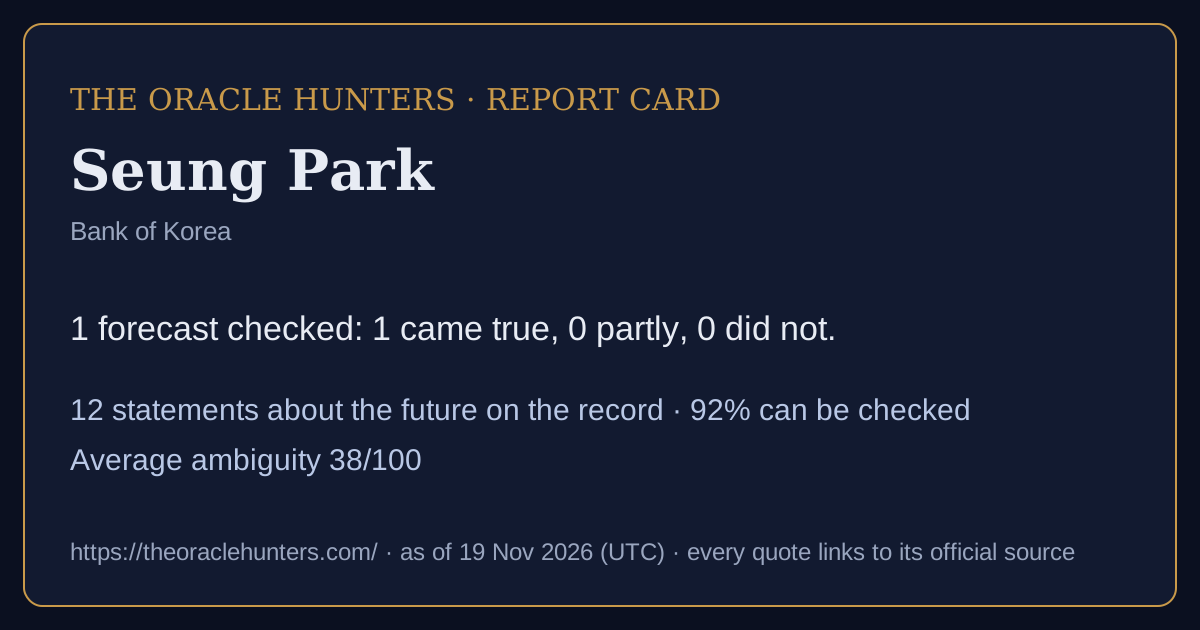
Track record: 1 forecast checked: 1 came true, 0 partly, 0 did not.
12forecasts & commitments on the record
92%can be checked as stated
38average ambiguity (0-100)
0goalpost moves recorded
0confirmed U-turns
Timeline
came true partly did not not due / being checked / too vague
Calibration score: shown after 10 checked forecasts with a stated likelihood (now 1).
How they speak about the future: based on data 10, educated guess 2.
Kinds of claim: forecast 10, scenario (if… then) 2. · Download this report card as a picture
In the nine words
How to read this
Each box is one sentence a public figure or institution said about the future, word for word, with a link to the official text. Can be checked means it names what will happen, by when, and how likely - so it can be compared with official figures later. Too vague to check means it does not. Ambiguity (0-100) is how many different ways the sentence can be read. When the date passes, the forecast is compared with official data and marked came true, partly or did not come true. Labels judge the sentence, never the person. Full guide and glossary.Checked
Next year Korea's GDP growth is expected to rise to 5.2 percent.
Came true. Said: economic growth around 5.2% in 2004. Official figure for Korea, Rep.: 5.2% (World Bank open data). On target. Off by 0.0 points. official data · checked 14 Nov 2026 · automatic check against official data (rules v3)
On the record (12)
By about 2040, Korea's share in global GDP is forecast to have increased slightly to 2% from 1.7% in 2003, while that of Japan, due to its relatively slow growth, is estimated to have shrunk to about half its current 12% share.
Picturing the world economy in 2040, Asia's share in world GDP is forecast to be 42%, while the shares of North America, Europe, and Other regions are expected to be 23%, 16%, and 20% respectively.
Looking at the big picture by country, in terms of overall national GDP, China is forecast to overtake Japan by around 2020 and be on a par with the US by approximately 2040, to account for about 1/5 of global GDP.
India would overtake Japan by about 2030, and by 2050 or so is projected matching Europe's 12% global GDP share.
Land prices too are very reasonable, and the highest level of corporate tax rate will be only 14%.
For example, if the central bank eased monetary policy to maintain financial stability, this could damage price stability which was the core goal of the central bank.
If we judge the Korean economy only by the prospects for next year's growth, prices and current account position, we might think that it has no serious problems.
Thus the Bank of Korea lowered its call rate target by 50 basis points in all to support a recovery of economic activity, bringing it down in May and July from 4.25 percent to the current 3.75 percent.
The current account is expected to register a surplus of around 12 billion dollars for the year thanks to the briskness of exports.
For its part, core inflation for the next year is anticipated to show stable movements at 2.8 percent.
Next year Korea's GDP growth is expected to rise to 5.2 percent.
Came true. Said: economic growth around 5.2% in 2004. Official figure for Korea, Rep.: 5.2% (World Bank open data). On target. Off by 0.0 points. official data · checked 14 Nov 2026 · automatic check against official data (rules v3)
For this year as a whole, too, our forecasts pointed to core inflation being held stable within its target range at the 3 percent level and to the current account maintaining its underlying surplus trend since the 1997 currency crisis.
Also said - not checkable as stated (12 newest)
Remarks about the future with no date, figure or likelihood that could be checked. They are kept on the record and shown here, but not scored.
The high growth of Japan after the war and that of Korea from the 1960s is frequently termed a 'miracle.' Although the industrialization of China and India so far holds out brilliant promise, it may still be thought of as something of a 'vast experiment in economic development', given that so much uncertainty surrounds its future course.
They may accompany the course of industrialization in the form of a widening gap between rich and poor, environmental and energy problems and the possibility of financial insolvencies.
First of all, it is vital that there should be a firm will for economic development and the resolution to carry it out.
The Nobel laureate Arthur Lewis pointed to 'the will to economize' as the most important motivation for economic growth.
If you wish, the Bank of Korea will be happy to further expand our cooperation and friendship with the Nepal Rastra Bank.
In addition, in order to overcome the weakness of its narrow market, Nepal should constantly expand its foreign trade.
Therefore, the central bank should devote intensive efforts to achieving price stability.
To put it briefly, while the government strives to increase production and investment, the central bank should conduct monetary policy consistently to avoid erosion of the basis for price stability.
Thirdly, we will push forward still more passionately in upgrading the industrial structure and improving corporate competitiveness.
What this means is that, with the contraction of the laborintensive industries, in which SMEs predominate, there are fewer new job opportunities opening up even though GDP may be growing.
it is showing the highest rate of growth worldwide, and so the gap between them in terms of economic scale is likely to widen.
Within the Kaesung Industrial Complex , wage levels will be fifty-seven and a half dollars a month, which is lower than those in China.