Seiji Nakamura
Bank of Japan
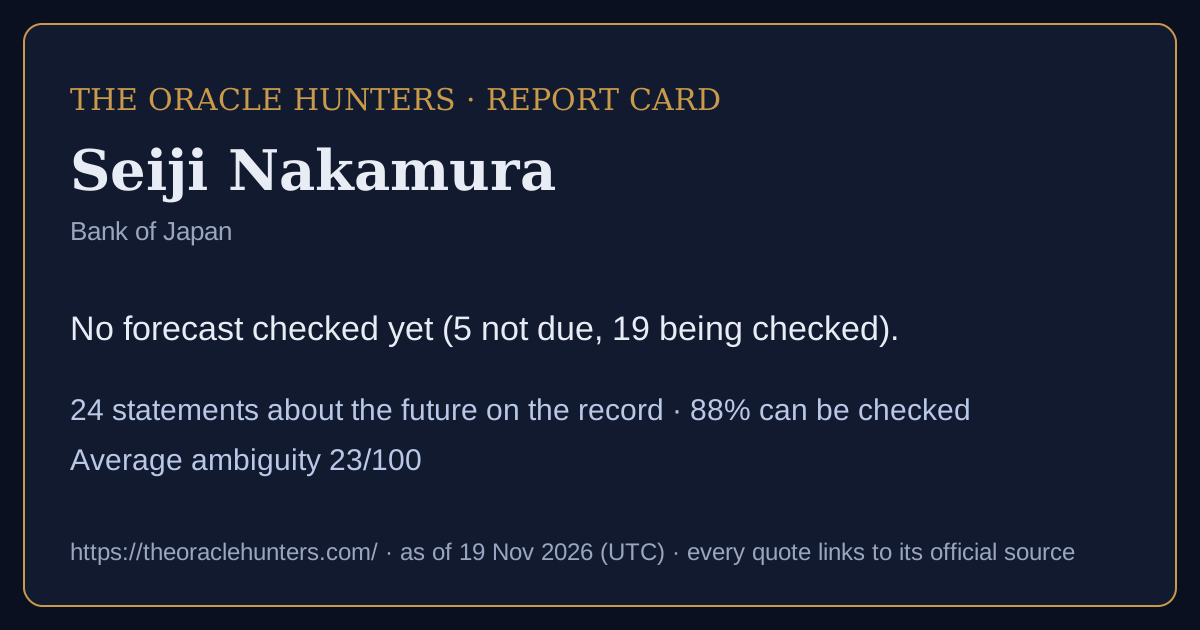
Track record: No forecast checked yet (5 not due, 19 being checked).
24forecasts & commitments on the record
88%can be checked as stated
23average ambiguity (0-100)
0goalpost moves recorded
0confirmed U-turns
Timeline
came true partly did not not due / being checked / too vague
Calibration score: shown after 10 checked forecasts with a stated likelihood (now 0).
How they speak about the future: based on data 24.
Kinds of claim: forecast 24. · Download this report card as a picture
In the nine words
How to read this
Each box is one sentence a public figure or institution said about the future, word for word, with a link to the official text. Can be checked means it names what will happen, by when, and how likely - so it can be compared with official figures later. Too vague to check means it does not. Ambiguity (0-100) is how many different ways the sentence can be read. When the date passes, the forecast is compared with official data and marked came true, partly or did not come true. Labels judge the sentence, never the person. Full guide and glossary.On the record (24)
Although these projections are down from those in June, taking into account the fact that advanced economies are decelerating, they are not necessarily low given that they are at around the same level as the average annual growth rate of 4.1 percent observed in the period from 2000 until 2008, the year that Lehman Brothers failed.
In addition, the Bank has made it clear that it will continue the virtually zero interest policy until it judges that price stability on the basis of the 'understanding of medium- to longterm price stability' - inflation of around 1 percent - is in sight, provided that no problem is identified in examining risk factors, including the accumulation of financial …
1 The Toronto Summit Declaration stated that 'advanced economies have committed to fiscal plans that will at least halve deficits by 2013 and stabilize or reduce government debt-to-GDP ratios by 2016'.
As for prices, against the background of the gradual improvement in the aggregate supply and demand balance, the forecasts for the year-on-year rate of change in the CPI for all items less fresh food were 0 percent for fiscal 2011, 0.1 percent for fiscal 2012, and 0.5 percent for fiscal 2013.
In the October Outlook Report released recently, the forecasts for the year-on-year growth rate of Japan's real GDP were 0.3 percent for fiscal 2011, 2.2 percent for fiscal 2012, and 1.5 percent for fiscal 2013.
In September 2011, the International Monetary Fund (IMF) projected that the year-on-year growth rate of the global economy would be 4.0 percent in both 2011 and 2012 and 4.5 percent in 2013.
The transmission mechanism by which increases in exports and production feed through into income and spending is likely to strengthen, and Japan's economy is projected to grow at a pace above its potential in fiscal 2012 due in part to a rebound from the significant deceleration in fiscal 2011.
In fiscal 2012, demand for reconstruction is likely to remain high, while overseas economies, especially emerging and commodity-exporting economies, are likely to continue growing steadily.
The Bank's forecast for the average annual rate of increase in the CPI is around 0.7 percent for both fiscal 2011 and 2012.
The Bank's forecast for real GDP growth released for reference in the Outlook Report is 0.6 percent for fiscal 2011 and 2.9 percent for fiscal 2012.
While the Federal Reserve has announced that it will end purchases of an additional 600 billion U.S. dollars of Treasury securities by the end of June 2011, as scheduled, it also emphasized that it will continue to maintain an accommodative monetary policy stance for an extended period in a situation where the U.S. economy lacks vigor as a whole.
According to the International Monetary Fund (IMF) World Economic Outlook released in April, the global economy is projected to grow 4.4 percent in 2011 and 4.5 percent in 2012, indicating that global economic growth is likely to remain firm.
In Europe, there are concerns that, in 2011, the effects of economic stimulus measures could wane with the implementation of fiscal austerity programs.
The median of the forecasts for the year-on-year rate of change in the CPI was minus 0.4 percent for fiscal 2010, plus 0.1 percent for fiscal 2011, and plus 0.6 percent for fiscal 2012.
The median of the forecasts for Japan's real GDP growth rate was 2.1 percent for fiscal 2010, 1.8 percent for fiscal 2011, and 2.1 percent for fiscal 2012.
In fiscal 2012, the Japanese economy was expected to continue growing at a pace above its potential growth rate, as the transmission mechanism by which the strength in exports and production fed through into income and spending would likely operate more effectively amid the continued relatively high growth in overseas economies, especially emerging and commodity-exporting economies.
The Outlook Report released on October 29, 2010 projected that, in the second half of fiscal 2010, the pace of recovery was likely to slow owing to factors including the slowdown in overseas economies and the ending of the boost from policy measures targeted at durable consumer goods, as well as the recent appreciation of the yen.
For 2011, it expects growth to continue at a relatively high rate of 4.2 percent.
In December 2009, the rate of decline in the core CPI marked a 1.3 percent fall as the effects of the setback in crude oil prices receded, and is expected to continue to diminish in line with a moderate economic recovery.
In the United States, real GDP for the October-December quarter of 2009 registered 5.7 percent growth and the economy as a whole has been recovering, although the level of economic activity is still low and a full-fledged recovery is likely to require more time.
The International Monetary Fund (IMF) saw the economic recovery as sustained, and on January 26, 2010 revised upward its outlook for world economic growth in 2010 to 3.9 percent, up 0.8 percentage points from its forecast released in October 2009.
In the latest interim assessment released after the Monetary Policy Meeting held on January 25 and 26, 2010, the median of the Policy Board members' forecasts for year-onyear real GDP growth was minus 2.5 percent for fiscal 2009, 1.3 percent for fiscal 2010, and 2.1 percent for fiscal 2011, indicating that the economy was developing basically in line with the …
Although the CPI is forecast to remain in negative territory until the end of fiscal 2011, the rate of decline is expected to moderate.
In the interim assessment of the October 2009 Outlook for Economic Activity and Prices released on January 26, 2010, the median forecast for the core CPI was minus 1.5 percent for fiscal 2009, minus 0.5 percent for fiscal 2010, and minus 0.2 percent for fiscal 2011.