Seiji Adachi
Bank of Japan
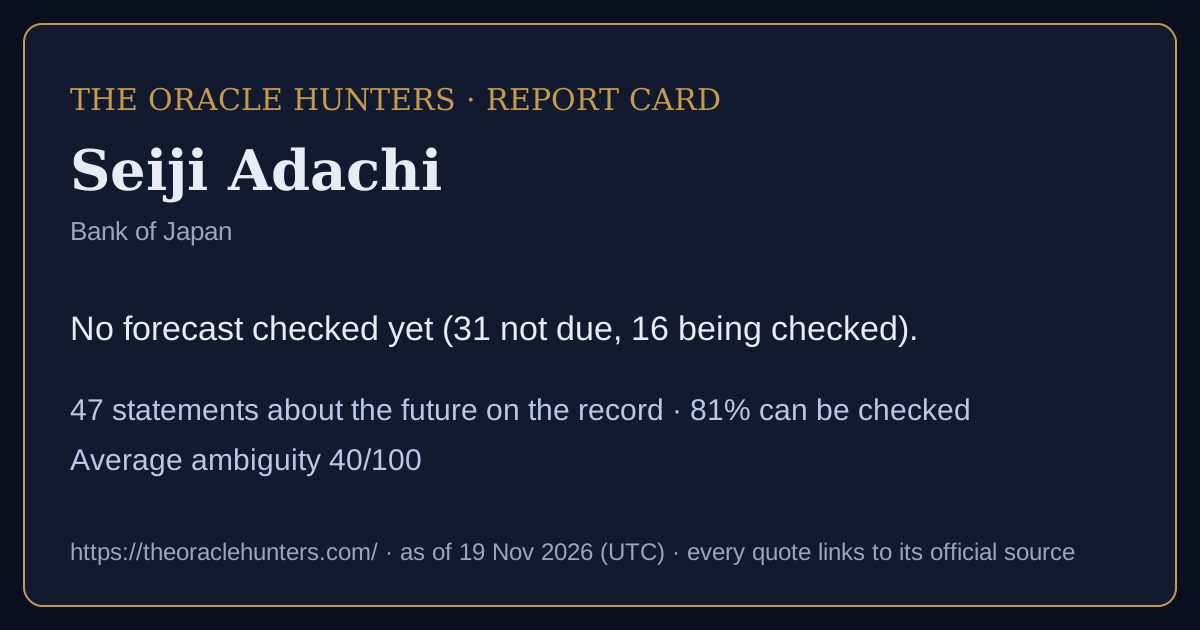
Track record: No forecast checked yet (31 not due, 16 being checked).
47forecasts & commitments on the record
81%can be checked as stated
40average ambiguity (0-100)
0goalpost moves recorded
0confirmed U-turns
Timeline
came true partly did not not due / being checked / too vague
Calibration score: shown after 10 checked forecasts with a stated likelihood (now 0).
How they speak about the future: based on data 39, stated on authority 5, educated guess 3.
Kinds of claim: forecast 31, mixed claim 9, scenario (if… then) 6, commitment 1. · Download this report card as a picture
In the nine words
πρόγνωσιςInference from evidence36 · 77%πρόνοιαPreparing for the future6 · 13%μαντείαInspired knowledge4 · 9%προαναγγελίαPublic pre-announcement1 · 2%
How to read this
Each box is one sentence a public figure or institution said about the future, word for word, with a link to the official text. Can be checked means it names what will happen, by when, and how likely - so it can be compared with official figures later. Too vague to check means it does not. Ambiguity (0-100) is how many different ways the sentence can be read. When the date passes, the forecast is compared with official data and marked came true, partly or did not come true. Labels judge the sentence, never the person. Full guide and glossary.On the record (47)
The Bank will conduct an interim assessment of the plan at the June 2025 MPM .
It also decided on a plan to gradually reduce its monthly purchase amount of Japanese government bonds (JGBs) so that it will be about 3 trillion yen in January-March 2026 (Charts 10 and 11).
Given these factors, the extent of wage hikes in 2025 will ultimately be determined by business performance in fiscal 2024, which in turn depends on whether there will be greater room for expansion in external demand and business fixed investment.
Given the high degree of the uncertainties that I mentioned earlier, mainly concerning the international situation, how wage hikes will play out next year remains very unclear.
Put differently, wage hikes from 2025 onward will ultimately depend on firms' business performance and, in turn, economic conditions.
The second reason is that, because I take a somewhat cautious view about whether sufficient wage hikes will be sustained in 2025, I think it is necessary to adequately examine these developments.
As I mentioned earlier, if the yen depreciates further or remains weak for a prolonged period, this could cause an earlier-than-expected reversal in the year-on-year rate of increase in the CPI.
This is for the following reasons: (1) even if high wage increases are realized in fiscal 2024, it is unlikely that structural labor shortages due to the declining and aging population will be resolved, and (2) the number of those who are not in the labor force is at a historically low level for seniors and women, whose labor participation …
Returning to Japan's economy, if a virtuous cycle between wages and prices starts to operate smoothly, reflecting wage increases in fiscal 2024, growth expectations for Japan's economy will be revised upward accordingly.
In terms of firms' inflation outlook, the Bank's March 2024 Tankan (Short-Term Economic Survey of Enterprises in Japan) shows that firms' medium- to long-term inflation expectations have been stable at about 2 percent since around 2022 (Chart 2).
Meanwhile, if the rate of increase in this fiscal year's consumer price index (CPI) is pushed upward through the channel I have mentioned, this could affect the results of the 2025 annual spring labor-management wage negotiations.
Moreover, if the reversal occurs and the prospect of sustainable and stable inflation exceeding 2 percent increases, the Bank may face the need to adjust the level of monetary accommodation more rapidly than expected by raising its policy interest rate.
Furthermore, as in the past statements on monetary policy, the Bank presented in its statement released immediately after the October MPM that it will continue expanding the monetary base until the year-on-year rate of increase in the observed CPI for all items less fresh food exceeds 2 percent and stays above this target in a stable manner, and it will …
In this regard, for firms to raise wages sustainably from fiscal 2024 onward, one of the key factors will be economic activity at home and abroad remaining stable, fostering an environment conducive to solid corporate profits.
By contrast, many local small and medium-sized firms have expressed concerns that this year's wage hikes were as much as they could manage, and that further increases will impair business continuity.
One concerns whether or not wage hikes at firms following the 2023 annual spring labor-management wage negotiations, which became more aggressive, are temporary or will continue in fiscal 2024 (Chart 11).
With such shift in the main factor pushing up prices, the year-on-year rate of increase in the CPI for all items less fresh food -- in terms of the median of the Bank's Policy Board members' forecasts presented in the October 2023 Outlook for Economic Activity and Prices -- was projected at 1.7 percent for fiscal 2025.
- Toward the end of the projection period, the Bank expects that underlying CPI inflation will increase gradually toward achieving the price stability target of 2 percent, while this increase needs to be accompanied by an intensified virtuous cycle between wages and prices.
It will continue expanding the monetary base until the yearon-year rate of increase in the observed CPI (all items less fresh food) exceeds 2 percent and stays above the target in a stable manner.
By doing so, it will aim to achieve the price stability target of 2 percent in a sustainable and stable manner, accompanied by wage increases.
Corporate bonds: Purchase at about the same pace as prior to the COVID-19 pandemic, so that their amount outstanding will gradually return to the pre-pandemic level of about 3 trillion yen.
The Bank will continue to allow 10-year JGB yields to fluctuate in the range of around plus and minus 0.5 percentage points from the target level, and will offer to purchase 10-year JGBs at 0.5 percent every business day through fixed-rate purchase operations, unless it is highly likely that no bids will be submitted.
In the current situation, however, sticky consumer prices, which are mainly composed of services prices, have not yet made a significant contribution to a rise in the CPI, though they could potentially make a greater contribution in response to the results of this year's annual spring labor-management wage negotiations.
Wage growth in this year's annual spring labormanagement wage negotiations is projected to exceed the past average and the previous forecast by a wide margin.
If monetary policy responds to every single short-term fluctuation and puts off achieving the target for the underlying trend in inflation, this could increase uncertainty over the future conduct of monetary policy.
That said, if a wage-price spiral takes place, this will likely cause a sizable increase in medium- to long-term inflation expectations and high inflation could become chronic.
This is suggested by the latest fiscal 2021 Annual Survey of Corporate Behavior released by the Cabinet Office, which shows that the projected real economic growth rate for the next five years based on firms' responses is somewhat low, at 1.0 percent (Chart 11).
Given the announcement that prices of food and many other items will be raised this month, it has become more likely that the incoming year-on-year rate of increase in the CPI for October will reach 2 percent, which is set as the Bank of Japan's price stability target, even in terms of the rate for all items less fresh food …
In this situation, it was reconfirmed at the April Monetary Policy Meeting that the Bank will persistently continue with its accommodative monetary policy with the aim of achieving the 2 percent target.
This may appear as if it has reached the Bank's 2 percent price stability target, but about 1.5 percentage points of this increase was attributable to the rise in energy prices, such as for crude oil.
The year-on-year rate of increase in the consumer price index (CPI, all items less fresh food) for April 2022, which was released on May 20, rose to 2.1 percent.
For the time being, while closely monitoring the impact of COVID-19, the Bank will support financing, mainly of firms, and maintain stability in financial markets, and will not hesitate to take additional easing measures if necessary; it also expects short- and long-term policy interest rates to remain at their present or lower levels.
The Bank will continue with Quantitative and Qualitative Monetary Easing (QQE) with Yield Curve Control, aiming to achieve the price stability target of 2 percent, as long as it is necessary for maintaining that target in a stable manner.
However, the medians of the Policy Board members' forecasts -- as presented in the Bank's Outlook for Economic Activity and Prices (Outlook Report) released on April 28 -- showed the rate for all items less fresh food at 1.1 percent for fiscal 2024, implying that achieving the 2 percent target will remain difficult.
The Bank of Japan will persistently continue with accommodative monetary policy until the 2 percent price stability target is achieved (Chart 12).
The higher margins earned by firms through price rises could lead to wage increases and are expected to serve as a great catalyst for achieving the 2 percent price stability target.
Meanwhile, the Bank of Japan will persistently continue with powerful monetary easing under the current framework of Quantitative and Qualitative Monetary Easing (QQE) with Yield Curve Control, with a view to achieving the 2 percent price stability target.
The Bank will be deliberating on the treatment of the COVID-19 Special Operations from April 2022 onward while carefully assessing the COVID-19 situation and its impact on corporate financing.
The year-on-year rate of increase in the CPI (less fresh food) is projected to be 0.0 percent in fiscal 2021, shifting to 0.9 percent in fiscal 2022 and 1.0 percent in fiscal 2023.
Based on the medians of the Policy Board members' forecasts for Japan's economy and inflation -- as shown in the Bank's Outlook for Economic Activity and Prices (Outlook Report) released on October 28, 2021 -- the real GDP growth rate is projected to be 3.4 percent for fiscal 2021, 2.9 percent for fiscal 2022, and 1.3 percent for fiscal 2023.
The intention here is to enhance the credibility of achieving the price stability target of 2 percent through an extremely strong commitment, in that the Bank promises to continue with monetary easing based on observed CPI inflation rather than the outlook for CPI inflation.
To achieve the price stability target of 2 percent, the Bank will (1) continue with monetary easing in a sustainable manner and (2) make nimble and effective responses without hesitationto counter changes in the situation.
As Japan's past deflationary phase is characterized by the fact that there were almost no price rises in the domestic demandoriented services industry, the post-COVID-19 era may afford a prime opportunity to achieve the 2 percent price stability target.
The Bank will continue to support Japan's economy in fostering an economic environment where some degree of occasional price rises is socially tolerated.
This implies that we must anticipate a long battle toward achieving the 2 percent price stability target.
If adversity can indeed be the source of new growth, it is possible that the foundations for next-generation innovation will be established during the process of pursuing the structural reforms in society to adapt to the COVID-19 era.
If it turns out that we are going to have to live with COVID-19 for the next few years, it will likely become harder to return to the growth path observed before the outbreak.
Also said - not checkable as stated (7 newest)
Remarks about the future with no date, figure or likelihood that could be checked. They are kept on the record and shown here, but not scored.
My view on prices is that they will continue to rise to a certain extent, but when questioned about whether I envision a path toward achieving the Bank's price stability target in a stable manner, I have to say that I still lack confidence in such achievement.
However, should there be a resurgence of COVID-19, there is concern over the risk that reinstated lockdowns in China's major cities and other measures may push down the manufacturing of industrial products.
How the Bank should take part in boosting the expected growth rate is a quite complex issue.
At an unscheduled MPM on May 22, the Bank decided on such measures as the introduction of a new fund-provisioning measure to support financing mainly of small and medium-sized firms.
During the initial phase of the COVID-19 outbreak, policy priority was focused on preventing an increase in unemployment or corporate bankruptcies so that the economy could withstand the spread of the disease, in preparation for the resumption of economic activity after the disease subsided.
While it had already been acknowledged that potential economic growth rates might be on the decline, especially in advanced countries, concerns are now growing that the recent spread of COVID-19 will further exacerbate secular stagnation.
The expansion of investment in digitalization is also expected to lead to growth in new demand in various related areas, including cloud services.