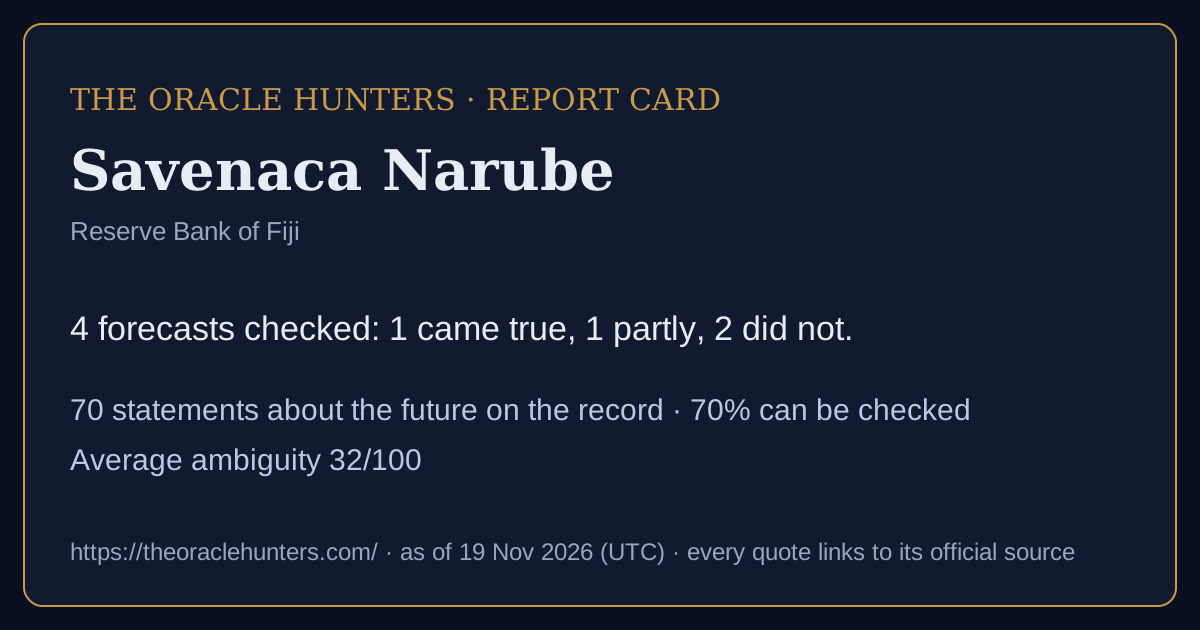
Savenaca Narube
Reserve Bank of Fiji
Track record: 4 forecasts checked: 1 came true, 1 partly, 2 did not.
70forecasts & commitments on the record
70%can be checked as stated
32average ambiguity (0-100)
0goalpost moves recorded
0confirmed U-turns
Timeline
came true partly did not not due / being checked / too vague
Calibration score: shown after 10 checked forecasts with a stated likelihood (now 3).
How they speak about the future: based on data 54, stated on authority 14, educated guess 2.
Kinds of claim: forecast 53, mixed claim 8, commitment 6, scenario (if… then) 3. · Download this report card as a picture
In the nine words
πρόγνωσιςInference from evidence50 · 71%μαντείαInspired knowledge11 · 16%προαναγγελίαPublic pre-announcement6 · 9%πρόνοιαPreparing for the future3 · 4%
How to read this
Each box is one sentence a public figure or institution said about the future, word for word, with a link to the official text. Can be checked means it names what will happen, by when, and how likely - so it can be compared with official figures later. Too vague to check means it does not. Ambiguity (0-100) is how many different ways the sentence can be read. When the date passes, the forecast is compared with official data and marked came true, partly or did not come true. Labels judge the sentence, never the person. Full guide and glossary.Checked
Moreover, inflation rose to a 20-year high but is expected to moderate in 2009.
Came true. Said: inflation would fall in 2009. Official figures for Fiji: 7.7% in 2008, 3.1% in 2009 (World Bank open data). official data · checked 14 Nov 2026 · automatic check against official data (rules v3)
We expect the economy to grow by around 2 percent next year on the back of growth in the tourism industry.
Partly came true. Said: economic growth around 2% in 2008. Official figure for Fiji: 1.0% (World Bank open data). Close: outside the margin, but within one more half point. Off by 1.0 points. official data · checked 14 Nov 2026 · automatic check against official data (rules v3)
We are projecting inflation to rise to 4 percent next year.
Did not come true. Said: inflation around 4% in 2006. Official figure for Fiji: 2.5% (World Bank open data). Missed. Off by 1.5 points. official data · checked 14 Nov 2026 · automatic check against official data (rules v3)
Over the next two years, GDP is forecast to grow by 4 percent in 2005 and to slow down further in 2006.
Did not come true. Said: economic growth around 4% in 2005. Official figure for Fiji: 0.7% (World Bank open data). Missed. Off by 3.3 points. official data · checked 14 Nov 2026 · automatic check against official data (rules v3)
On the record (70)
My estimate is that if we raise productivity growth by 1 percentage point it will raise GDP by at nearly twice that.
I believe that if we all implement 50 percent of what we say we will do, we will be far better off than where we are today.
Given what is happening around us, we will do extremely well to achieve the 2.4 percent growth that was released in November last year.
Our old coins, including the 1 and 2 cents coins will be officially demonetised on 31 March 2009 meaning they will cease to be a legal tender from 01 April 2009.
The new and old coins will co-circulate for about three months until 31 March 2009.
The new coins will be issued into circulation on 13 January 2009, the 40th anniversary of decimal currency in Fiji.
Television advertisements will start in January 2009.
Hence, if we assume that we will not change these coins in another forty years, these savings can amount to over 100 million dollars.
Forecasts for 2009 and 2010 are 2.4 percent and 1.9 percent, respectively.
- The major drivers of growth are tourism, agriculture, manufacturing, mining and water, while the major drag, particularly for 2010 and 2011, is the reduction in Government expenditure, following the fiscal stimulus expected for 2009.
Moreover, inflation rose to a 20-year high but is expected to moderate in 2009.
Came true. Said: inflation would fall in 2009. Official figures for Fiji: 7.7% in 2008, 3.1% in 2009 (World Bank open data). official data · checked 14 Nov 2026 · automatic check against official data (rules v3)
- Monetary policy objectives - year-end inflation are still expected at 7.5 percent but will moderate next year.
- The IMF has revised world growth successively, down to 3.7 percent this year and is expecting a global recession, with growth forecast at 2.2 percent in 2009.
In a few weeks time, the Government will deliver the National Budget for 2009.
These prices may stay with us for some time although some easing of food prices is expected toward the end of this year.
However, if we could lift our growth rate to, say, 5 percent per year, we would double our economy in less than 20 years.
The next three years will be no different with a projected average growth rate of below 2 percent.
Last year the economy is expected to have contracted by 4.4%, investment fell, companies have closed down (I'm sure they were more in the small and micro enterprise category, or SMEs), jobs have been lost and business and consumer sentiment and confidence has been, and remains, weak.
I have highlighted this in several past speeches but I feel it is important to do so again: with a growth rate this low, we will double the size of our economy in about 50 years - that is half a century!; for some, it is a lifetime!
Looking ahead, over the next three years, although the economy is forecast to grow, this growth is expected to be modest, averaging only 1.5 percent.
If we cannot safeguard the first two, growth will virtually be impossible.
If this happens, prices will permanently rise without any real improvements to the economy - purchasing power will decline, asset prices will erode, investment will suffer and growth will be even more difficult to achieve.
There is also a real fear that the world economy will enter a recession or even a depression this year.
I understand that there may be another Westpac branch opening in downtown Suva in 2008.
In 2008, a mild economic recovery of 2 percent is expected led mainly by the tourism industry contributing to growth in the wholesale & retail trade and hotels & restaurants and transport & communication sectors.
We look forward to the announcement of economic policies that will take us forward in the next two years.
Under the facility, the Reserve Bank will provide funds to the commercial banks and the Fiji Development Bank at an interest rate that is aligned to the 182 day treasury bill market rate with a cap of 2 percent.
The re-opening of the Vatukoula gold mine will also contribute to economic growth in 2008.
A mild economic recovery of about 2 percent is expected in 2008.
Our inflation has started to come down again and we project it at around 3.5 percent at the end of the year.
Alignment to these values now determines the rewards that one will be awarded at year end.
Alignment to these values now determines the rewards that one will receive at year end.
The new policy will still become effective at the beginning of next year.
You may recall that we had announced earlier this year our intention to reduce the local borrowing allowed by non-resident companies and individuals beginning from next year.
We have released our revised economic projections with a larger economic decline of 3.1 percent this year compared to 2.5 percent expected earlier.
We expect the economy to grow by around 2 percent next year on the back of growth in the tourism industry.
Partly came true. Said: economic growth around 2% in 2008. Official figure for Fiji: 1.0% (World Bank open data). Close: outside the margin, but within one more half point. Off by 1.0 points. official data · checked 14 Nov 2026 · automatic check against official data (rules v3)
At 6.6 percent at the end of May, inflation is at its highest level for many years and in my view, we have yet to see the peak.
Lastly, the effects of the recent floods on sugar and other agricultural products will worsen the economic decline projected for this year but their impact is still being assessed.
A similar growth rate is expected for 2009.
Looking ahead, for 2008 the economy is expected to rebound by 2 percent.
As you know, we project that the economy will fall by 2.5 percent this year.
Later this year, the Reserve bank will be introducing an automated payments system which will facilitate faster clearance of cheques amongst banks.
We will see increased competition for banking services and products.
Economic growth will continue in the next three years but at the same level as we have seen in the last five years.
In Fiji we will be struggling for small businesses to make up 10 percent of the economy.
At this rate of growth, we will double our economy in 50 years and that is a half of a century.
This is expected to bring government debt back down to 45 percent of GDP by 2011.
If we lift our growth rate to say 5 percent per year we will double the size of our economy in 20 years and that is a huge 30 year difference.
Our growth rate has averaged 2.4 percent over the past 5 years and is expected to be around the same level in the next 3 years.
Economic growth has averaged around 2.4 percent over the past 5 years and is expected to average around 2.7 percent in the next 3 years.
Showing the newest 50 - the ledger has all 70.
Also said - not checkable as stated (12 newest)
Remarks about the future with no date, figure or likelihood that could be checked. They are kept on the record and shown here, but not scored.
One day if we are not careful we will all disappear under the waves.
I suppose as humans we will always do that.
We should focus all our energy in getting things done in a coherent and consistent fashion.
I trust that we will all enjoy the book and more importantly emulate the qualities of Siwa in our lives and in our leadership.
I hope that the Reserve Bank will not be blamed for this economic scenario.
Fiji will not be immune from this global recession.
While Siwa may not have faced the same situation as the Governor of the Reserve Bank, I have often wondered what Siwa would advise us to get us through these unprecedented difficult times.
As the custodian of the financial system, it was quite obvious to me that the Reserve Bank will need to spearhead the work on anti money laundering which we did.
However, I had expected that while the Bank can administer the FIU, the Government should foot the bill.
So while we may say or feel in Fiji that we do not need to worry to much about these activities, let me tell you today that the evidences show otherwise.
We will send out a signal to criminals that they can launder money through our country.
I urge those of us here today, to be champions in this global war on money laundering.