Sarah Hunter
Reserve Bank of Australia
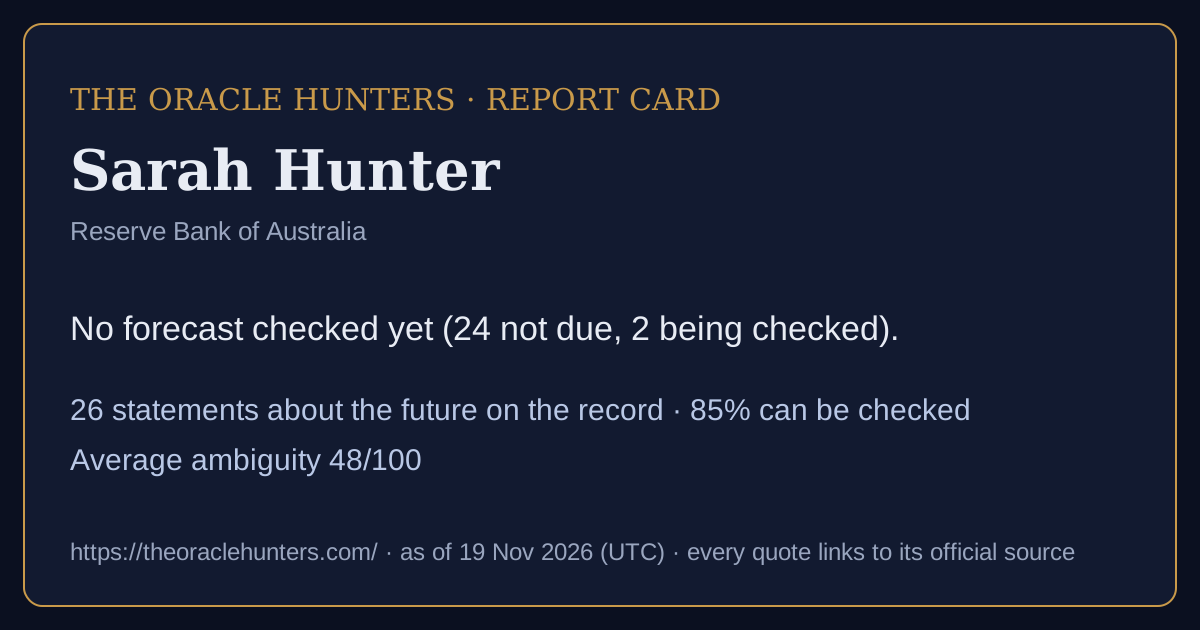
Track record: No forecast checked yet (24 not due, 2 being checked).
26forecasts & commitments on the record
85%can be checked as stated
48average ambiguity (0-100)
0goalpost moves recorded
0confirmed U-turns
Timeline
came true partly did not not due / being checked / too vague
Calibration score: shown after 10 checked forecasts with a stated likelihood (now 0).
How they speak about the future: based on data 20, educated guess 5, stated on authority 1.
Kinds of claim: forecast 19, scenario (if… then) 6, mixed claim 1. · Download this report card as a picture
In the nine words
πρόγνωσιςInference from evidence19 · 73%πρόνοιαPreparing for the future6 · 23%μαντείαInspired knowledge1 · 4%
How to read this
Each box is one sentence a public figure or institution said about the future, word for word, with a link to the official text. Can be checked means it names what will happen, by when, and how likely - so it can be compared with official figures later. Too vague to check means it does not. Ambiguity (0-100) is how many different ways the sentence can be read. When the date passes, the forecast is compared with official data and marked came true, partly or did not come true. Labels judge the sentence, never the person. Full guide and glossary.On the record (26)
Largely via these direct effects, our May forecasts see headline inflation peaking at 4.8 per cent in the June quarter, significantly higher than was expected in our February forecasts (Graph 8).
The shock to oil prices puts upward pressure on inflation over the next year, contributing around 0.4 percentage points to underlying inflation in the March quarter 2027.
Prior to the conflict, growth in activity was expected to slow over 2026 and remain subdued in 2027, reflecting tighter financial conditions and the waning boost from factors that have supported growth recently.
According to the NAIRU framework, if demand in the economy outstrips supply and the unemployment rate is consistently below the NAIRU, then inflation expectations could rise to a level that is not consistent with low and stable inflation and create a feedback loop between inflation outcomes and expectations, resulting in continually rising, or 'accelerating', inflation. '®!
This means that our full employment objective is closely linked with our inflation objective; while deviations can occur in the short run, over time if the labour market is in balance (i.e. achieving full employment), then inflation will be at our mandated target (i.e. low and stable). |!
This framework means that when the labour market is sustainably at full employment, inflation is expected to move from its current rate towards 2.5 per cent and then remain stable.
If we can sustain this over time and expectations remain anchored, inflation will be within our 2-3 per cent target band and the labour market will be sitting at full employment.
In the most recent National Accounts, GDP growth picked up to be 1.8 per cent over the year to the June quarter, slightly above our forecasts.
But the 'productivity growth plus 2.5 per cent' rule of thumb does provide a useful guide to what rate of nominal wages growth could be sustained in the long run, when the economy is sustainably and persistently at full employment.
Recognising this, and the evidence that at least part of the slowdown has reflected structural factors that are likely to persist, we downgraded our medium-term trend productivity growth assumption from 1.0 per cent per annum to 0.7 per cent in the August SMP.
In fact, joint work by staff at the RBA and Treasury suggests that returning to mid-2000's levels of competition could improve resource allocation and thereby raise productivity and the level of GDP by up to 3 per cent. |°!
We expected inflation to stay around the midpoint of the target band over the next two years and for labour market conditions to remain broadly stable, with employment growth tracking underlying population growth.
Given this, we downgraded our forecast for year-ended GDP growth by 0.3 percentage points by the end of our forecast horizon, which was in line with the downgrade to our forecast for potential output growth.
These were provided to the Monetary Policy Board to help inform their decision-making; taking all the information into account and considering the risks to the outlook, they decided to cut the cash rate by 25 basis points.
Simultaneously, travel service imports (i.e. outward tourism) may decline if the Australian dollar depreciates; holidaying overseas will become more expensive than taking a trip locally.
- There will also be limited effect on indirect demand for Australian exports from higher US tariffs on other countries, as accounting for this indirect demand only raises Australia's export exposure to the United States to a little over 2.25 per cent of Australian GDP.
Together, these two outcomes mean that inflation is forecast to be a little lower than at the February SMP, settling around the midpoint of the 2-3 per cent target range.
Resources make up 75 per cent of Australian good exports, and despite the exposure of China and other resource intensive countries to the tariff shock, we might expect export volumes to remain resilient in the short run.
Higher US tariffs on Australian exports are unlikely to have a material direct impact as Australian exports to the United States only account for around 1.5 per cent of Australian GDP, a low share compared with other countries (Graph 6). [ 9]
This tells us that - according to MARTIN at least - the decisions we make today will have their largest effect on economic output at the end of 2025, and on inflation in mid-2026. 19
Looking at a large, if unlikely, stimulus gives a sense of what it might mean for the Australian economy and also illuminates the channels that would be at play for a smaller stimulus (Graph 5). 7 While here we look at the impact of a stimulus package in isolation, in practice a large stimulus would be most likely if growth …
The dark blue range shows that 70 per cent of two-year ahead inflation forecasts have fallen within ± 1 percentage points of the central forecasts since 1993, and 90 per cent fall within ± 2 percentage points.
That is, they would not bring the economy back into balance in the second half of 2026; in the strong-demand scenario, inflation would remain above 2.5 per cent, while in the weak-demand scenario it would drop below 2.5 per cent by the end of the forecast horizon (see solid black lines in right-hand panels of Graphs 6 and 7).
For example, they might expect to see a sharp increase in grocery prices in the future if it's reported that the harvest has been poor.
This could be workers, or their union representatives, bargaining for higher wages if they think inflation will be higher. !°!
That is, people across the economy believe inflation will generally average a low rate (in Australia's case, 2-3 per cent), and they make decisions based on this underlying belief that becomes self-reinforcing.
Also said - not checkable as stated (12 newest)
Remarks about the future with no date, figure or likelihood that could be checked. They are kept on the record and shown here, but not scored.
Aboriginal and Torres Strait Islander peoples should be aware that this website may contain the names, images and voices of people who are now deceased.
Today I'm going to talk about inflation and how the RBA has used our frameworks to think about the outlook in the context of the current Iran conflict.
This helps us understand how different economic conditions will show up in inflation. [ 3]
My remarks today will focus on the findings of the recent RBA Review with respect to our mandate, the recent refinements that were made in response and how they have impacted the RBA Monetary Policy Board's (Board) '+! strategy and operations.
Amongst other things, the Board now provides a clearer assessment of current conditions and the outlook for the economy, and the implications of this for monetary policy strategy; over time, we hope that this will help people across the economy to better understand policy decisions.
To help clarify the implication of these changes for policymakers, changes were also made to the Statement on the Conduct of Monetary Policy (an agreement between the Board and the Government on how the Board will discharge its mandate).
- » Inflation target midpoint: The Board should aim to set policy to return inflation to the midpoint of the inflation target of 2-3 per cent, so as to maximise the likelihood that the inflation target is met.
- » Clear communication when objectives may not be met: When inflation is expected to be significantly away from the midpoint or when labour market conditions are expected to deviate significantly from those consistent with full employment, the Board will communicate how long it expects it will be before it meets each objective and why.
Long-term inflation expectations remained anchored to the RBA's target, which meant we did not need to push back against an unhelpful feedback loop between higher expected and realised inflation.
They refine our approach to be more systematic, comprehensive and transparent — and we will continue improving this over time.
As you can see, we have plenty of questions that we're actively digging into, and we'll have more to say on how we're thinking about full employment next year.
This work deepens our understanding of current conditions and the outlook by how monetary policy transmits through the economy and how longer term forces may be changing the economy's fundamentals.