Sarah Cardell
Competition and Markets Authority · GBR
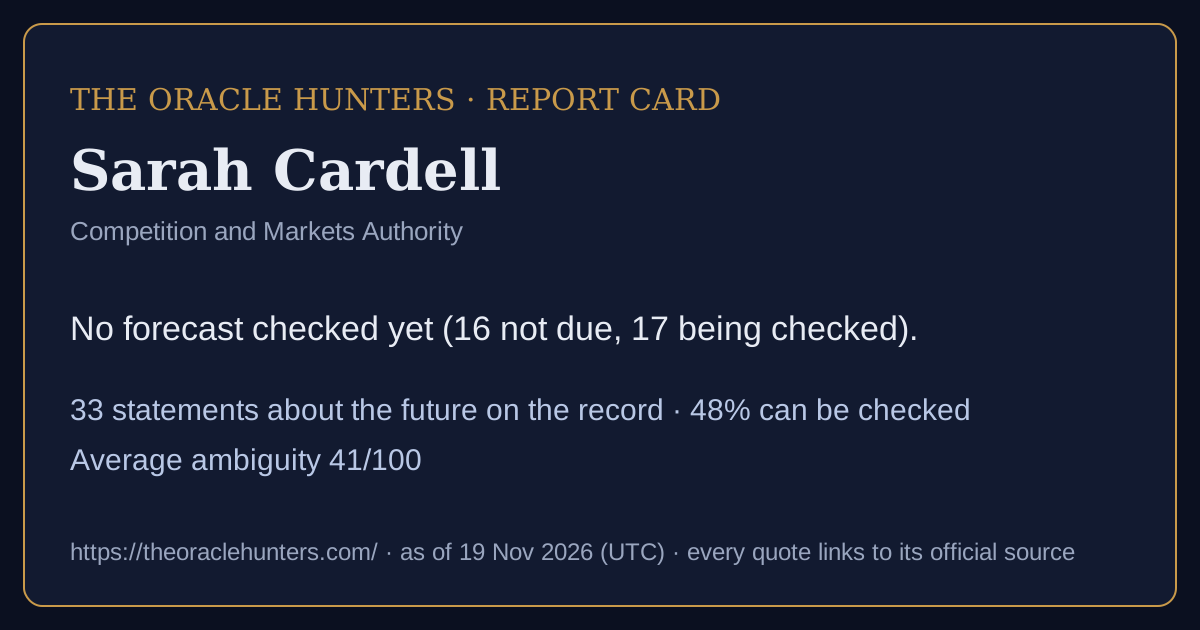
Track record: No forecast checked yet (16 not due, 17 being checked).
33forecasts & commitments on the record
48%can be checked as stated
41average ambiguity (0-100)
0goalpost moves recorded
0confirmed U-turns
Timeline
came true partly did not not due / being checked / too vague
Calibration score: shown after 10 checked forecasts with a stated likelihood (now 0).
How they speak about the future: stated on authority 24, based on data 8, educated guess 1.
Kinds of claim: forecast 17, commitment 9, mixed claim 6, scenario (if… then) 1. · Download this report card as a picture
In the nine words
μαντείαInspired knowledge16 · 48%προαναγγελίαPublic pre-announcement9 · 27%πρόγνωσιςInference from evidence7 · 21%πρόνοιαPreparing for the future1 · 3%
How to read this
Each box is one sentence a public figure or institution said about the future, word for word, with a link to the official text. Can be checked means it names what will happen, by when, and how likely - so it can be compared with official figures later. Too vague to check means it does not. Ambiguity (0-100) is how many different ways the sentence can be read. When the date passes, the forecast is compared with official data and marked came true, partly or did not come true. Labels judge the sentence, never the person. Full guide and glossary.On the record (33)
And one UK-based AI startup told us that a successful pilot with a government department could have delivered around 20% growth for the business and created new regional jobs.
In March this year we published research that explored how agentic AI could change what agency means for consumers.
Whether booking your teenage daughter’s first driving lesson (something I will have the pleasure of next year), deciding where to park, buying flights for a well-deserved holiday, a new washing machine, or a ticket to see your favourite band, you should be able to do so with confidence.
In other cases, the most effective route may be guidance, warning letters, commitments or settlements – like the £100 million we secured from housebuilders last year, delivering an immediate contribution to affordable housing for low-income households across the UK.
But be in no doubt: truly anti-competitive mergers do not operate in the interests of economic growth or household prosperity and we will remain resolute in these cases.
In particular, we will prioritise outcomes that benefit the UK interest, ensuring that every action we take is unequivocally in service of a clear end goal: to drive economic growth and improve household prosperity.
We will only maximise these opportunities if we safeguard public procurement from collusion, which can inflate prices by up to 20% and stifle incentives to innovate.
So, within this first objective we will also step up our action to enable legitimate, pro-growth collaboration – which can help firms to scale, secure investment, make innovative breakthroughs, and bank productivity gains.
Hosting the ICN Annual Conference in Edinburgh in May this year was a particularly energising reminder for me of the quality of expertise and strength of collaborative endeavour within this community.
The statutory deadlines for our final designation decisions are in October and, in the event we proceed with designations, we expect to consult on a first set of conduct requirements before the end of the year.
We will not simply step aside in those cases when an unfounded ‘growth narrative’ is rolled out by firms and advisors.
That’s why the UK government’s new strategic steer to the CMA, issued in May this year, is particularly helpful – recognising the importance of our fundamentals while clearly situating our work within the growth mission.
The regime will only deliver on its enormous potential for growth and wider benefits if we – the CMA and innovative, ambitious businesses across the tech sector – work together, constructively and collaboratively.
I know techUK and its members will provide valuable insights and collaboration across much of our work this year.
We will continue to strengthen ties with trade associations and UK-based venture capital firms, partnering on a series of events over 2025.
We will engage relevant members of our Growth and Investment Council during our SMS investigations, so that we hear key industry and expert perspectives.
The CMA’s Microeconomics Unit will publish work in early 2025 that will bring greater clarity to this relationship between competition and investment.
We will continue to ensure that the power of competition drives the growth and prosperity we all wish to see.
Finally, we will include in our Annual Report and Accounts a review of the impact of our work on economic growth, and will seek feedback on the best approach to this.
And some of our most significant opportunities to unlock competition as a force for growth – especially in the vital UK tech sector – will begin next year with the new Digital Markets, Competition and Consumers Act (DMCCA).
As we plan our portfolio of work for next year we will have a laser focus on growth.
We expect the operation of the new regime will formally commence towards the end of this year.
The unit will also produce the CMA’s next State of Competition report in Spring 2024, deepening even further our understanding of market power, market structure, business dynamism, innovation and productivity across the UK economy.
Our goal is to help this new, rapidly scaling technology develop in ways that ensure open, competitive markets and effective consumer protection and we will be publishing an initial report in September this year.
The UK currently has around 25,000 chargepoints for electric vehicles and forecasts suggest more than 10 times this amount may be needed by 2030 given the anticipated demand.
We will be consulting next month on a proposal that will ease the requirements on firms and provide more clarity on what businesses can do.
Our Equality, Diversity and Inclusion Strategy for 2020 to 2024 and the Action Plans we publish under it will keep us focused on building and supporting a diverse workforce.
In May this year, we held a public event on the metaverse focused on the opportunities and challenges it may present to consumers and competitive markets.
And we will continue use all our powers to the fullest extent to ensure prices remain as low as possible.
The changes are subject to legislation and therefore will take some time and are not anticipated to come into effect this year.
We expect to publish our conclusions by the end of the year.
This year we provided further guidance for businesses on our use of advisory and warning letters, intended to encourage compliance with competition law where we are concerned that there may have been a breach of those laws but a full formal investigation would not be justified under our prioritisation principles.
For example, this year we have launched a market study into legal services, where we will examine long standing concerns into the affordability of legal services and standards of service.
Also said - not checkable as stated (12 newest)
Remarks about the future with no date, figure or likelihood that could be checked. They are kept on the record and shown here, but not scored.
That means both understanding what we are choosing based on clear and accurate information; and having the confidence we will be treated fairly.
Over the next 3 months we will be publishing updates across our road fuel, dentistry and childcare work and, in each case, our analysis of the drivers of poor outcomes will include a strong focus on regional and local disparities.
In road fuel, we will build on our 2023 market study and subsequent statutory monitoring function, with a particular focus on what is driving persistent variation in localised pricing and how the recently launched Fuel Finder can be harnessed to kickstart more effective competition in that market.
Where government seeks greater strategic autonomy in critical technologies and infrastructure, it may need to accept greater uncertainty and a more active market-shaping role than traditional procurement approaches typically allow today.
If procurement is expected to support a stronger and more dynamic industrial base, government needs to understand whether its purchasing decisions are actually helping firms to grow, invest and compete.
Public procurement is expected to deliver a wider range of objectives than ever before: not just value for money, but innovation, growth, resilience, national security, domestic jobs, skills and social value.
Inevitably, that wide range of objectives may require trade-offs and certainly needs clear prioritisation.
In some cases, local employment and training opportunities may be the priority; in others, access to world leading capabilities from global markets may be required.
At the frontier, the technologies which are fast becoming pivotal to economic security and growth, the best solution may not yet exist.
And in defence, we will be working alongside the Regulatory Innovation Office, supporting a series of MoD ‘regulatory sprints’ – the first one on autonomous systems - with a particular focus on where regulatory change could help enable more effective competition.
But we will also do things differently as we go about that work.
Before I unpack how we will achieve that, I’d like to touch on our independence.