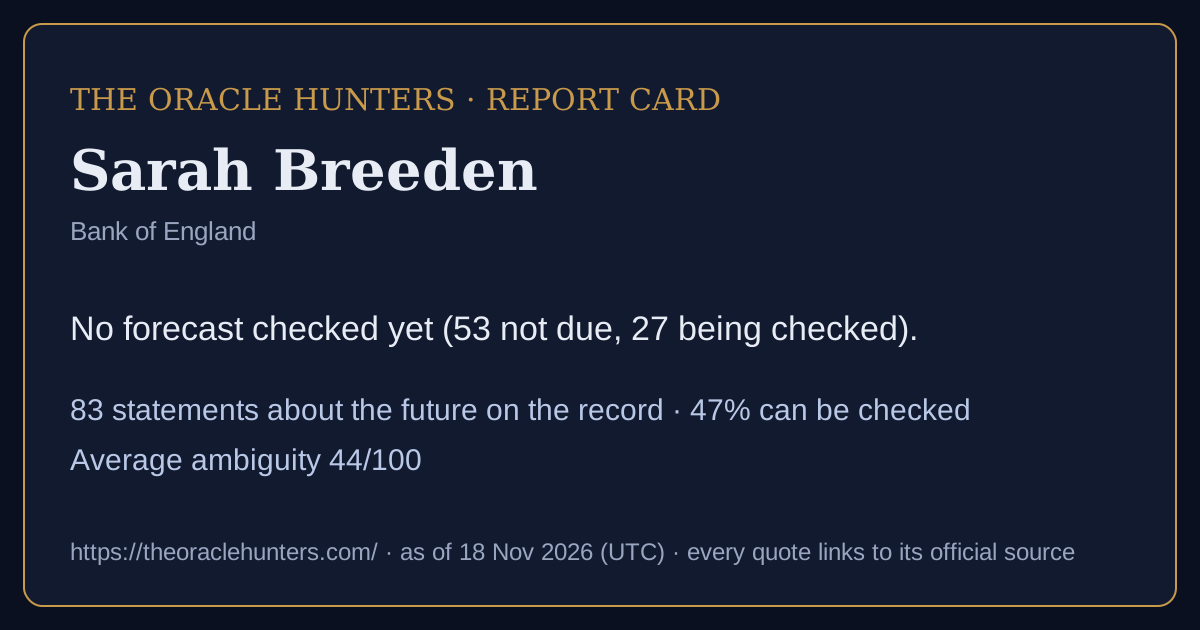
Sarah Breeden
Bank of England · GBR
Track record: No forecast checked yet (53 not due, 27 being checked).
83forecasts & commitments on the record
47%can be checked as stated
44average ambiguity (0-100)
0goalpost moves recorded
0confirmed U-turns
Timeline
came true partly did not not due / being checked / too vague
Calibration score: shown after 10 checked forecasts with a stated likelihood (now 0).
How they speak about the future: based on data 43, stated on authority 32, educated guess 8.
Kinds of claim: forecast 53, mixed claim 17, scenario (if… then) 6, commitment 5, speculation 1, call for action 1. · Download this report card as a picture
In the nine words
πρόγνωσιςInference from evidence42 · 51%μαντείαInspired knowledge26 · 31%πρόνοιαPreparing for the future7 · 8%προαναγγελίαPublic pre-announcement4 · 5%εἰκασίαConjecture3 · 4%φρόνησιςPractical wisdom1 · 1%
How to read this
Each box is one sentence a public figure or institution said about the future, word for word, with a link to the official text. Can be checked means it names what will happen, by when, and how likely - so it can be compared with official figures later. Too vague to check means it does not. Ambiguity (0-100) is how many different ways the sentence can be read. When the date passes, the forecast is compared with official data and marked came true, partly or did not come true. Labels judge the sentence, never the person. Full guide and glossary.On the record (83)
If AI agents respond similarly to the same prompts or triggers, they could amplify volatility in stress – especially if their objectives drift from original goals or public policy objectives, in a manifestation of the misalignment problem that can arise with some AI models.footnote
If AI agents respond similarly to the same prompts or triggers, they could amplify volatility in stress - especially if their objectives drift from original goals or public policy objectives, in a manifestation of the misalignment problem that can arise with some AI models.
Responses to the Call for Input will help shape that work and feed into a roadmap across authorities, industry and the Champion by year-end.
For systemic stablecoins, the Bank will publish draft rules next month and finalise them by year-end, in line with the US timeline.
We will engage with industry on the detail through a discussion paper later this year.
We will work with firms and authorities on next steps and provide a comprehensive update in early 2027.
This year we will conduct our second SWES focused on private markets, bringing together alternative asset managers, large banks and institutional investors such as insurers and pension funds (Bank of England, 2025).
This year we will conduct our second SWES focused on private markets, bringing together alternative asset managers, large banks and institutional investors such as insurers and pension funds ( Bank of England, 2025).
- ¥ digital money issued by non-banks (that is, systemic stablecoins, where we will finalise a regulatory regime this year to ensure they have the robustness of money when used in real-world payments); and footnote
Significant and rapid outflows of bank deposits into such stablecoins could lead to a precipitous drop in credit for businesses and households if the banking system were unable to increase, at scale and at pace, its use of wholesale financing from non-banks (insurers, funds etc).
That will put us in a position to finalise our regulatory regimes next year Ð as is the aim in the US.
The FCA consulted on its detailed requirements for stablecoins in May this year.
Synchronisation functionality, which will allow central bank money to be fully integrated with wholesale tokenised transactions, will initially launch next year in our Synchronisation Lab, to enable testing of real-world use cases.
We will be consulting on the precise details of this and other parts of the BankÕs requirements later this year.Ó
We will consult later this year on our requirements for sterling-denominated stablecoins used in systemic payment systems.
Indeed, the MPC had been forecasting a pick-up in inflation over 2025 since the time of the February MPR, with inflation then expected to rise to 3.5% in June and to peak at around 3.7% in Q3 (Figure 1).
Looking further ahead, wage growth is expected to fall back further over 2026.
While we expect inflation to begin to fall back from next month and gradually return to target thereafter, it is right that we question the risks around this projection.
This should, in turn, pass through to lower services price inflation next year.
For example, 3.4 million mortgage holders expect to see an increase in payments over the next three years, compared to 2.8 million expecting a decrease (Figure 9).
The latest intelligence from our Agents however continues to suggest that pay growth will fall back to around 3.7% by the end of the year - a level that is consistent with the latest data on pay settlements too.
Later this year PVDC will publish its strategy and a Payments Forward Plan.
Trust in money is our core concern - and we will be laser focused on ensuring that it is preserved, whilst also ensuring new technologies and innovations drive economic growth and better outcomes for the businesses and consumers who use payments every day.
And, as I discussed earlier this year, interoperability and harmonisation could lay the necessary groundwork for much needed improvements in cross-border payments.
A steady and reliable supply of credit to the real economy is a key enabler of economic growth and is an area we will remain focused on as innovation in money progresses.
This blueprint, due to be published next year, will set out the key design elements necessary to support the Bank and HM Treasury in assessing the policy case for a digital pound.
And next year we will launch our synchronisation lab that will allow central bank settlement to be fully integrated with transactions happening on other ledgers - again including programmable and distributed ones.
Our November 2024 Financial Stability Report found that in the most pessimistic climate scenarios, the 1% of properties most exposed to increases in flood risk could lose around 20% of their value.
Scenario analysis undertaken by Bank staff suggests that a portfolio of long-duration G7 sovereign bonds could lose 10-20% of its value given interest rate risk and increasing risk premia (depending on the scenario). Corporate credit spreads could widen, making the repricing of corporate asset classes even more significant. footnote
We estimate that around 1 percentage point of both the increase and subsequent fall in headline inflation over the 2021-23 period is likely to have originated from these changes to carbon policy (Chart 2, RHS).
The London Stock Exchange Group (LSEG) UKA forecast (green dots) is in normal terms (adjusted for 2% inflation)
Under current Government plans, all commercial property will need an EPC rating of B or above by 2030. 83% of commercial buildings in major cities currently fall below that standard.
In a study for the ECB, Kotz et al (2023) show that without adaptation measures, global food price inflation might increase by 1-3pp by 2035, increasing pressures on headline inflation by between 0.3-1.2 pp.
Some estimates suggest that the total value of cross-border payments could reach nearly $290 trillion by 2030, up over 50% on last year. 3
In 2024, however, carbon costs which amounted to roughly 50% of the fuel costs for gas-fired electricity producers in the UK were a major driver of prices. Overall we might expect close to 100% of carbon costs naturally to be passed on in wholesale market prices.
As I mentioned earlier, a 1 percentage point upwards revision in the output gap, which is roughly what we have here, might push up on inflation by 0.3 to 0.4 percentage points.
medium-term inflation, via the Philips curve. A rough rule-of-thumb might map a 1 percentage point increase in the output gap into around a 0.3 to 0.4 percentage point increase in inflation a year or so later.
In December I judged that the evidence supported maintaining Bank Rate at 4.75% and that recent developments supported the case for a gradual approach to the withdrawal of policy restrictiveness in the coming months.
A more sophisticated cross check using a model built by Bank staff confirms that demand shocks may have turned negative in Q3 of this year, having been more positive at the start of the year ( Chart 7 ).
Taken at face value, on their own these revisions might imply higher inflation next year and into 2026 by up to 1 percentage point.
Our cooperation can also strengthen our collective resilience should bad actors try to use AI to destabilise the financial system, including through cyber attacks.
Indeed, the FPC will publish early next year its assessment of AI's impact on financial stability and set out how it will monitor the evolution of those risks.
As we do so, we will work with the UK Financial Conduct Authority (FCA), the government and international counterparts - to support AI's safe adoption as the best contribution we can make to harnessing its benefits for growth.
AI could also increase the probability of existing interconnectedness turning into financial stability risk - in particular through cyber-attacks.
If it were possible to bring about a situation where both resilience and growth could be increased, that outcome would lie on a higher indifference curve than the one shown in figure A, indicating that it would be a preferred outcome for financial stability policymakers.
This will also support HM Treasury's work this year in setting out a National Payments Vision .
Later this year, it will transition to a more resilient and capable core settlement engine (including with capability to move to near 24/7 operation in future).
Our work over the next two years or so will be focused on making a robust and objective assessment of potential benefits and costs, including operational and technical feasibility.
There it is already at rates close to 4% compared to over 6% in the UK, probably reflecting differences in wage growth, which is higher in the UK than elsewhere.
Starting with inflation, headline CPI inflation ended the year at 4.0% in December — a little over half a percentage point lower than we expected at the time of the November Monetary Policy Report (MPR) and down from over 11% at its peak in October 2022.
Showing the newest 50 - the ledger has all 83.
Also said - not checkable as stated (12 newest)
Remarks about the future with no date, figure or likelihood that could be checked. They are kept on the record and shown here, but not scored.
For some years, central banks, including the Bank of England, have worked to promote responsible AI adoption in the financial system.footnote And since AI looks likely to be the next ‘general purpose technology’ and a key source of long-term economic growthfootnote , it’s in all our interests to do so.
In 2019, the length of software task the latest AI models could complete doubled roughly every seven months.footnote In 2024, that had sped up to around four months.footnote Major advances this Spring in models for identifying cyber vulnerabilities suggest it may now be faster still.footnote
The financial system looks likely therefore to evolve quickly into one that operates more autonomously, at scale and speed: AI agents transacting on behalf of consumers and merchants; devising and executing trading strategies in financial markets; and identifying and chaining together cyber vulnerabilities.
That will of course require central banks to respond.
The Bank’s Financial Policy Committee will publish its updated assessment on 7 July, so I won’t front-run that.
For some years, central banks, including the Bank of England, have worked to promote responsible AI adoption in the financial system. And since AI looks likely to be the next 'general purpose technology' and a key source of long-term economic growth, it's in all our interests to do so.
In 2019, the length of software task the latest AI models could complete doubled roughly every seven months. In 2024, that had sped up to around four months. Major advances this Spring in models for identifying cyber vulnerabilities suggest it may now be faster still.
The Bank's Financial Policy Committee will publish its updated assessment on 7 July, so I won't front-run that.
We will soon publish our approach to the stablecoins permitted for use in the DSS, shortly after publication of our draft rules for systemic sterling stablecoins.
We will work with firms to ensure the DSS supports innovation and ensure there is a clear pathway for firms inside it to move out into permanent authorisation.
In that way, as technology evolves, we will deliver our vision of both a robust, multi-money retail payments system – offering trust in money, competition, choice and innovation – and a multi-asset, multi-currency wholesale ecosystem that builds on the UK’s long-standing strengths as a global financial centre.
We will consult on that design shortly. footnote