Sarah Bloom Raskin
Federal Reserve · USA
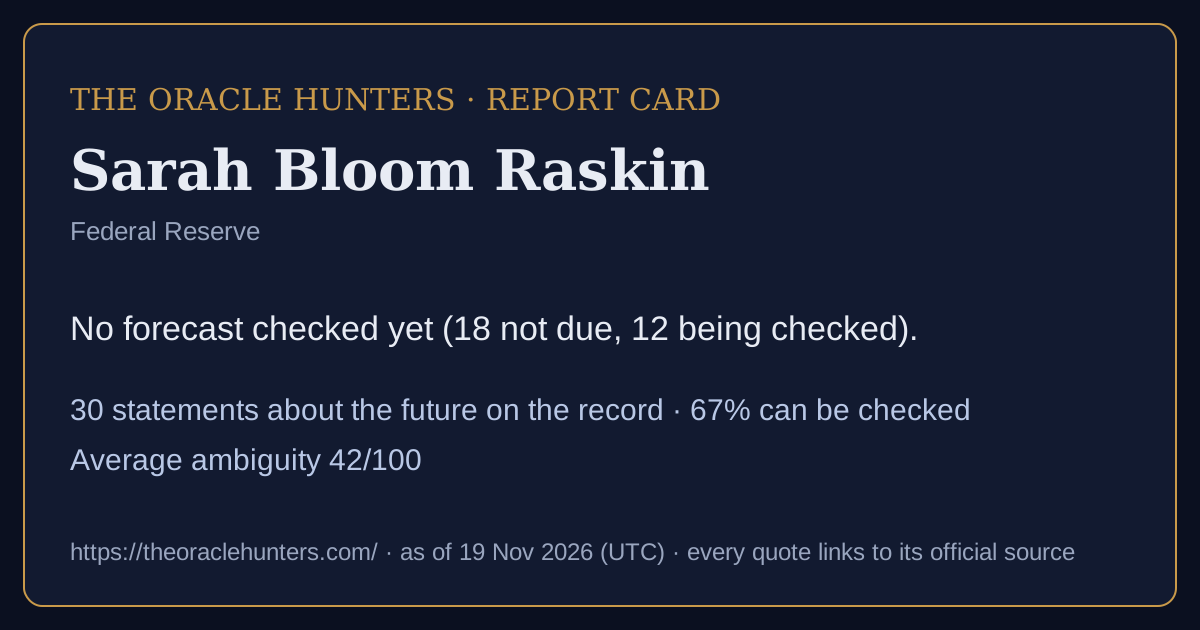
Track record: No forecast checked yet (18 not due, 12 being checked).
30forecasts & commitments on the record
67%can be checked as stated
42average ambiguity (0-100)
0goalpost moves recorded
0confirmed U-turns
Timeline
came true partly did not not due / being checked / too vague
Calibration score: shown after 10 checked forecasts with a stated likelihood (now 0).
How they speak about the future: based on data 22, educated guess 5, stated on authority 3.
Kinds of claim: forecast 24, scenario (if… then) 4, mixed claim 2. · Download this report card as a picture
In the nine words
πρόγνωσιςInference from evidence22 · 73%πρόνοιαPreparing for the future4 · 13%μαντείαInspired knowledge3 · 10%εἰκασίαConjecture1 · 3%
How to read this
Each box is one sentence a public figure or institution said about the future, word for word, with a link to the official text. Can be checked means it names what will happen, by when, and how likely - so it can be compared with official figures later. Too vague to check means it does not. Ambiguity (0-100) is how many different ways the sentence can be read. When the date passes, the forecast is compared with official data and marked came true, partly or did not come true. Labels judge the sentence, never the person. Full guide and glossary.On the record (30)
If these conditions seem likely to continue, an initial rise in the asset's price leads to expectations of further increases, which adds to investor demand, spurring further borrowing and credit growth and increased household and financial sector leverage, which, in turn, could drive asset prices still higher.
If many investors employ this strategy and they borrow to invest in the same asset, the price of that asset, and perhaps the prices of closely related assets as well, will increase noticeably faster than the historical trend.
Meanwhile, since Basel III sets a final deadline for implementation of 2019, one might ask why it is so imperative to act sooner.
The bank probably had no more than $30 million in assets.
Specifically, we said that we anticipate that an exceptionally low funds rate is likely to be warranted at least as long as the unemployment rate remains above 6‑1/2 percent, inflation over the period between one and two years ahead is projected to be no more than 1/2 percentage point above 2 percent, and longer-term inflation expectations remain well anchored.
Meanwhile, inflation was expected to remain close to or a little below the Committee's objective of 2 percent, consistent with ongoing slack in the labor and product markets and well-anchored inflation expectations.
As I already mentioned, both the tax legislation signed into law in January and the sharp spending cuts associated with sequestration will likely significantly hinder GDP growth this year.
In the projection, participants also expected the unemployment rate to be in the range of 7.3 to 7.5 percent by the end of the year.
According to the Summary of Economic Projections that was released by Federal Reserve Board members and Reserve Bank presidents after the March FOMC meeting, my colleagues and I expected real GDP growth to step up moderately this year, rising roughly 2-1/2 percent after having risen 1‑3/4 percent in 2012.
Indeed, the Congressional Budget Office has estimated that these changes in fiscal policy would reduce GDP growth by 1-1/2 percentage points this year relative to what we otherwise would have achieved.3 Looking further ahead, fiscal policy seems likely to remain restrictive at the federal level.
In a 2011 McKinsey Global Institute U.S. Jobs Survey of 2,000 employers of all sizes and in all sectors, 34 percent of employers indicated that they expect their companies to increase temporary and contract workers over the next five years.
And inflation is expected to run at or below our 2 percent longer-run goal.
The FOMC judged that economic conditions, including the outlook for low rates of resource utilization and subdued inflation over the medium run, are likely to warrant exceptionally low levels of the federal funds rate at least through late 2014, more than a year later than it had indicated in the postmeeting statements starting last August.
Looking forward, the projections that the Federal Open Market Committee (FOMC) prepared in late January show real GDP increasing 2.2 to 2.7 percent this year, not much different from its pace in the second half of last year.
The moderation in consumer price inflation continued in January, but gasoline prices have been rising again of late, which will likely push up overall inflation in coming months.
But if I wanted to cut back the number of pages and still accumulate enough to go to the movies sometime, I would need to find an interest rate out there for my earnings of three or more times what the bank was offering--not likely for a very young investor with limited funds.
I knew as a kid, however, that in order to buy a ticket to go to the movies with my friends, I was going to have to number around 400 pages, and if I did more pages than that and invested the money in a savings account at a bank at a compounded annual interest rate of 4-1/2 percent, I …
If times were more typical, we would expect a smooth transmission in which lower interest rates would fuel credit expansion that would be used to finance expanding payrolls, capital investment, inventories, and other short-term operating expenses.
In particular, the federal funds rate target, which stood at 5‑1/4 percent in mid‑2007, was subsequently reduced to a range of 0 to 1/4 percent by the end of 2008, and that target range has been maintained since then.
By the end of 2009, the unemployment rate reached a horrifying 10 percent, corresponding to more than 15 million Americans being out of work, with all of the attendant social consequences--including lost income and wealth, mortgage foreclosures, family strains, health problems, and so on.
In its November survey, the National Federation of Independent Business continued to indicate a sizable proportion of small businesses reporting that credit has become more difficult to obtain.2 These businesses not only expect credit to become tighter in coming months but--like other businesses--remain concerned about the broader economic outlook.
Indeed, because currency has an implicit interest rate of exactly zero, economists generally agree that a zero interest rate is the effective lower bound for the federal funds rate because investors could simply choose to hold cash if a central bank tried to drive short-term interest rates significantly below zero.
In particular, the federal funds rate target, which stood at 5-1/4 percent in mid-2007, was subsequently reduced to a range of 0 to 1/4 percentage point by the end of 2008, and that target range has been maintained since then.
By the end of 2009, the unemployment rate reached a horrifying 10 percent, corresponding to more than 15 million Americans being out of work, with all of the attendant social consequences, including lost income and wealth, mortgage foreclosures, family strains, health problems, and so on.
As indicated in figure 2c of the June 2011 Summary of Economic Projections, 11 out of 17 Committee participants projected a longer-run inflation rate for personal consumption expenditures of 2 percent while the remaining participants' projections were a bit below 2 percent.
Based on their longer-run projections for inflation, Committee participants judge that an inflation rate of 2 percent or a bit less, as measured by the price index for personal consumption expenditures, is most consistent with our statutory mandate of maximum employment and price stability.3 The Committee currently strives for as low an unemployment rate as possible, consistent with price stability.
That spread had widened substantially since earlier this year, and the continuation of such a trend could have pushed up mortgage rates and adversely affected the housing sector.
The headline unemployment rate was 9.1 percent in May, representing about 13.9 million Americans out of work.
With real estate owned (REO) inventories projected to reach one million by the end of 2010, servicer actions will heavily influence the effectiveness of neighborhood stabilization efforts at a time of persistent decline in home values and in fragile markets already weakened by a glut of vacant and abandoned properties, particularly in low-wealth communities.
Our projections remain very grim for the foreseeable future: All told, we expect about two and one-quarter million foreclosure filings this year and again next year, and about two million more in 2012.
Also said - not checkable as stated (12 newest)
Remarks about the future with no date, figure or likelihood that could be checked. They are kept on the record and shown here, but not scored.
A loss of confidence that is institution-specific could spread, causing other institutions to experience their own heightened solvency risks, liquidity problems, and need to de-lever through asset sales.
There is no question but that a higher quantity and quality of bank capital will strengthen the banking system.
If investors have access to credit, they might try to raise the return on their money by funding a greater portion of their purchases with debt.
At the same time, increased demand for credit to finance these asset purchases could lead lenders to increase their reliance on less expensive, unstable short-term funding, such as uninsured deposits, commercial paper, or repo transactions, in order to fund the loans.
In particular, we have seen that highly capitalized banks are more likely to maintain their lending activity through good times and bad, as evidenced during the recent crisis, a trend that helps their customers and the overall economy.5 A framework requiring higher quality and quantity of capital should be established post-haste.
In simple terms--and I should caution that reality is seldom this simple--if an institution has a leverage ratio of 3 percent, a decline in value of assets on the balance sheet of greater than 3 percent is likely to render the institution insolvent.
Regulators are also continuing to oversee improvements to the operational problems in the massive numbers of foreclosures in the wake of the financial crisis and exploring the risks to financial stability that may persist in the differentially regulated parts of our financial system.
What is not happening--what in fact may be difficult to achieve until this post-crisis work is near completion and the overarching goal of financial stability has been addressed--is a more proactive inquiry and articulation of a positive vision of what kind of financial system we want to foster or preserve.
Instead, my remarks today are specifically focused on adding to the conversation about how such disparities in income and wealth could be relevant for a macro understanding of the financial crisis and the recovery and the appropriate course of monetary policy today.
Thus, as in past recessions, suffering in the Great Recession--though widespread--was most painful and most perilous for low- and middle-income households, which were also more likely to be affected by job loss and had little wealth to fall back on.
Of course, it is not part of the Federal Reserve's mandate to address inequality directly, but I want to explore these issues today because the answers may have implications for the Federal Reserve's efforts to understand the recession and conduct policy in a way that contributes to a stronger pace of recovery.
The unexpected drop in house prices on its own reduced both households' wealth and their access to credit, likely leading them to pull back their spending.