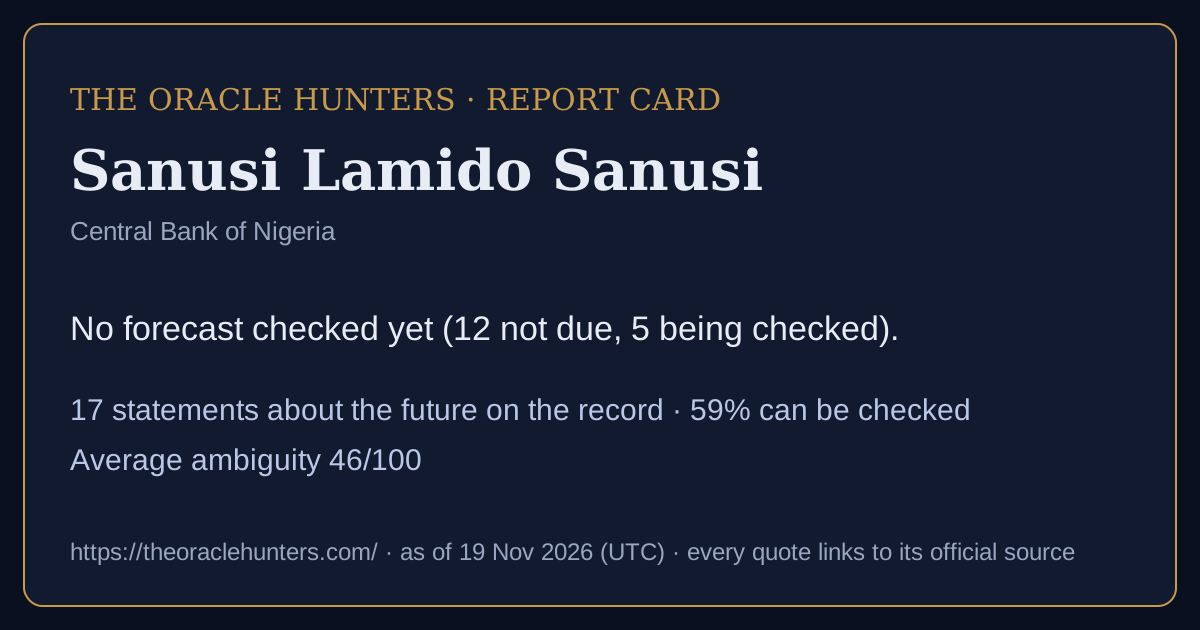
Sanusi Lamido Sanusi
Central Bank of Nigeria
Track record: No forecast checked yet (12 not due, 5 being checked).
17forecasts & commitments on the record
59%can be checked as stated
46average ambiguity (0-100)
0goalpost moves recorded
0confirmed U-turns
Timeline
came true partly did not not due / being checked / too vague
Calibration score: shown after 10 checked forecasts with a stated likelihood (now 0).
How they speak about the future: based on data 15, stated on authority 1, educated guess 1.
Kinds of claim: forecast 15, mixed claim 1, scenario (if… then) 1. · Download this report card as a picture
In the nine words
πρόγνωσιςInference from evidence15 · 88%πρόνοιαPreparing for the future1 · 6%μαντείαInspired knowledge1 · 6%
How to read this
Each box is one sentence a public figure or institution said about the future, word for word, with a link to the official text. Can be checked means it names what will happen, by when, and how likely - so it can be compared with official figures later. Too vague to check means it does not. Ambiguity (0-100) is how many different ways the sentence can be read. When the date passes, the forecast is compared with official data and marked came true, partly or did not come true. Labels judge the sentence, never the person. Full guide and glossary.On the record (17)
This Fund will provide long-term low interest funding to eligible MFI, for un-lending to beneficiaries at single digit interest rates. 60% of the Fund is dedicated to businesses owned and managed by women.
In 2011, the real GDP growth rate stood at 5.2 per cent, while the population living below the poverty line is less than 4.0 per cent, with unemployment projected at 3.1 per cent.
The CBN shall contribute N50 billion annually to AMCON, while each of the participating banks shall contribute an amount equivalent to 0.3 per cent of its total assets annually into a sinking fund as at the date of their audited financial statement for the immediate preceding financial year.
Also, of the other liquidity injections approved by the CBN, N80.701 billion had already been disbursed under the Commercial Agricultural Credit Scheme (CACS), while N368.84 million had been paid by the Bank as its 6.0 per cent interest rebate obligation on 35 large scale agricultural projects under the Agricultural Credit Support Scheme.
Credit by non-intervened banks rose from N127,270 in April 2010 to N145,885 million in May 2010, and N218,904 million in October 2010, representing increases of 14.63 per cent and 50.1 per cent, respectively.
New credit to the economy increased from N145,459 million in April 2010 to N173, 807 million in May 2010, N345,998 million in June, 2010 representing increases of 19.49 per cent and 99.1 per cent respectively.
Projections by the National Bureau of Statistics (NBS), showed that real GDP in 2010 will grow by 7.85 per cent compared to 6.66 per cent in 2009.
With improvements in the agricultural and industrial sectors and the resultant improvement in household incomes, the building and construction sector and the wholesale and retail trade sectors would blossom and contribute as high as 24.0 and 22.0 per cent to the GDP in the near-to-medium term from 12.3 and 11.3 per cent in 2009.
Savings and investment will propel growth if and only if such other conditions as integrated commodity and developed financial (money and capital) markets, highly developed infrastructure, well-trained and educated workforce, the motivation to succeed, and an efficient government bureaucracy/institutions, etc. are prevalent.
Thus, the contribution of the oil and gas industry to the economy may recover from negative 1.33 per cent in 2009 to positive 4.0-5.0 per cent in the near-to-medium term.
In addition, in 2005 'Global Economics' Paper No. 134 published a list of eleven countries that could have the BRIC effect and achieve global economy-giant-status by 2025.
In a bid to address the problem of infrastructure deficit and enhance credit to the real sector, a total of N500.0 billion Fund was set up by the CBN made up of N300.0 billion for Power/Infrastructure projects and for intervention in the Aviation sector and N200.0 billion for the Refinancing/Restructuring of banks' existing loan portfolios to manufacturers and small and …
In the next three years, we will reduce overhead costs in the banking industry by 30%.
A 50% increase in exchange rate volatility leads to a 0.33% reduction in annual productivity growth; and a fixed exchange rate could add almost one percentage point to a country like Nigeria's annual GDP growth.
May I begin by thanking the Vice-Chancellor, the Senate and Congregation of this great university for the honour of inviting me to deliver this year's convocation lecture.
This process is on-going and we expect all banks to be totally weaned off CBN support by the end of Q3 2010.
The Bank will continue to pursue the payments system reforms as outlined in the Financial System Strategy FSS 2020.
Also said - not checkable as stated (12 newest)
Remarks about the future with no date, figure or likelihood that could be checked. They are kept on the record and shown here, but not scored.
Let me use this opportunity to urge the Nigerian financial institutions and other stakeholders here present, to support innovations and services that will enhance the success of the implementation of the EDC in the South-South.
- 3.0 In its bid to support efforts to reverse these glaring development challenges, the Central Bank of Nigeria has over the years, continued to partner with Government at all levels and some stakeholders to initiate policies, programmes and schemes that will impact the lives of youth in the country.
- 9.0 The State Government is expected to provide the enabling environment through the provision of conducive structure and a site for the centres, while the Central Bank of Nigeria engages private consultants to independently operate the centres.
It will assist in job and wealth creation, promote growth and
On this note, I declare the Central Bank of Nigeria- Entrepreneurship Development Centre South-South geopolitical zone opened and particularly expect the Centre to be a resourceful Entrepreneurship Centre for the teeming youths of the South-South geopolitical Zone.
Achieving these targets will require the collaborative efforts of all the stakeholders in the financial industry, and with this in mind the Central Bank of Nigeria has approved a number initiatives centered around improving inclusion some of which include;
The potential uses of a tool like this are limitless and the Central Bank of Nigeria is excited to be partnering with the Bill and Melinda Gates Foundation on this project which will act as a catalyst in the realization of the targets outlined in our National Financial Inclusion Strategy.
It is also important to note that the statistics provided from this mapping will enable Nigeria measure certain indicators and compare them across several countries providing for country by country comparison on progress of our inclusion efforts.
In conclusion, I believe that we are taking a very important step here today and the partnership between the Central Bank of Nigeria and the Bill and Melinda Gates Foundation will go a long way in ensuring that our efforts to realize the targets set are a success.
It is important to note, that Financial Inclusion efforts rely largely on data based evidence which is why tracking the progress of our National Financial Inclusion Strategy needs to be data driven.
For Nigeria, it is essential for the political leaders to be visionary and transformational, to be able to see, project and assemble a vision of a desired future for the nation.
The political stability should encompass adequate security to foster the requisite environment under which business and commercial activities can thrive.