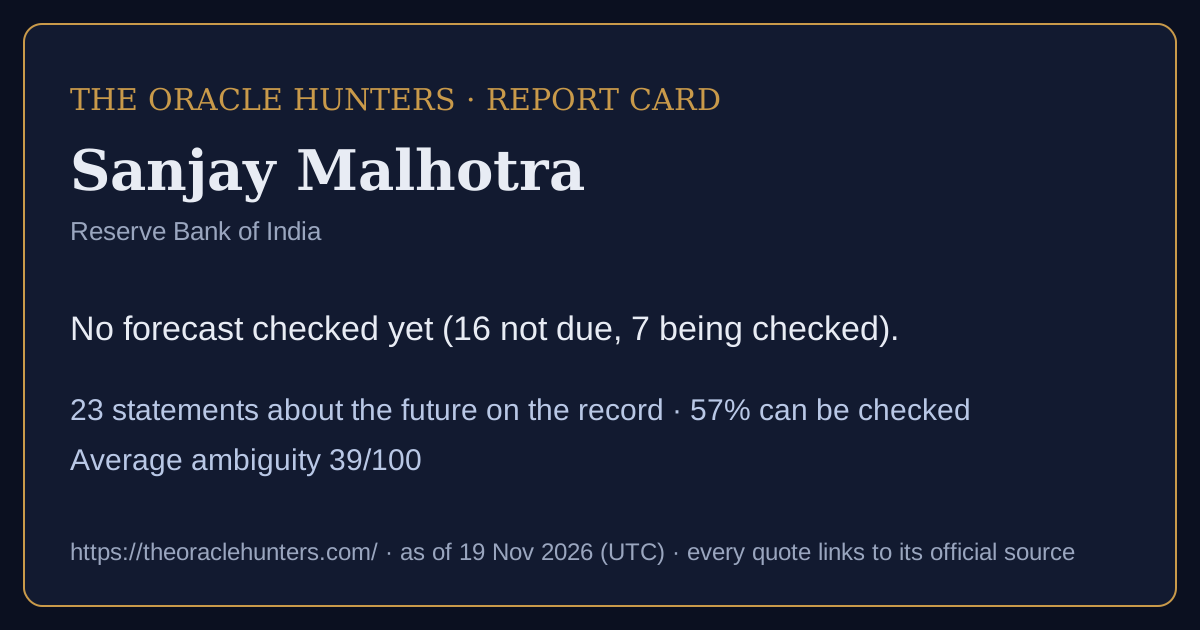
Sanjay Malhotra
Reserve Bank of India
Track record: No forecast checked yet (16 not due, 7 being checked).
23forecasts & commitments on the record
57%can be checked as stated
39average ambiguity (0-100)
0goalpost moves recorded
0confirmed U-turns
Timeline
came true partly did not not due / being checked / too vague
Calibration score: shown after 10 checked forecasts with a stated likelihood (now 0).
How they speak about the future: based on data 14, stated on authority 9.
Kinds of claim: forecast 16, commitment 4, mixed claim 3. · Download this report card as a picture
In the nine words
πρόγνωσιςInference from evidence14 · 61%μαντείαInspired knowledge5 · 22%προαναγγελίαPublic pre-announcement4 · 17%
How to read this
Each box is one sentence a public figure or institution said about the future, word for word, with a link to the official text. Can be checked means it names what will happen, by when, and how likely - so it can be compared with official figures later. Too vague to check means it does not. Ambiguity (0-100) is how many different ways the sentence can be read. When the date passes, the forecast is compared with official data and marked came true, partly or did not come true. Labels judge the sentence, never the person. Full guide and glossary.On the record (23)
The MSME entrepreneurs present here, may be individually small, but collectively contribute 31% of GDP, account for approximately 35% of manufacturing output, and represent close to half of India's merchandise exports , while sustaining livelihoods for over 32 crore people .
As for the Reserve Bank, our commitment to you is equally simple: we will continue to build the rails, reduce the friction, and stay in the room with you as this sector grows.
We shall continue to strive to create a conducive financial system for your growth and prosperity.
The sufficiently wide tolerance band of (+)/(-) 200 basis points around the inflation target of 4% provides the necessary policy space to accommodate supply shock induced volatility in the short run, while maintaining focus on the medium-term objective of price stability.
We have projected an average CPI inflation of 4.6 per cent for FY 27.
Growth in 2026-27 is projected at 6.9 per cent.
This has been embedded in our regulation making framework, which we formalised in May this year.
The proposed expected credit loss (ECL) framework for provisioning norms, announced in October this year 3 , is a good example of this evolution.
In doing so, FinTechs will not only secure their own growth but also play a pivotal role in driving progress and contributing to the vision of Viksit Bharat 2047.
First and foremost, we will continue strengthening financial stability.
We will continue to conduct monetary policy with the primary objective of price stability keeping in view the objective of growth.
Similarly, the FDI cap in the Insurance sector was raised from 49 per cent to 74 per cent, and as announced in the Union Budget 2025, it will further rise to 100 per cent - with the condition that the entire premium is invested within India.
4 It is projected to decline to 75.8 percent in 2030 (IMF World Economic Outlook, April 2025).
With more than 1,800 GCCs, the sector is expected to expand from $64.6 billion in 2024 to $110 billion by 2030.
Even this year, our growth is expected to remain robust at 6.5 per cent.
Even though we have projected a somewhat lower real GDP growth for FY26 at 6.5 per cent, India is still the fastest growing economy.
We will continue to work towards fulfilling our commitment to the effective implementation of the next phase of G20 roadmap towards inclusive cross-border payments by 2027.
One may argue that this amounts to only four complaints per thousand accounts per year as there are about 2.5 billion bank accounts.
Work on this repository is underway and we expect to launch it later this year.
During this year, the content and method of delivery of eBAAT will be reviewed, and a pilot will be conducted (in a large State) with the objective to reach a very large number of people in the most efficient way.
The Reserve Bank, as in the previous years, will be running multimedia campaigns around this year's theme.
Third, while in domestic payments, the success of UPI has propelled India to a leadership position with a share of 48.5 per cent in global real-time payments by volume 2 , we will endeavour to make cross-border payments more efficient.
This year too, we will continue our awareness activities.
Also said - not checkable as stated (12 newest)
Remarks about the future with no date, figure or likelihood that could be checked. They are kept on the record and shown here, but not scored.
I will therefore urge all of you and the fintech industry to focus on the broader purposes these tools must serve and realise their "potential to impact".
Many fintechs may be outside the perimeter of prudential regulation - and rightly so, since proportionate regulation should not burden early-stage innovation.
Our greatest contribution will therefore lie in exporting products, sharing approaches, public digital infrastructure, governance frameworks and institutional experience.
Looking ahead, the recommendations of the RBI's FREE-AI Committee, the draft framework on Model Risk Management, our work towards a comprehensive AI governance framework for the financial sector, and the recently constituted Quantum Secure and Adaptive Financial Ecosystem (Q-SAFE) Committee on quantum resilience reflect our commitment to anticipate technological change rather than merely respond to it.
Compliance with the Digital Personal Data Protection Act is the floor, not the ceiling, of what customers should expect from their bank.
We will continue to work on these areas.
You will need to invest in technology: IT infrastructure, talent, skilling and reskilling, forging sustainable partnerships and building governance structures.
### What We Expect, and What You Should Expect of Us
We shall continue to facilitate and catalyse development of common utilities such as MuleHunter and the proposed Digital Payments Intelligence Platform to strengthen fraud detection and safeguard the system.
It is a theme that, I believe, will define this decade of Indian banking as decisively as liberalisation defined the 1990s and digitalisation defined the 2010s.
We will continue to work with all stakeholders to ensure that the financing needs of the MSMEs are met fully.
If I may draw an analogy that will resonate with many of you: just as UPI transformed how this country moves money - instantly, digitally, and without friction - we believe that Unified Lending Interface has the potential to do the same for how this country accesses credit.