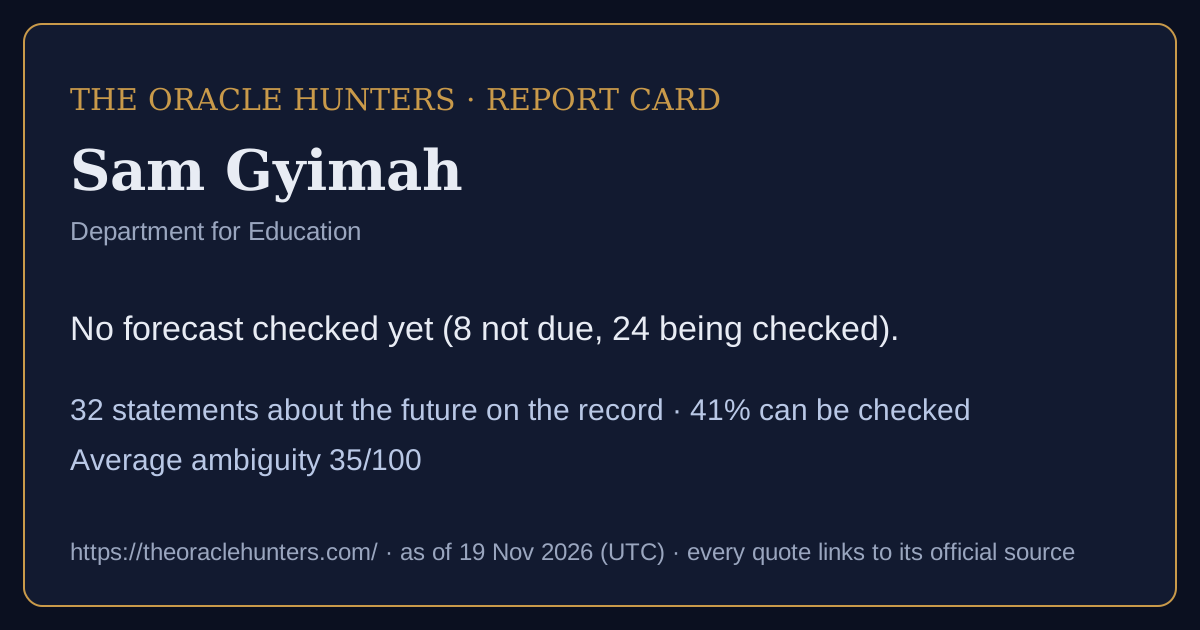
Sam Gyimah
Department for Education · GBR
Track record: No forecast checked yet (8 not due, 24 being checked).
32forecasts & commitments on the record
41%can be checked as stated
35average ambiguity (0-100)
0goalpost moves recorded
0confirmed U-turns
Timeline
came true partly did not not due / being checked / too vague
Calibration score: shown after 10 checked forecasts with a stated likelihood (now 0).
How they speak about the future: based on data 26, stated on authority 3, educated guess 3.
Kinds of claim: forecast 22, mixed claim 4, commitment 3, scenario (if… then) 3. · Download this report card as a picture
In the nine words
πρόγνωσιςInference from evidence24 · 75%πρόνοιαPreparing for the future3 · 9%προαναγγελίαPublic pre-announcement3 · 9%μαντείαInspired knowledge2 · 6%
How to read this
Each box is one sentence a public figure or institution said about the future, word for word, with a link to the official text. Can be checked means it names what will happen, by when, and how likely - so it can be compared with official figures later. Too vague to check means it does not. Ambiguity (0-100) is how many different ways the sentence can be read. When the date passes, the forecast is compared with official data and marked came true, partly or did not come true. Labels judge the sentence, never the person. Full guide and glossary.On the record (32)
And they could benefit further still – for example, from the BEIS Energy Innovation Programme, committing more than £500 million to help accelerate the commercialisation of innovative clean energy technologies and processes.
This sort of thing will only become more frequent, because back in January of this year we pledged more than £180 million from the Engineering and Physical Sciences Research Council to fund science and engineering research.
The role of universities as economic hubs, as magnets for investment and sources of support for businesses, will be vital if we want broadly based economic growth.
If we want to promote growth and opportunity across the country, universities’ local engagement will be more important than ever.
I’m keenly aware that the UK’s departure from the EU raises a variety of important practical issues that we and you are working together to address, from the future of ERASMUS+ to how UK researchers will participate in Horizon 2020 and Horizon Europe.
And it’s clear to me that our future plans for a tech-driven, high-growth economy will only succeed if we can take advantage of them.
Currently all Member States pay in to the pot to access Horizon 2020 and will continue to do so for Horizon Europe.
That is why we will remain a leading power in science and innovation, and why our Industrial Strategy has a target that 2.4% of our GDP will go to R&D funding by 2027.
The UK and EU Joint Report, published in December, sets out that UK entities’ right to participate in EU programmes, including Horizon 2020, will be unaffected by the UK’s withdrawal from the EU.
Of course, with or without the decision to leave the European Union in 2020 the current EU research programme will come to an end.
To provide further reassurance, in addition to agreement of the joint report, our commitment to guarantee the UK share of Horizon 2020 funding stands no matter the outcome of negotiations so all successful Horizon 2020 bids submitted while the UK remains a member state will be able to continue with an uninterrupted flow of funding.
As underlined in December by the joint report published by EU and UK negotiating teams, UK-based organisations and people will be able to bid for Horizon 2020 funding and lead and participate in consortia in 2019 and 2020.
The challenges we will face in the years to come – from clean growth and an aging population to the future of transport and the advancement of AI and robotics – will only be met by a concerted research and innovation effort as I’m sure you’re all aware.
We have begun this process with the biggest increase in public R&D funding for 40 year, ensuring that public spending on R&D will rise in every year of this parliament to around £12.5 billion in in 2021/22.
This will start in April this year and will encourage innovation and build on the work already undertaken in the 6 reform prisons.
And I expect to see a significant improvement by the end of this year.
Soon you will discover more details of our plans for prison safety and reform in a White Paper – the blueprint for change up to 2020 and beyond.
In September the early implementers will mean that working parents of 3- and 4-year-olds in some areas of the country will be able to use 30 hours of free childcare, with the national roll-out following a year later in 2017.
That’s why we’re making sure that from September 2016 parents in schools will have a right to request wraparound childcare - before and after school, and during the school holidays.
Early implementation pilots will mean this will happen earlier - in 2016 - in some parts of the country.
In addition to this, from September 2017, working parents of 3- and 4-year-olds will be able to get 30 hours a week of free childcare, worth up to £5,000 per child a year.
We will build on existing successes - such as the 96% take up of the existing 3- and 4-year-old offer - to continue developing a childcare system which delivers for families.
As the Chancellor announced at the Spending Review, we are committed to ensuring that funding is allocated in the fairest way and we will consult on an early years national funding formula next year.
By 2019 to 2020 we will be spending over £6 billion to support parents with childcare, £1 billion more per year, covering the free entitlements for 2-, 3- and 4-year-olds, Tax-Free Childcare, and the childcare element of the Universal Credit, which will provide support of up to 85% of childcare costs.
Tax-Free Childcare will be rolled out in 2017.
By channelling £5 million of government funding into partnering teaching schools with local nurseries, we will improve both the quality of the workforce and sharing of best practice.
almost half of nurseries expect business conditions to improve by mid-2015
in fact, demand may increase by as much as 15% by 2015 to 2016
Tax-free childcare expenditure is forecast to rise to £990 million per year by 2018 to 2019.
And, when tax-free childcare is introduced in autumn 2015, the government will pay for a further 20% of childcare costs per child, capped at £2,000 a year, and benefiting 2 million families with children up to 12 years of age.
This will help them take on at least 50 new children’s centres and nurseries over the next 3 years, offering subsidised nursery places and support to more than 15,000 new families each year.
There’s the tax-free childcare scheme starting in autumn 2015 - which will see an extra £750 million going to parents to spend on childcare - to help either cut their childcare bill or buy more hours of care.
Also said - not checkable as stated (12 newest)
Remarks about the future with no date, figure or likelihood that could be checked. They are kept on the record and shown here, but not scored.
Not only will these developments help in the global fight against climate change, they’ll also mean more business for the winners and, we hope, new trade and investment opportunities between our two nations.
We’ll be bringing together innovators from both countries to demonstrate our shared ability to aggregate and manage distributed generation, energy storage and flexible loads in future energy systems so that we can learn to respond to greater demand, complexity and volatility that our future energy grid will face.
Today, alongside the Department for International Trade, we’re launching a brochure which highlights the impressive breadth and depth of the capability which British companies offer, allowing potential partners from around the world to see where they might be able to complement UK expertise and experience, bringing together the brightest and best from around the world to work in partnership with …
Lastly, with clarity and simplicity in mind, today we launch a data visualisation tool which will show the different clean energy projects funded by our innovation funding programmes.
That debate is about the future of the UK – about our place in the world, how we will thrive as a nation, and the sort of country we aspire to be.
We will need to build on universities’ track record of improving access for those from the most deprived backgrounds.
Universities’ research mission will also be vital for the kind of Britain we need to create.
And we need to set a direction that will sustain us not just for the next 9 months, but for the next 30 years.
I will be asking the Government Office for Science to work with UKRI and the Better Regulation Executive in the coming months to develop this.
But there is one other attribute we will need to draw on - and that is ambition, and the can-do spirit.
Take Artificial Intelligence - the UK is already home to some of the biggest names in the business, such as Deepmind, Swiftkey and Babylon, and we have seen an acceleration of VC investment in UK AI businesses that will provide the next wave of world-class businesses.
I want to see to N8 Alliance of Northern Universities become powerhouses of economic growth in their area, and to ensure we back innovation wherever it may be.