Sam Altman
OpenAI · USA
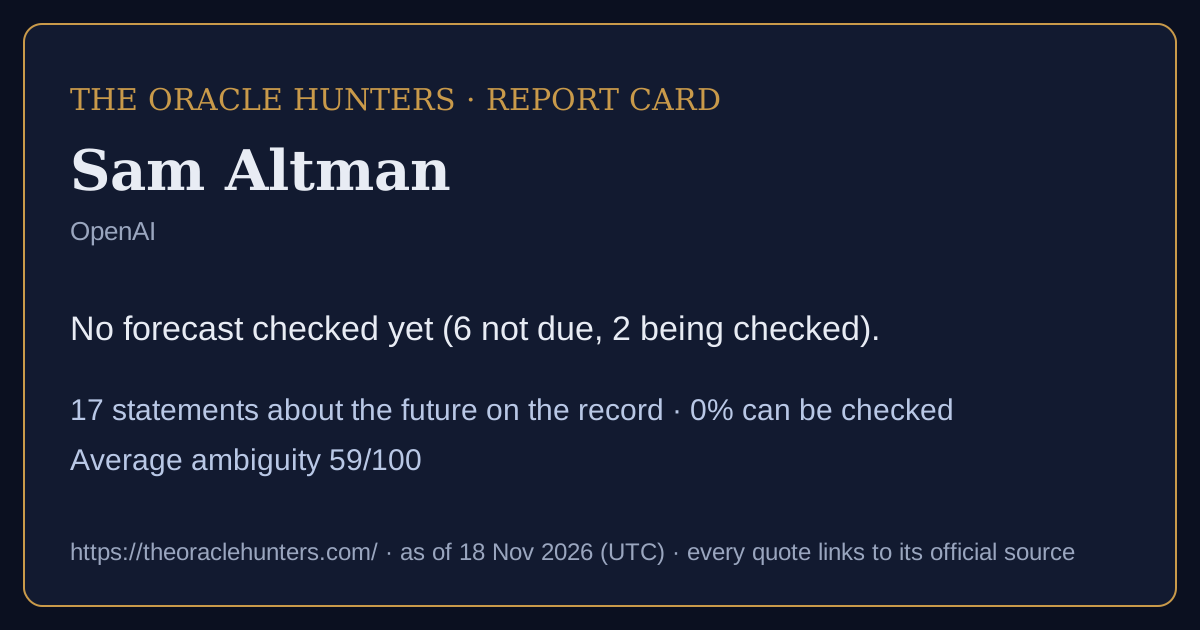
Track record: No forecast checked yet (6 not due, 2 being checked).
17forecasts & commitments on the record
0%can be checked as stated
59average ambiguity (0-100)
0goalpost moves recorded
0confirmed U-turns
Timeline
came true partly did not not due / being checked / too vague
Calibration score: shown after 10 checked forecasts with a stated likelihood (now 0).
How they speak about the future: educated guess 10, based on data 5, stated on authority 2.
Kinds of claim: speculation 7, mixed claim 3, forecast 3, call for action 3, scenario (if… then) 1. · Download this report card as a picture
In the nine words
εἰκασίαConjecture8 · 47%πρόγνωσιςInference from evidence5 · 29%πρόνοιαPreparing for the future4 · 24%
How to read this
Each box is one sentence a public figure or institution said about the future, word for word, with a link to the official text. Can be checked means it names what will happen, by when, and how likely - so it can be compared with official figures later. Too vague to check means it does not. Ambiguity (0-100) is how many different ways the sentence can be read. When the date passes, the forecast is compared with official data and marked came true, partly or did not come true. Labels judge the sentence, never the person. Full guide and glossary.On the record (17)
No one understands the impacts of superintelligence yet, but they will be immense.
If AI stays on the trajectory that we think it will, then amazing things will be possible.
Generally speaking, the ability for one person to get much more done in 2030 than they could in 2020 will be a striking change, and one many people will figure out how to benefit from.
2025 has seen the arrival of agents that can do real cognitive work; writing computer code will never be the same. 2026 will likely see the arrival of systems that can figure out novel insights. 2027 may see the arrival of robots that can do tasks in the real world.
We do need to solve the safety issues, technically and societally, but then it’s critically important to widely distribute access to superintelligence given the economic implications.
Humanity is close to building digital superintelligence, and at least so far it’s much less weird than it seems like it should be.
May we scale smoothly, exponentially and uneventfully through superintelligence.
It’s hard to even imagine today what we will have discovered by 2035; maybe we will go from solving high-energy physics one year to beginning space colonization the next year; or from a major materials science breakthrough one year to true high-bandwidth brain-computer interfaces the next year.
But public policy and collective opinion on how we should integrate AGI into society matter a lot; one of our reasons for launching products early and often is to give society and the technology time to co-evolve.
Although some industries will change very little, scientific progress will likely be much faster than it is today; this impact of AGI may surpass everything else.
We expect the impact of AGI to be uneven.
AGI will be the biggest lever ever on human willfulness, and enable individual people to have more impact than ever before, not less.
Superintelligent tools could massively accelerate scientific discovery and innovation well beyond what we are capable of doing on our own, and in turn massively increase abundance and prosperity.
We started OpenAI almost nine years ago because we believed that AGI was possible, and that it could be the most impactful technology in human history.
Helion has been progressing even faster than I expected and is on pace in 2024 to 1) demonstrate Q > 1 fusion and 2) resolve all questions needed to design a mass-producible fusion generator.
This is especially true if next year will be too late.
You should try to limit yourself to opportunities that could be $10 billion companies if they work (which means they have, at least, a fast-growing market and some sort of pricing power).
Also said - not checkable as stated (12 newest)
Remarks about the future with no date, figure or likelihood that could be checked. They are kept on the record and shown here, but not scored.
We are all learning about something new very quickly; some of our beliefs will be right and some will be wrong, and sometimes we will need to change our mind quickly as the technology develops and society evolves.
Laws and norms are going to change, but we have to work within the democratic process, even though it will be messy and slower than we’d like.
*AI will be the most powerful tool for expanding human capability and potential that anyone has ever seen.
The world deserves huge amounts of AI and we must figure out how to make it happen.
*AI has to be democratized; power cannot be too concentrated.
We are going to make two changes soon (and many more to come).
First, we will give rightsholders more granular control over generation of characters, similar to the opt-in model for likeness but with additional controls.
Second, we are going to have to somehow make money for video generation.
We are going to try sharing some of this revenue with rightsholders who want their characters generated by users.
We will experiment in the early days of the product with different approaches.
In addition to the mitigations we have already put in place (which include things like mitigations to prevent someone from misusing someone’s likeness in deepfakes, safeguards for disturbing or illegal content, periodic checks on how Sora is impacting users’ mood and wellbeing, and more) we are sure we will discover new things we need to do if Sora becomes very …
If that’s not the case, we will make significant changes (and if we can’t fix it, we would discontinue offering the service).