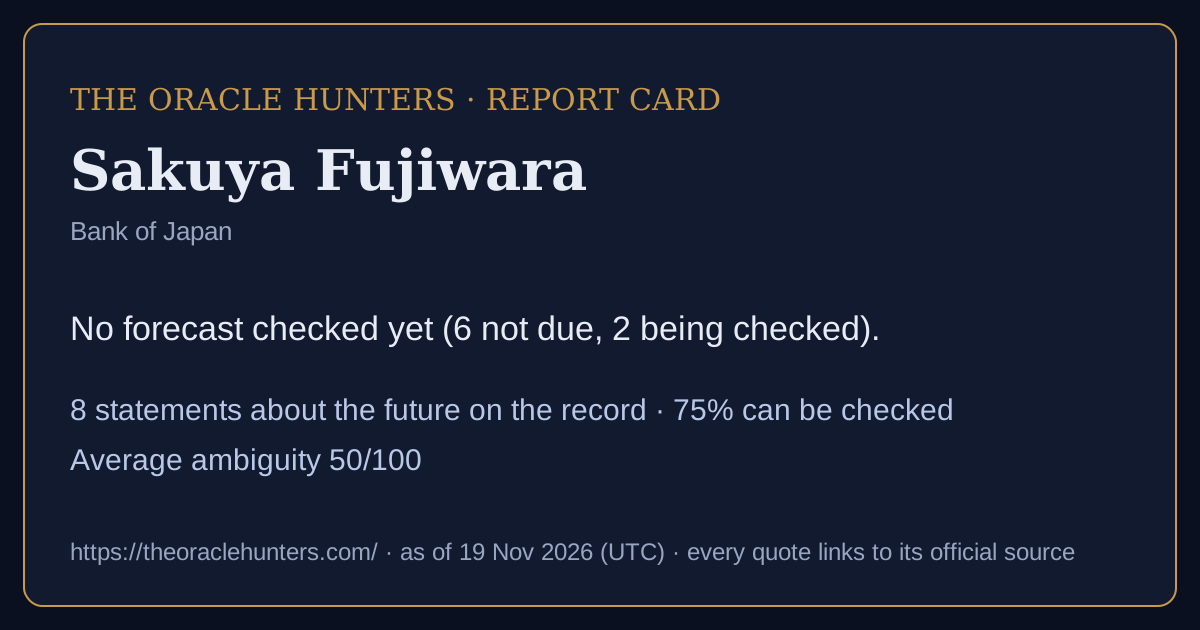
Sakuya Fujiwara
Bank of Japan
Track record: No forecast checked yet (6 not due, 2 being checked).
8forecasts & commitments on the record
75%can be checked as stated
50average ambiguity (0-100)
0goalpost moves recorded
0confirmed U-turns
Timeline
came true partly did not not due / being checked / too vague
Calibration score: shown after 10 checked forecasts with a stated likelihood (now 0).
How they speak about the future: based on data 3, educated guess 3, stated on authority 2.
Kinds of claim: forecast 4, scenario (if… then) 3, mixed claim 1. · Download this report card as a picture
In the nine words
πρόνοιαPreparing for the future3 · 38%πρόγνωσιςInference from evidence3 · 38%μαντείαInspired knowledge2 · 25%
How to read this
Each box is one sentence a public figure or institution said about the future, word for word, with a link to the official text. Can be checked means it names what will happen, by when, and how likely - so it can be compared with official figures later. Too vague to check means it does not. Ambiguity (0-100) is how many different ways the sentence can be read. When the date passes, the forecast is compared with official data and marked came true, partly or did not come true. Labels judge the sentence, never the person. Full guide and glossary.On the record (8)
However, if public investment generated by a fiscal deficit is inefficient, production capacity of the economy as a whole will not increase and the 'wealth' which generates future income and consumption will not accumulate.
According to textbook Keynesian economics, the expansion of fiscal expenditure financed by the issuance of government bonds will stimulate an economy unless taxpayers hold back consumption reflecting expectations of a future increase in the tax burden.
With such a commitment in place, the public's expectations with respect to when prices will start to rise will be adjusted if the economy further deteriorates.
In other words, under-subscription is an expression of financial institutions' views that 'liquidity has already been provided sufficiently so that there is no need for additional liquidity even at the rate of 0.01%.' Under-subscription was frequently observed from the beginning to the middle of May, and the Bank responded to such situations by reducing the unit for every bid to …
For example, in competitive yield auctions on May 21st to provide liquidity, while the Bank offered one trillion yen, financial institutions' bids were less than 400 billion yen even at a rate of 0.01%, virtually zero percent.
In addition, if considered necessary for the smooth provision of liquidity, the Bank will increase its outright purchase of long-term government bonds from the previous 400 billion yen per month subject to certain conditions.
At that time, mounting demand for New Year liquidity put an upward pressure on interest rates of the contracts maturing beyond the year-end, although there was a widespread perception that the overnight call rate would likely be near-zero for some time under the zero interest rate policy.
Yet, in view of the greater downside risks that I noted earlier, we cannot rule out the possibility that some negative news might trigger instability in financial markets or uneasiness on the part of market participants about fiscal year-end funding.
Also said - not checkable as stated (12 newest)
Remarks about the future with no date, figure or likelihood that could be checked. They are kept on the record and shown here, but not scored.
This wide range of information is extremely important in monetary policy decision-making, because the Bank must adjust monetary policy to changes in economic activity and financial markets while at the same time forecasting the likely effect of policy measures in the long term.
As you may be aware, my five-year tenure as Deputy Governor of the Bank of Japan is drawing to an end.
The Bank of Japan Law of 1997 mandates that the Bank's monetary policy shall be aimed, through the pursuit of price stability, at contributing to the sound development of the national economy, making it clear that the objective of monetary policy is to achieve price stability.
What is more, unexpected fluctuations in prices could cause serious losses to savers or borrowers.
This would not be fair, and could also have an adverse impact on the general level of economic activity.
I will try to describe the scene, and the atmosphere in which monetary policy decisions are formulated.
At the same time, we need to monitor carefully the impact that a slowdown in production and exports might have on the business decision-making with respect to investment for the next fiscal year, for the slowdown is a negative element in the corporate sector, which has led the entire economy to date.
We will therefore have to examine both economic and financial developments attentively and without preoccupation, in order to find out whether the market is excessively pessimistic or simply preceding economic fundamentals to come about.
In order to avoid any misunderstanding, I should hasten to add that we, at present, see no seizing up in corporate finance or any other particular area, or anomalies in interest rates on contracts maturing beyond the fiscal year-end.
The report is published twice a year and, in the case of the October 2000 issue, it covers the most likely scenario for fiscal years 2000 and 2001.
The Bank of Japan, as a central bank, must contribute to ensuring a stable macroeconomic environment through appropriate monetary policy measures, which will form the basis for creative and future-oriented corporate activity.
The start of real-time gross settlement of fund transfers and government bond transfers from the beginning of next year is one of such efforts.