Sajid Javid
HM Treasury · GBR
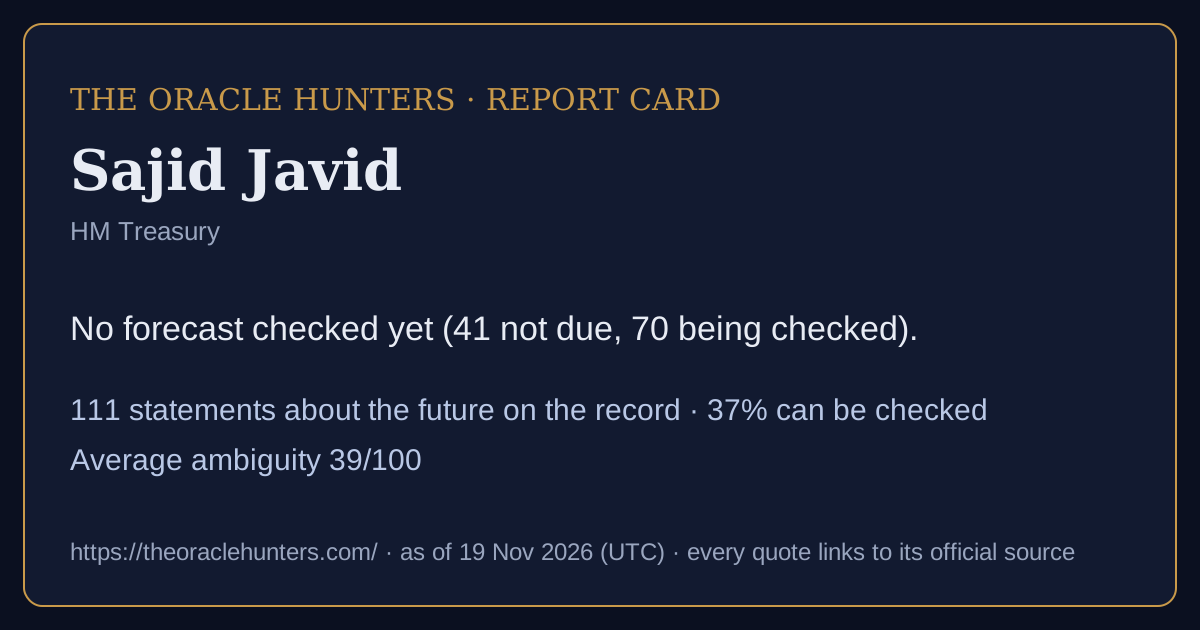
Track record: No forecast checked yet (41 not due, 70 being checked).
111forecasts & commitments on the record
37%can be checked as stated
39average ambiguity (0-100)
0goalpost moves recorded
0confirmed U-turns
Timeline
came true partly did not not due / being checked / too vague
Calibration score: shown after 10 checked forecasts with a stated likelihood (now 0).
How they speak about the future: based on data 69, stated on authority 39, educated guess 3.
Kinds of claim: forecast 76, mixed claim 22, commitment 8, scenario (if… then) 5. · Download this report card as a picture
In the nine words
πρόγνωσιςInference from evidence60 · 54%μαντείαInspired knowledge37 · 33%προαναγγελίαPublic pre-announcement8 · 7%πρόνοιαPreparing for the future5 · 5%εἰκασίαConjecture1 · 1%
How to read this
Each box is one sentence a public figure or institution said about the future, word for word, with a link to the official text. Can be checked means it names what will happen, by when, and how likely - so it can be compared with official figures later. Too vague to check means it does not. Ambiguity (0-100) is how many different ways the sentence can be read. When the date passes, the forecast is compared with official data and marked came true, partly or did not come true. Labels judge the sentence, never the person. Full guide and glossary.On the record (111)
At the moment, 86% of NHS trusts have a form of electronic patient record in place, and we’re on target to hit my aim of 90% by the end of next year, whereas just 45% of social care providers currently have any form of digital care records.
That means we will be able to cut waste, improve patient outcomes and prosperity, because, as I have said before, economic freedom and public health are mutually reinforcing.
The plan shows how we will effectively create a single, life-long digital health and care record for everyone, giving patients a chance to easily access their own data, with these records in place universally by 2024.
By the end of this year, those services will proactively communicate with bereaved families within days of a death to offer their support.
These trials have already shown to be a great success and I’m pleased to confirm today that we will now be rolling this initiative out nationally and it’ll be operational from early next year.
We’ve set out ambitious public targets to slash long waits in the coming years through the COVID-19 elective recovery plan, and we’re projected to meet the first of these targets by next month.
But demanding spending growth of this kind suggests that we will fail to reduce demand through prevention, early diagnosis and more effective care – as well as fail to increase health and care productivity with improved use of capital, skills, management, data and innovative models of care.
This important document, the new Data Strategy, it shows how we will keep accelerating and innovating, and working with tech innovators like you, to transform health and care for the better.
I have already given the NHS a new target of to ensure 90% coverage of Electronic Patient Records by the end of next year, and we are on track to hit that.
So we are now needing a radical programme of digital reform that will make sure the NHS is set up to meet the challenges of 2048 – not 1948, when it was first established.
But we must acknowledge that if health and care doesn’t keep up with the rapidly changing world around us, then we will get stuck in the slow lane, and we won’t be able to deliver the care that people deserve and expect.
To do this, I want us to be using the NHS number universally across adult social care, and by March 2024 we’ve set a target for at least 80% of all CQC-registered social care providers to have a digitised care record, which will be integrated with the wider shared care record.
Although it’s fantastic that the NHS already has seen 63% of English adults have downloaded the NHS app – last year I understand it was the most-downloaded free iPhone app in England – I’m determined to make sure this number for the app reaches 75% of all adults in England, and we will do this by adding much more functionality …
By 2025, 1 million people in the UK are expected to have dementia, and is expected to rise to 1.6 million by 2040.
With an increasingly ageing population – where nearly one in 7 people is projected to be aged over 75 by 2040 – and more and more comorbidities, technology can do so much to help people to live independent lives and minimise the time they spend in clinical settings.
So I want to accelerate the rollout of these vital records with a new approach, so that we hit 90% coverage by December 2023 – by the end of next year.
It’s also clear we simply need to build more units: and our continued investment of over £200 million in the Care and Support Specialised Housing Fund will accelerate the development of specialist affordable housing that meets the needs of older people and adults with disabilities or mental health challenges.
Our plan is to recover elective services over the coming years, so that by March 2024, 99 percent of people are waiting less than a year.
The new ‘Health Promotion Taskforce’ is joining up work with every part of government and I will launch a Health Disparities White Paper later this year to help prevent disease and reduce deep-seated inequalities.
I might not be here in 2032, but my successors – and, far more importantly, the British people – would never forgive me if we didn’t get started now.
This year, the NHS will spend its original 1948 budget, adjusted for inflation, once every month.
It will go directly to health and social care services across the whole of our United Kingdom, raising almost £36 billion over the next three years.
The National Institute for Health Research predicts that, on current trends, two in every three adults over 65 will live with multiple health conditions by 2035. 17 percent would be living with four or more diseases – double the number in 2015, and one-third of these would have a mental illness like dementia and depression.
It will take a far-reaching look at what we want cancer care to be in 2032 – ten years from now.
My ambition is for England to be smoke free by 2030 and this year we will publish a new Tobacco Control Plan for England setting out how we are going to get there.
And on Wednesday, we announced that we will be publishing a Health Disparities White Paper this year looking at how we can tackle the core drivers of inequalities in health and I see plenty of areas where we can level up disparities on cancer.
It’s estimated there will be almost half a million extra job opportunities in adult social care by 2035 – with more than 100,000 current vacancies to be filled.
So we will invest at least half a billion pounds into the social care workforce over the next three years.
This means that the NHS in England can deliver significantly more elective activity by 2024 to 2025 than it could even before the pandemic.
In the UK, children from the poorest 20% of households are 4 times as likely to have serious mental health difficulties by the age of 11 compared with those from the wealthiest 20% of households.
The NHS app, which lets you view your NHS Covid Pass, or book appointments – it’s now reached 16 million users, compared to 4 million in May.
The Government will also increase early years spending by £66million…
So I can announce today that councils will have access to new funding of £1.5 billion for social care next year.
Today we reaffirm our commitment to the NHS with a £6.2 billion increase in NHS funding next year.
…an increase in their capital budget to £620 million next year…
A prosperous Britain where we will live within our means and growth comes from every corner of this union.
Next year I will add £13.4 billion to the plans for total public spending, including £1.7 billion added to capital spending.
So I’m pleased to announce that later this year we will publish a national strategy covering our comprehensive response to all forms of Child Sexual Abuse.
The first interim codes will be published later this year.
For example, you might have heard or remember there was a conviction earlier this year after a victim was rescued by the British High Commission in Bangladesh.
We’ve also committed £50 million over the next year to boost cyber capabilities within law enforcement.
The Chancellor has also promised that, for example, mental health services will receive an additional £2 billion a year.
But also a commitment from the Chancellor that he and I will be working together to ensure that the police have the resources that they need for 2019/20 in time for the police settlement which is due in December.
…and I’m pleased to say that his father will collect his posthumous George Medal in Buckingham Palace next month.
And today I’m pleased to announce that £400,000 of this money will be used to support the proposal by Chief Constable Andy Rhodes and the College of Policing, to get a new wellbeing outreach prevention service on the road next month.
That’s why as a government we put over £50 million over the next year to boost cyber capabilities within law enforcement at a national, regional and local level.
I am pleased to announce that the next Five Country Ministerial meeting, which I will be chairing in the UK next year – will prioritise combating child sexual exploitation.
In parallel, we will provide a further £2.6 million to collaborate with child protection organisations to improve our understanding of offender behaviour and prevent future offending.
Today I’m pleased to announce that we will be investing an extra £21 million over the next 18 months to bolster the response of our law enforcement agencies to these types of crimes.
Obviously this incident will invoke memories of the reckless murder attempts of Sergei and Yulia Skripal earlier this year.
Showing the newest 50 - the ledger has all 111.
Also said - not checkable as stated (12 newest)
Remarks about the future with no date, figure or likelihood that could be checked. They are kept on the record and shown here, but not scored.
It sets out in one single place how we will have a more digitised, more efficient and more personalised system of health and care, putting more power into the hands of patients and our brilliant frontline innovators.
This plan outlines how we will make this app the front door to NHS services, and add an array of new features over the coming years.
Each month we will be adding new functionality to the app making it ever more useful for even more people: from booking hospital and GP appointments to delivering video consultations and mental health care.
So we will be publishing a new 10-year mental health plan.
Finally, we will make the most of the kind of new technologies that helped this country through the pandemic.
At the moment we have a call for evidence asking for people’s views and shortly afterwards we will be publishing a new 10-year suicide prevention plan.
As we take forward our plans for suicide prevention we will also keep focusing on those communities where suicide is the greatest risk so for instance, the LGBT community which makes up a third of people who access an organisation called SHOUT, a suicide prevention hotline.
This government will always make sure our health and care system has what it needs to face the future with confidence.
We need to accelerate the development of new, innovative models of care and build a more personalised service in a way that people now come to expect.
And next month the bulk of the new Health and Care Act comes into force, including our statutory integrated care systems (ICSs).
We will have zero-tolerance on discrimination, bullying and blame cultures.
This includes our Health Disparities White Paper, which we will be publishing shortly.