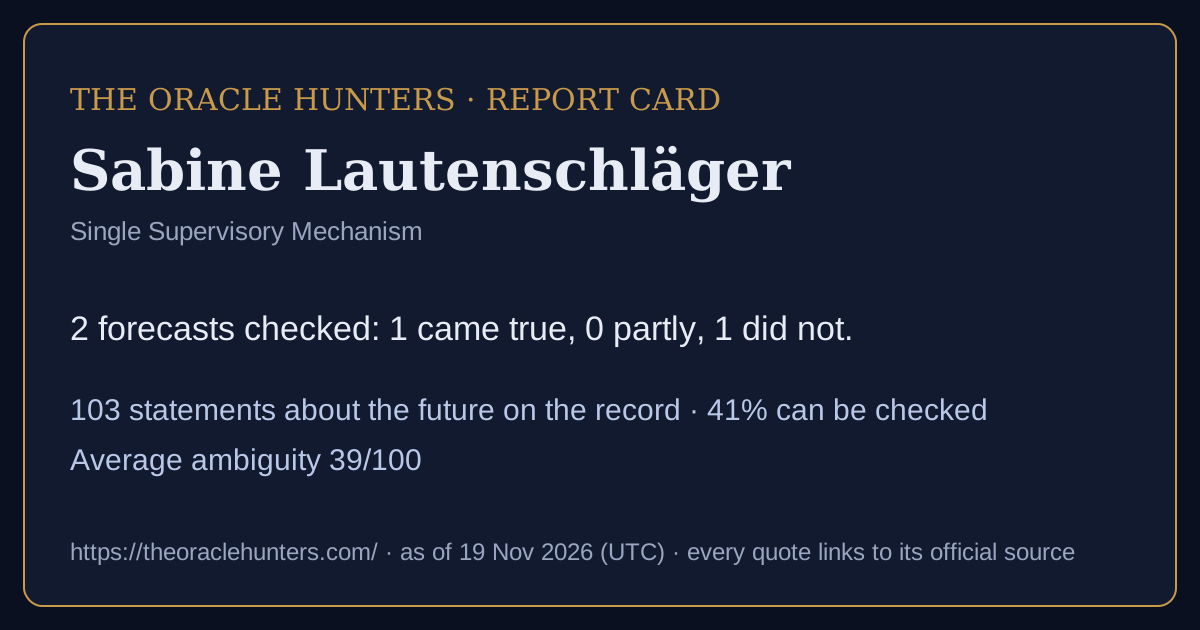
Sabine Lautenschläger
Single Supervisory Mechanism
Track record: 2 forecasts checked: 1 came true, 0 partly, 1 did not.
103forecasts & commitments on the record
41%can be checked as stated
39average ambiguity (0-100)
0goalpost moves recorded
0confirmed U-turns
Timeline
came true partly did not not due / being checked / too vague
Calibration score: shown after 10 checked forecasts with a stated likelihood (now 2).
How they speak about the future: based on data 74, stated on authority 19, educated guess 10.
Kinds of claim: forecast 62, mixed claim 27, scenario (if… then) 10, commitment 4. · Download this report card as a picture
In the nine words
πρόγνωσιςInference from evidence70 · 68%μαντείαInspired knowledge16 · 16%πρόνοιαPreparing for the future10 · 10%προαναγγελίαPublic pre-announcement4 · 4%εἰκασίαConjecture2 · 2%πρόβλεψιςSeeing the signs1 · 1%
How to read this
Each box is one sentence a public figure or institution said about the future, word for word, with a link to the official text. Can be checked means it names what will happen, by when, and how likely - so it can be compared with official figures later. Too vague to check means it does not. Ambiguity (0-100) is how many different ways the sentence can be read. When the date passes, the forecast is compared with official data and marked came true, partly or did not come true. Labels judge the sentence, never the person. Full guide and glossary.Checked
The rate of inflation, which this year is just above 0%, is forecast to rise to 1.1% next year and 1.7% in 2017.
Came true. Said: inflation around 1.7% in 2017. Official figure for Euro area: 1.4% (World Bank open data). On target. Off by 0.3 points. official data · checked 14 Nov 2026 · automatic check against official data (rules v3)
Their projections for next year put the rate of inflation at 1.1%, while the rate of inflation in 2016 is expected to be 1.4%.
Did not come true. Said: inflation around 1.4% in 2016. Official figure for Euro area: 0.1% (World Bank open data). Missed. Off by 1.2 points. official data · checked 14 Nov 2026 · automatic check against official data (rules v3)
On the record (103)
The European Commission predicts that, over the next 10 to 15 years, 90% of global growth will be generated outside of Europe.
One study shows that, for example, new trade restrictions in Europe could reduce Germany’s economic output by 8 %. In their external trade, too, countries that go it alone only stand to lose.
For me it's asymmetric as the Governing Council has defined price stability as an inflation rate of below 2 % over the medium term, while our inflation aim is defined as close to but below 2%.
Recent ECB communications have consistently stressed that the medium term target inflation rate of below but close-to 2% is, and has always been, symmetric….
It will report back on the outcome of this work by November 2019.
For fully unsecured exposures and unsecured parts of partially secured exposures, we expect banks to achieve 100% coverage within two years after a loan has been classified as non-performing.
But as I have said elsewhere, financial stability is more than the sum of its parts. Even if all banks were stable, the financial system could still be a bit shaky.
As regards financial stability, we will continue to cooperate with European and national institutions to work towards a stable financial system.
The ECB will start publishing ESTER by October 2019.
Thanks to the granular data it provides, we will be better able to understand what is driving credit growth, making it easier to know whether such growth is healthy or not.
But some might now point to the latest economic data indicating that growth has lost some momentum and wonder if this is reason to be concerned, or even to change plans?
So, June might be the month to decide once and for all to gradually end net asset purchases by the end of this year.
In 2017, the euro area economy grew by 2.5%, compared with potential growth estimates of 1.5% for the year. Against this backdrop, one could expect to see it to slow down.
A second idea that is often put forward is that we should change our objective and strive for higher inflation. Proponents of this idea claim that we should no longer aim for inflation rates of below, but close to, 2% over the medium term.
And if those who come bring along a stable and resilient banking sector as well as a tradition of strong banking supervision, the gains will be mutual.
And we need it quickly, and in any case before 2023, which is when the SRF will reach its target volume.
This year, the European Banking Authority, EBA for short, will conduct a stress test involving the largest banks in the EU.
It will allow us to identify blind spots early on and define areas which we need to investigate further; this will eventually feed into our plans for 2019.
Second, the European Banking Authority estimates that, for EU banks, the final Basel III package will lead to an aggregate Tier 1 capital shortfall of €34.4 billion.
From mid-2018 into 2019, we will assess models that cover low-default portfolios.
By mid-2018, we will have conducted 120 on-site inspections.
When certain business activities are pushed out of the banking sector, it does not necessarily mean that the risks for financial stability increase, but nor does it mean that these activities will not pose risks if they are handled by other market participants.
So I hope that the latest package of global banking standards – Basel III – will be completed this year.
Banks with trading books below €300 million could use a simpler standardised approach to calculate market risk.
Banks with small trading books below €50 million could be exempted from the obligation to have a prudential trading book.
For even if we allow our net purchases to come to an end, monetary policy will remain expansive.
And we have the time, because we made the decision to define our goal with a view to the medium term: inflation rates of below, but close to, 2% over the medium term.
The conditions are all in place for inflation to reach a stable trend towards our goal: below, but close to, 2% in the medium term.
To be more precise: in the medium term, inflation should be below, but close to, 2%.
To increase awareness and to communicate our expectations, we will organise seminars and discussions with banks.
The thematic review will conclude at the end of this year.
And, as expected, inflation in May has fallen again, to 1.4% At the same time, domestic price pressures are still subdued; the same is true for wages.
And the ECB too will be taking a very close look at the smaller German banks this year.
And it is a clear one: over the medium term, inflation should be close to, but below, 2%.
One and a half years ago, an analysis done by the Bundesbank showed that the profits of the smaller German banks could fall by 25% by 2019 – in a worst-case scenario they could even fall by up to 75%.
Taming the fire Statement by Sabine Lautenschläger, Member of the Executive Board of the ECB and Vice-Chair of the Supervisory Board of the ECB, at the Credit Risk 2017 forum, Vienna, 23 March 2017 Theodore Roosevelt is supposed to have said: “Risk is like fire: if controlled it will help us; if uncontrolled it will rise up and destroy us”.
They decided on a €120 billion pact for growth; they decided that the rescue funds, the European Financial Stability Facility and the European Stability Mechanism, could directly recapitalise banks under certain conditions; and they pledged to use the instruments of the rescue funds flexibly and efficiently.
The programme itself comes to an end next year, provided that it is not renewed, in the event that our optimistic expectations are not met after all and inflation is lower.
If we assume that all this is not just for a m onth, but that we also have inflation that rises for several months and continues to rise next year, then we would have the possibility to slow down a bit in respect of something else.
My daughter is 25 and I tell her very clearly: 'Y ou have to set something aside for about 40 years, we want to ensure with our monetary policy measures that you can save for 40 years and not just for next year with higher interest rates.
Zero interest rate, zero inflation, i.e. if som eone has €10,000 then he or she, when inflation is at 1.7% - and most economists believe that next year it will be around that - then that person only has €9,830 [after one year] and €8,400 after ten years.
A t the end of the year we will have reached a purchase volume of over €2 trillion - it's a number that's hard to imagine.
Our review is certainly a huge project - in 2017 alone, we will be conducting more than 100 assessments, each of them covering three to four models.
For the next three years we will conduct a targeted review of these internal models in order to ensure consistent model outputs and restrict unjustified variability in the calculation of risk-weighted assets.
Our mandate is to ensure price stability in the medium term, and that means a medium-term inflation rate of below, but close to, 2%.
With regard to the future stance of the ECB, hasn't another expansion of the asset purchase programme aimed at quantitative easing (QE) long been a foregone conclusion - if only because there is a risk of turmoil when you reduce the purchases in one go, from €80 billion a month in March to zero in A pril 2017?
The second point applies to savers: a 3% interest rate with 3% inflation is exactly the same as a 0% interest rate with 0% inflation, although for many people it might feel different.
Our current projections see inflation in 2018 back at 1.6%.
We should not forget that returning inflation to just under 2% is a medium-term goal.
Let me also remind you that for the upcoming EBA stress test, the results will be published for banks that represent 70% of the assets of the euro area.
Showing the newest 50 - the ledger has all 103.
Also said - not checkable as stated (12 newest)
Remarks about the future with no date, figure or likelihood that could be checked. They are kept on the record and shown here, but not scored.
We will need to carefully monitor how this will affect competition, because a lack of competition can impair the efficiency and quality of services in the long term, to the detriment of consumers.
To ensure that we have a safe, efficient and modern European payment system in the long term, though, we will need to work together at the European level.
We will also need to work fundamentally on our understanding of politics and our culture of debate.
In such an interconnected world, individual countries will therefore find it increasingly difficult to uphold their prosperity and social security provisions.
The account of last month's monetary policy meeting of the Governing Council showed the ECB has become more pessimistic in its assessment of the eurozone growth and inflation outlook over the longer term, to the extent that the baseline growth scenario may need to be revised.
And I am still convinced that the Asset Purchase Programme (APP) is the ultima ratio , and it should only be used if you have a risk of deflation; and the risk of deflation is nowhere to be seen now.
Could you envisage circumstances in which existing TLTROs could be repriced, in order to make them more attractive to banks?
Equally , if there is to be an interest rate cut on September 12, does it follow that there has to be tiering in order to gain support for such a measure?
Today we will update you on the second round of the cyber resilience survey, which we conducted again across mostly the same population of FMIs throughout Europe.
I will later explain why I think that the ERPB’s work on instant payments is so important for the future of an integrated European payments market.
But, in the long run, simply being reachable for incoming payments initiated by other banks’ customers will not be enough.
And finally banks could also benefit from higher cost efficiencies and generate new revenue streams.