The public record of what the powerful say about the futureAll times UTCYour time ATHENA News Room is liveSealed daily · anchored in BitcoinΕλληνικά A Tekmerion product
THE ORACLE HUNTERS • EVERY PROPHECY ON THE RECORD •AAAWgmp1bWIAAAAeanVtZGMycGEAEQAQgAAAqgA4m3EDYzJwYQAAABZcanVtYgAAAEdqdW1kYzJtYQARABCAAACqADibcQN1cm46YzJwYTo4MTk5ZDlhYi0zYzIzLTQwZDYtYTc1NS04MTM5NWJhODhjMTYAAAADl2p1bWIAAAApanVtZGMyYXMAEQAQgAAAqgA4m3EDYzJwYS5hc3NlcnRpb25zAAAAALxqdW1iAAAARGp1bWRjYm9yABEAEIAAAKoAOJtxE2MycGEuaW5ncmVkaWVudC52MwAAAAAYYzJzaIxn7Lz8d2kiZVLVmLMqjH8AAABwY2JvcqNpZGM6Zm9ybWF0bWltYWdlL3N2Zyt4bWxqaW5zdGFuY2VJRHgseG1wOmlpZDpjNjQzY2M2MC03NmU5LTRkODUtODAzNi04Y2U2YmUwZDA0MzRscmVsYXRpb25zaGlwaHBhcmVudE9mAAAB4mp1bWIAAABBanVtZGNib3IAEQAQgAAAqgA4m3ETYzJwYS5hY3Rpb25zLnYyAAAAABhjMnNoYoNKEfN7QooyLxBggQwrRAAAAZljYm9yomdhY3Rpb25zgqJmYWN0aW9ua2MycGEub3BlbmVkanBhcmFtZXRlcnOha2luZ3JlZGllbnRzgaJjdXJseC1zZWxmI2p1bWJmPWMycGEuYXNzZXJ0aW9ucy9jMnBhLmluZ3JlZGllbnQudjNkaGFzaFggGR++KIZKhTpFlfMpaeP4xKARvK6IpGRCm/JKHJsg8z+kZmFjdGlvbngdY29tLmFudGhyb3BpYy5jbGF1ZGUucHJvdmlkZWRqcGFyYW1ldGVyc6F4H2NvbS5hbnRocm9waWMub3JpZ2luLWNvbmZpZGVuY2VndW5rbm93bmtkZXNjcmlwdGlvbnhmQ2xhdWRlIHByb3ZpZGVkIHRoaXMgZmlsZSBhdCB0aGUgcmVxdWVzdCBvZiBhIHVzZXIgYW5kIG1heSBoYXZlIGNyZWF0ZWQgb3IgbW9kaWZpZWQgdGhlIGZpbGUgY29udGVudHMubXNvZnR3YXJlQWdlbnShZG5hbWVmQ2xhdWRlcmFsbEFjdGlvbnNJbmNsdWRlZPUAAADIanVtYgAAAEBqdW1kY2JvcgARABCAAACqADibcRNjMnBhLmhhc2guZGF0YQAAAAAYYzJzaLTPAMahVK/46OuJ/Q+uuA8AAACAY2JvcqVjYWxnZnNoYTI1NmNwYWRMAAAAAAAAAAAAAAAAZGhhc2hYII7HF9R24wInyRZy4rI4Fw0mI4Rb/ZNxjfxeO7PO35j2ZG5hbWVuanVtYmYgbWFuaWZlc3RqZXhjbHVzaW9uc4GiZXN0YXJ0GQiaZmxlbmd0aBkeBAAAAj5qdW1iAAAAJ2p1bWRjMmNsABEAEIAAAKoAOJtxA2MycGEuY2xhaW0udjIAAAACD2Nib3KlY2FsZ2ZzaGEyNTZpc2lnbmF0dXJleE1zZWxmI2p1bWJmPS9jMnBhL3VybjpjMnBhOjgxOTlkOWFiLTNjMjMtNDBkNi1hNzU1LTgxMzk1YmE4OGMxNi9jMnBhLnNpZ25hdHVyZWppbnN0YW5jZUlEeCx4bXA6aWlkOjljYzUwMDc4LTgzMDctNDI0ZS04NjE4LTVmYTQzMmE1MWJmNHJjcmVhdGVkX2Fzc2VydGlvbnODomN1cmx4LXNlbGYjanVtYmY9YzJwYS5hc3NlcnRpb25zL2MycGEuaW5ncmVkaWVudC52M2RoYXNoWCAZH74ohkqFOkWV8ylp4/jEoBG8roikZEKb8kocmyDzP6JjdXJseCpzZWxmI2p1bWJmPWMycGEuYXNzZXJ0aW9ucy9jMnBhLmFjdGlvbnMudjJkaGFzaFggjvXIkXvJ7aXB5IwuH8TLLMTeq4OAYClzgZHySVCatNCiY3VybHgpc2VsZiNqdW1iZj1jMnBhLmFzc2VydGlvbnMvYzJwYS5oYXNoLmRhdGFkaGFzaFggIhTKhum+9R2LsXAUkQyOeb6aKanhapGjq6FRT3EaJ9V0Y2xhaW1fZ2VuZXJhdG9yX2luZm+jZG5hbWVvQW50aHJvcGljIEZpbGVzZ3ZlcnNpb25lMS4wLjBrc3BlY1ZlcnNpb25lMi40LjAAABA4anVtYgAAAChqdW1kYzJjcwARABCAAACqADibcQNjMnBhLnNpZ25hdHVyZQAAABAIY2JvctKEWQISogEmGCFZAgowggIGMIIBjaADAgECAhRA5aAK7sI50L64g/oGQgU9Z1UTADAKBggqhkjOPQQDAzBJMRcwFQYDVQQKEw5BbnRocm9waWMsIFBCQzEuMCwGA1UEAxMlQW50aHJvcGljIENvbnRlbnQgQ3JlZGVudGlhbHMgUm9vdCBDQTAeFw0yNjA4MDcxODQzNTZaFw0yODA4MDYxOTQzNTZaMEQxFzAVBgNVBAoTDkFudGhyb3BpYywgUEJDMSkwJwYDVQQDEyBBbnRocm9waWMgQ2xhdWRlIENvbnRlbnQgU2lnbmluZzBZMBMGByqGSM49AgEGCCqGSM49AwEHA0IABJh6CmvLUBgFFNU0vUKlOVtE6djd17L5SuwX0LemFisBM3dkd/3cyjxFA3Qo5S46fX0/ihY0VZ7mfb9KF703t5OjWDBWMA4GA1UdDwEB/wQEAwIHgDAVBgNVHSUEDjAMBgorBgEEAYPoXgIBMAwGA1UdEwEB/wQCMAAwHwYDVR0jBBgwFoAUzlHiBIFOZFsj+OPEz5o+nMHXXMIwCgYIKoZIzj0EAwMDZwAwZAIwMXMdFJ4BetLLVY7ORuE9noqbbAZOZn/aArXyTwFAZfKrPzxF2vPoJNf1+UCdg1XGAjBwX1zd9WGqYkqmL5SFqw1QySjr1zJfpJM9+1rdDwSPLMOPOjKuiXjoU/pUUeG9RwmhY3BhZFkNngAAAAAAAAAAAAAAAAAAAAAAAAAAAAAAAAAAAAAAAAAAAAAAAAAAAAAAAAAAAAAAAAAAAAAAAAAAAAAAAAAAAAAAAAAAAAAAAAAAAAAAAAAAAAAAAAAAAAAAAAAAAAAAAAAAAAAAAAAAAAAAAAAAAAAAAAAAAAAAAAAAAAAAAAAAAAAAAAAAAAAAAAAAAAAAAAAAAAAAAAAAAAAAAAAAAAAAAAAAAAAAAAAAAAAAAAAAAAAAAAAAAAAAAAAAAAAAAAAAAAAAAAAAAAAAAAAAAAAAAAAAAAAAAAAAAAAAAAAAAAAAAAAAAAAAAAAAAAAAAAAAAAAAAAAAAAAAAAAAAAAAAAAAAAAAAAAAAAAAAAAAAAAAAAAAAAAAAAAAAAAAAAAAAAAAAAAAAAAAAAAAAAAAAAAAAAAAAAAAAAAAAAAAAAAAAAAAAAAAAAAAAAAAAAAAAAAAAAAAAAAAAAAAAAAAAAAAAAAAAAAAAAAAAAAAAAAAAAAAAAAAAAAAAAAAAAAAAAAAAAAAAAAAAAAAAAAAAAAAAAAAAAAAAAAAAAAAAAAAAAAAAAAAAAAAAAAAAAAAAAAAAAAAAAAAAAAAAAAAAAAAAAAAAAAAAAAAAAAAAAAAAAAAAAAAAAAAAAAAAAAAAAAAAAAAAAAAAAAAAAAAAAAAAAAAAAAAAAAAAAAAAAAAAAAAAAAAAAAAAAAAAAAAAAAAAAAAAAAAAAAAAAAAAAAAAAAAAAAAAAAAAAAAAAAAAAAAAAAAAAAAAAAAAAAAAAAAAAAAAAAAAAAAAAAAAAAAAAAAAAAAAAAAAAAAAAAAAAAAAAAAAAAAAAAAAAAAAAAAAAAAAAAAAAAAAAAAAAAAAAAAAAAAAAAAAAAAAAAAAAAAAAAAAAAAAAAAAAAAAAAAAAAAAAAAAAAAAAAAAAAAAAAAAAAAAAAAAAAAAAAAAAAAAAAAAAAAAAAAAAAAAAAAAAAAAAAAAAAAAAAAAAAAAAAAAAAAAAAAAAAAAAAAAAAAAAAAAAAAAAAAAAAAAAAAAAAAAAAAAAAAAAAAAAAAAAAAAAAAAAAAAAAAAAAAAAAAAAAAAAAAAAAAAAAAAAAAAAAAAAAAAAAAAAAAAAAAAAAAAAAAAAAAAAAAAAAAAAAAAAAAAAAAAAAAAAAAAAAAAAAAAAAAAAAAAAAAAAAAAAAAAAAAAAAAAAAAAAAAAAAAAAAAAAAAAAAAAAAAAAAAAAAAAAAAAAAAAAAAAAAAAAAAAAAAAAAAAAAAAAAAAAAAAAAAAAAAAAAAAAAAAAAAAAAAAAAAAAAAAAAAAAAAAAAAAAAAAAAAAAAAAAAAAAAAAAAAAAAAAAAAAAAAAAAAAAAAAAAAAAAAAAAAAAAAAAAAAAAAAAAAAAAAAAAAAAAAAAAAAAAAAAAAAAAAAAAAAAAAAAAAAAAAAAAAAAAAAAAAAAAAAAAAAAAAAAAAAAAAAAAAAAAAAAAAAAAAAAAAAAAAAAAAAAAAAAAAAAAAAAAAAAAAAAAAAAAAAAAAAAAAAAAAAAAAAAAAAAAAAAAAAAAAAAAAAAAAAAAAAAAAAAAAAAAAAAAAAAAAAAAAAAAAAAAAAAAAAAAAAAAAAAAAAAAAAAAAAAAAAAAAAAAAAAAAAAAAAAAAAAAAAAAAAAAAAAAAAAAAAAAAAAAAAAAAAAAAAAAAAAAAAAAAAAAAAAAAAAAAAAAAAAAAAAAAAAAAAAAAAAAAAAAAAAAAAAAAAAAAAAAAAAAAAAAAAAAAAAAAAAAAAAAAAAAAAAAAAAAAAAAAAAAAAAAAAAAAAAAAAAAAAAAAAAAAAAAAAAAAAAAAAAAAAAAAAAAAAAAAAAAAAAAAAAAAAAAAAAAAAAAAAAAAAAAAAAAAAAAAAAAAAAAAAAAAAAAAAAAAAAAAAAAAAAAAAAAAAAAAAAAAAAAAAAAAAAAAAAAAAAAAAAAAAAAAAAAAAAAAAAAAAAAAAAAAAAAAAAAAAAAAAAAAAAAAAAAAAAAAAAAAAAAAAAAAAAAAAAAAAAAAAAAAAAAAAAAAAAAAAAAAAAAAAAAAAAAAAAAAAAAAAAAAAAAAAAAAAAAAAAAAAAAAAAAAAAAAAAAAAAAAAAAAAAAAAAAAAAAAAAAAAAAAAAAAAAAAAAAAAAAAAAAAAAAAAAAAAAAAAAAAAAAAAAAAAAAAAAAAAAAAAAAAAAAAAAAAAAAAAAAAAAAAAAAAAAAAAAAAAAAAAAAAAAAAAAAAAAAAAAAAAAAAAAAAAAAAAAAAAAAAAAAAAAAAAAAAAAAAAAAAAAAAAAAAAAAAAAAAAAAAAAAAAAAAAAAAAAAAAAAAAAAAAAAAAAAAAAAAAAAAAAAAAAAAAAAAAAAAAAAAAAAAAAAAAAAAAAAAAAAAAAAAAAAAAAAAAAAAAAAAAAAAAAAAAAAAAAAAAAAAAAAAAAAAAAAAAAAAAAAAAAAAAAAAAAAAAAAAAAAAAAAAAAAAAAAAAAAAAAAAAAAAAAAAAAAAAAAAAAAAAAAAAAAAAAAAAAAAAAAAAAAAAAAAAAAAAAAAAAAAAAAAAAAAAAAAAAAAAAAAAAAAAAAAAAAAAAAAAAAAAAAAAAAAAAAAAAAAAAAAAAAAAAAAAAAAAAAAAAAAAAAAAAAAAAAAAAAAAAAAAAAAAAAAAAAAAAAAAAAAAAAAAAAAAAAAAAAAAAAAAAAAAAAAAAAAAAAAAAAAAAAAAAAAAAAAAAAAAAAAAAAAAAAAAAAAAAAAAAAAAAAAAAAAAAAAAAAAAAAAAAAAAAAAAAAAAAAAAAAAAAAAAAAAAAAAAAAAAAAAAAAAAAAAAAAAAAAAAAAAAAAAAAAAAAAAAAAAAAAAAAAAAAAAAAAAAAAAAAAAAAAAAAAAAAAAAAAAAAAAAAAAAAAAAAAAAAAAAAAAAAAAAAAAAAAAAAAAAAAAAAAAAAAAAAAAAAAAAAAAAAAAAAAAAAAAAAAAAAAAAAAAAAAAAAAAAAAAAAAAAAAAAAAAAAAAAAAAAAAAAAAAAAAAAAAAAAAAAAAAAAAAAAAAAAAAAAAAAAAAAAAAAAAAAAAAAAAAAAAAAAAAAAAAAAAAAAAAAAAAAAAAAAAAAAAAAAAAAAAAAAAAAAAAAAAAAAAAAAAAAAAAAAAAAAAAAAAAAAAAAAAAAAAAAAAAAAAAAAAAAAAAAAAAAAAAAAAAAAAAAAAAAAAAAAAAAAAAAAAAAAAAAAAAAAAAAAAAAAAAAAAAAAAAAAAAAAAAAAAAAAAAAAAAAAAAAAAAAAAAAAAAAAAAAAAAAAAAAAAAAAAAAAAAAAAAAAAAAAAAAAAAAAAAAAAAAAAAAAAAAAAAAAAAAAAAAAAAAAAAAAAAAAAAAAAAAAAAAAAAAAAAAAAAAAAAAAAAAAAAAAAAAAAAAAAAAAAAAAAAAAAAAAAAAAAAAAAAAAAAAAAAAAAAAAAAAAAAAAAAAAAAAAAAAAAAAAAAAAAAAAAAAAAAAAAAAAAAAAAAAAAAAAAAAAAAAAAAAAAAAAAAAAAAAAAAAAAAAAAAAAAAAAAAAAAAAAAAAAAAAAAAAAAAAAAAAAAAAAAAAAAAAAAAAAAAAAAAAAAAAAAAAAAAAAAAAAAAAAAAAAAAAAAAAAAAAAAAAAAAAAAAAAAAAAAAAAAAAAAAAAAAAAAAAAAAAAAAAAAAAAAAAAAAAAAAAAAAAAAAAAAAAAAAAAAAAAAAAAAAAAAAAAAAAAAAAAAAAAAAAAAAAAAAAAAAAAAAAAAAAAAAAAAAAAAAAAAAAAAAAAAAAAAAAAAAAAAAAAAAAAAAAAAAAAAAAAAAAAAAAAAAAAAAAAAAAAAAAAAAAAAAAAAAAAAAAAAAAAAAAAAAAAAAAAAAAAAAAAAAAAAAAAAAAAAAAAAAAAAAAAAAAAAAAAAAAAAAAAAAAAAAAAAAAAAAAAAAAAAAAAAAAAAAAAAAAAAAAAAAAAAAAAAAAAAAAAAAAAAAAAAAAAAAAAAAAAAAAAAAAAAAAAAAAAAAAAAAAAAAAAAAAAAAAAAAAAAAAAAAAAAAAAAAAAAAAAAAAAAAAAAAAAAAAAAAAAAAAAAAAAAAAAAAAAAAAAAAAAAAAAAAAAAAAAAAAAAAAAAAAAAAAAAAAAAAAAAAAAAAAAAAAAAAAAAAAAAAAAAAAAAAAAAAAAAAAAAAAAAAAAAAAAAAAAAAAAAAAAAAAAAAAAAAAAAAAAAAAAAAAAAAAAAAAAAAAAAAAAAAAAAAAAAAAAAAAAAAAAAAAAAAAAAAAAAAAAAAAAAAAAAAAAAAAAAAAAAAAAAAAAAAAAAAAAAAAAAAAAAAAAAAAAAAAAAAAAAAAAAAAAAAAAAAAAAAAAAAAAAAAAAAAAAAAAAAAAAAAAAAAAAAAAAAAAAAAAAAAAAAAAAAAAAAAAAAAAAAAAAAAAAAAAAAAAAAAAAAAAAAAAAAAAAAAAAAAAAAAAAAAAAAAAAAAAAAAAAAAAAAAAAAAAAAAAAAAAAAAAAAAAAAAAAAAAAAAAAAAAAAAAAAAAAAAAAAAAAAAAAAAAAAAAAAAAAAAAAAAAAAAAAAAAAAAAAAAAAAAAAAAAAAAAAAAAAAAAAAAAAAAAAAAAAAAAAAAAAAAAAAAAAAAAAAAAAAAAAAAAAAAAAAAAAAAAAAAAAAAAAAAAAAAPZYQLfUpeT/MPsu1gA3RgZ8fvvIDmyZYJDWmz6ftVFNojm4kOQbEdCSTa0XP3aqZnboyhQ+RU/hD3bq8nBGJ+yvrXI=The Oracle HuntersEvery prophecy, on the record. · Οἱ Κυνηγοὶ τῶν ΧρησμῶνUnder development

← Tracking the Prophets

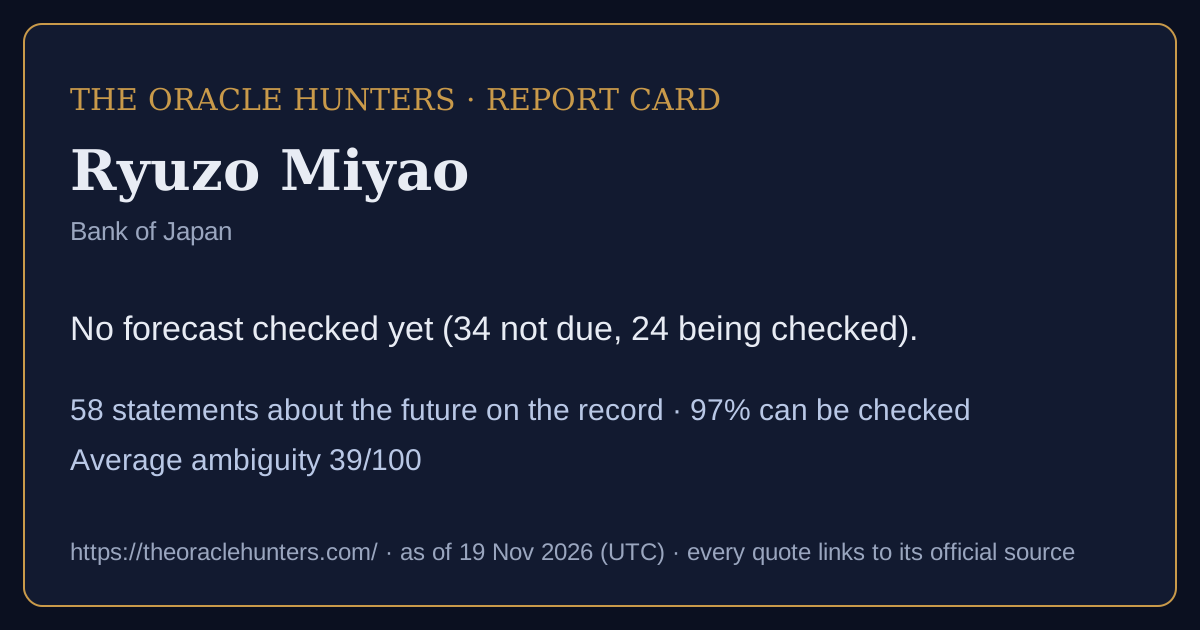
Ryuzo Miyao

Bank of Japan

Track record: No forecast checked yet (34 not due, 24 being checked).
58forecasts & commitments on the record
97%can be checked as stated
39average ambiguity (0-100)
0goalpost moves recorded
0confirmed U-turns

Timeline

20102010: Not due yet2010: Due - being checked20112011: Not due yet2011: Due - being checked2011: Not due yet2011: Not due yet2011: Due - being checked2011: Due - being checked2011: Not due yet2011: Not due yet20122012: Not due yet2012: Not due yet2012: Not due yet2012: Due - being checked2012: Due - being checked2012: Due - being checked2012: Not due yet2012: Not due yet (+4 more)20132013: Not due yet2013: Not due yet2013: Due - being checked2013: Not due yet2013: Not due yet2013: Not due yet2013: Not due yet2013: Not due yet (+7 more)20142014: Due - being checked2014: Due - being checked2014: Due - being checked2014: Due - being checked2014: Due - being checked2014: Due - being checked2014: Not due yet2014: Not due yet (+7 more)20152015: Not due yet2015: Not due yet2015: Not due yet2015: Not due yet2015: Not due yet2015: Not due yet
came true partly did not not due / being checked / too vague

Calibration score: shown after 10 checked forecasts with a stated likelihood (now 0).
How they speak about the future: based on data 46, educated guess 8, stated on authority 4.
Kinds of claim: forecast 40, scenario (if… then) 7, mixed claim 7, commitment 4. · Download this report card as a picture
In the nine words

πρόγνωσιςInference from evidence46 · 79%πρόνοιαPreparing for the future7 · 12%προαναγγελίαPublic pre-announcement4 · 7%εἰκασίαConjecture1 · 2%
How to read this Each box is one sentence a public figure or institution said about the future, word for word, with a link to the official text. Can be checked means it names what will happen, by when, and how likely - so it can be compared with official figures later. Too vague to check means it does not. Ambiguity (0-100) is how many different ways the sentence can be read. When the date passes, the forecast is compared with official data and marked came true, partly or did not come true. Labels judge the sentence, never the person. Full guide and glossary.

On the record (58)

If the virtuous cycle of economic activity is sustained, a view that 'around 2 percent inflation will continue with improvements in corporate profits, employment, and wages' will spread widely throughout the country, and a new inflation rate that the general public perceives as representing price stability will take hold.
Bank of Japan · said 04 Mar 2015 (date) · Challenges in shaping modern monetary policy · evidence & why
πρόγνωσις · Inference from evidencePartly checkableMixed claimbased on dataambiguity 56/100implied call / likelihood: Yes · 85% · for the most partbelow the RIM-1 standardNot due yetinflationgrowthlabour
The key question is whether the inflation rate will trend upward toward 2 percent together with a sustainable economic recovery.
Bank of Japan · said 04 Mar 2015 (date) · Challenges in shaping modern monetary policy · evidence & why
I personally hold the view that, although the precise timing for reaching 2 percent can be either earlier or later to some extent, the rate will likely rise close to 2 percent as a trend as downward pressure exerted by the decline in crude oil prices eventually will dissipate on a year-on-year basis.
Bank of Japan · said 04 Mar 2015 (date) · Challenges in shaping modern monetary policy · evidence & why
πρόγνωσις · Inference from evidencePartly checkableForecastbased on dataambiguity 71/100implied call / likelihood: Yes · 70% · probablebelow the RIM-1 standardNot due yetinflationenergy
According to the Bank's projections for economic activity and prices made in January 2015, the year-on-year rate of increase in the consumer price index is likely to reach around 2 percent in or around fiscal 2015.
Bank of Japan · said 04 Mar 2015 (date) · Challenges in shaping modern monetary policy · evidence & why
πρόγνωσις · Inference from evidencePartly checkableForecastbased on dataambiguity 71/100implied call / likelihood: Yes · 70% · probablebelow the RIM-1 standardNot due yetinflationgrowthfiscalfinance
It is very likely that the Bank will achieve the price stability target of 2 percent and, by maintaining that target in a stable manner, re-anchor the inflation rate that the general public perceives as representing price stability at around 2 percent.
Bank of Japan · said 04 Mar 2015 (date) · Challenges in shaping modern monetary policy · evidence & why
In fact, as for forward guidance under QQE in Japan, the Bank adopts the following broad approach: 'the Bank will continue with QQE, aiming to achieve the price stability target of 2 percent, as long as it is necessary for maintaining that target in a stable manner.
Bank of Japan · said 04 Mar 2015 (date) · Challenges in shaping modern monetary policy · evidence & why
Thereafter, the rate of increase is likely to accelerate gradually toward the second half of fiscal 2015 and reach around 2 percent - the price stability target - in or around that half, as the effects of the decline in crude oil prices will dissipate and the output gap will continue expanding in positive territory (Chart 16).
Bank of Japan · said 12 Nov 2014 (date) · Economic activity and prices in Japan and monetary policy · evidence & why
πρόγνωσις · Inference from evidenceCan be checkedForecastbased on dataambiguity 71/100implied call / likelihood: Yes · 70% · probablebelow the RIM-1 standarddue 31 Dec 2015Due - being checkedinflationgrowthfiscalenergy
I personally hold the view that the rate of increase in the CPI will likely be kept at around the current level of around 1 percent until summer 2015, mainly because downward pressure associated with the decline in crude oil prices will contain upward pressure on prices.
Bank of Japan · said 12 Nov 2014 (date) · Economic activity and prices in Japan and monetary policy · evidence & why
πρόγνωσις · Inference from evidenceCan be checkedForecastbased on dataambiguity 56/100implied call / likelihood: Yes · 70% · probablebelow the RIM-1 standarddue 31 Dec 2015Due - being checkedinflationenergy
In particular, the effects of the decline in crude oil prices - based on the outlook for these prices, to which I referred earlier - will continue to exert a considerable degree of downward pressure on consumer prices until around summer 2015, as these effects will spread to electricity and gas prices, in addition to prices of petroleum products such …
Bank of Japan · said 12 Nov 2014 (date) · Economic activity and prices in Japan and monetary policy · evidence & why
πρόγνωσις · Inference from evidenceCan be checkedForecastbased on dataambiguity 36/100implied call / likelihood: Yes · 85% · for the most partbelow the RIM-1 standarddue 31 Dec 2015Due - being checkedinflationenergy
fiscal 2015 onward, the gap is expected to move further into excess demand territory and upward pressure on prices is likely to steadily increase.
Bank of Japan · said 12 Nov 2014 (date) · Economic activity and prices in Japan and monetary policy · evidence & why
πρόγνωσις · Inference from evidenceCan be checkedForecastbased on dataambiguity 0/100implied call / likelihood: Yes · 70% · probablemeets the RIM-1 standarddue 31 Dec 2015Due - being checkedinflationfiscal
As a result, it may be possible to achieve the 2 percent target and start discussing an exit strategy sooner - to be specific, as early as in the second half of fiscal 2015.
Bank of Japan · said 12 Nov 2014 (date) · Economic activity and prices in Japan and monetary policy · evidence & why
πρόγνωσις · Inference from evidenceCan be checkedForecastbased on dataambiguity 36/100implied call / likelihood: No · 40% · probablebelow the RIM-1 standarddue 31 Dec 2015Due - being checkedfiscal
Considering the above points, the year-on-year rate of increase in the CPI (for all items less fresh food and excluding the direct effects of the consumption tax hikes) is likely to reach around 2 percent in or around fiscal 2015.
Bank of Japan · said 12 Nov 2014 (date) · Economic activity and prices in Japan and monetary policy · evidence & why
πρόγνωσις · Inference from evidenceCan be checkedForecastbased on dataambiguity 56/100implied call / likelihood: Yes · 70% · probablebelow the RIM-1 standarddue 31 Dec 2015Due - being checkedinflationfiscal
If people expect that economic activity and sales will continue to improve, their inflation expectations will increase - considering, for example, the Phillips curve relation in the future.
Bank of Japan · said 18 Oct 2014 (date) · Japan's economy and monetary policy · evidence & why
πρόνοια · Preparing for the futurePartly checkableScenario (if… then)educated guessambiguity 36/100implied call / likelihood: Yes · 70% · probablebelow the RIM-1 standardNot due yetinflationgrowth
If these developments are structural, this will steepen the Phillips curve, which will also increase upward pressure on prices.
Bank of Japan · said 18 Oct 2014 (date) · Japan's economy and monetary policy · evidence & why
πρόνοια · Preparing for the futurePartly checkableScenario (if… then)educated guessambiguity 36/100implied call / likelihood: Yes · 85% · for the most partbelow the RIM-1 standardNot due yetinflation
The economy is therefore expected to follow a path toward achieving the 2 percent price stability target in a balanced manner, accompanied by improvements such as in employment, wages, and corporate profits.
Bank of Japan · said 18 Oct 2014 (date) · Japan's economy and monetary policy · evidence & why
In addition, the authorities' stance that they will continue to pay consideration to economic activity while progressing with structural reforms is affirmed particularly by the fact that the Chinese government set the GDP growth target for 2014 at around 7.5 percent, the same level as the previous year.
Bank of Japan · said 10 Apr 2014 (date) · Economic activity and prices in Japan and monetary policy · evidence & why
Thus far, Japan's economic activity and prices are developing in line with the Bank's Policy Board members' median forecasts - in other words, with real GDP growth at 1.4 percent and 1.5 percent in fiscal 2014 and 2015, respectively, and CPI inflation excluding the effects of the consumption tax hikes at 1.3 percent and 1.9 percent in those years (Chart …
Bank of Japan · said 10 Apr 2014 (date) · Economic activity and prices in Japan and monetary policy · evidence & why
πρόγνωσις · Inference from evidencePartly checkableForecastbased on dataambiguity 36/100below the RIM-1 standarddue 31 Dec 2015Due - being checkedinflationgrowthfiscalfinance
- e The Bank will continue with the QQE, aiming to achieve the price stability target of 2%, as long as it is necessary for maintaining that target in a stable manner.
Bank of Japan · said 10 Apr 2014 (date) · Economic activity and prices in Japan and monetary policy · evidence & why
Regarding the price outlook in particular, the ESP Forecast Survey indicates that prices are expected to rise at around 1 percent in both fiscal 2014 and 2015, which presents a gap in comparison with the Bank's forecasts.
Bank of Japan · said 10 Apr 2014 (date) · Economic activity and prices in Japan and monetary policy · evidence & why
πρόγνωσις · Inference from evidenceCan be checkedForecastbased on dataambiguity 36/100implied call / likelihood: Yes · 70% · probablebelow the RIM-1 standarddue 31 Dec 2015Due - being checkedinflationfiscalfinance
The ratio of the monetary base to nominal GDP is expected to increase to about 56 percent by end-2014.
Bank of Japan · said 10 Apr 2014 (date) · Economic activity and prices in Japan and monetary policy · evidence & why
πρόγνωσις · Inference from evidenceCan be checkedForecastbased on dataambiguity 0/100implied call / likelihood: Yes · 70% · probablemeets the RIM-1 standarddue 31 Dec 2014Due - being checkedgrowth
The Bank will continue with QQE, which consists of the measures I have just cited, aiming to achieve the price stability target of 2 percent, as long as it is necessary for maintaining that target in a stable manner.
Bank of Japan · said 10 Apr 2014 (date) · Economic activity and prices in Japan and monetary policy · evidence & why
After about half a year, although the recovery in the world economy - the first stage of the path - has lagged somewhat behind and household spending - the fourth stage - has turned out to be somewhat stronger than expected, it can be judged that the path is generally on track to achieve the 2 percent price stability target.
Bank of Japan · said 13 Nov 2013 (date) · Economic activity and prices in Japan and monetary policy · evidence & why
I continued that, if the virtuous cycle of the five-stage path was maintained thereafter and the medium- to long-term trend inflation rate increased toward 2 percent, the actual inflation rate was expected to approach the 2 percent price stability target.
Bank of Japan · said 13 Nov 2013 (date) · Economic activity and prices in Japan and monetary policy · evidence & why
And fourth, for CP and corporate bonds, the Bank continues with these asset purchases until their amounts outstanding reach 2.2 trillion yen and 3.2 trillion yen, respectively, by end-2013; thereafter, it will maintain these amounts outstanding.
Bank of Japan · said 13 Nov 2013 (date) · Economic activity and prices in Japan and monetary policy · evidence & why
πρόγνωσις · Inference from evidenceCan be checkedForecastbased on dataambiguity 0/100implied call / likelihood: Yes · 85% · for the most partmeets the RIM-1 standarddue 31 Dec 2013Due - being checkedfinance
Specifically, the Bank will purchase a massive amount of JGBs so that the outstanding amount of its JGB holdings will increase by 50 trillion yen annually.
Bank of Japan · said 28 May 2013 (date) · Central banking further into uncharted territory · evidence & why
As the actual inflation rate rises further beyond 1 percent, the public recognizes that the anchor will increase accordingly.
Bank of Japan · said 28 May 2013 (date) · Central banking further into uncharted territory · evidence & why
As I told above, the Japan's economy is likely to achieve the 2 percent target as the inflation rate rises together with a sustainable economic recovery.
Bank of Japan · said 28 May 2013 (date) · Central banking further into uncharted territory · evidence & why
As a result, the actual inflation rate is projected to continue to rise, approaching the 2 percent price stability target.
Bank of Japan · said 28 May 2013 (date) · Central banking further into uncharted territory · evidence & why
Toward the latter half of the three-year projection period, the CPI inflation is likely to reach the price stability target of about 2 percent (Chart 1).
Bank of Japan · said 28 May 2013 (date) · Central banking further into uncharted territory · evidence & why
And, in that situation, the actual inflation rate is likely to rise above 1 percent during fiscal 2014.
Bank of Japan · said 28 May 2013 (date) · Central banking further into uncharted territory · evidence & why
πρόγνωσις · Inference from evidenceCan be checkedForecastbased on dataambiguity 0/100implied call / likelihood: Yes · 70% · probablemeets the RIM-1 standarddue 31 Dec 2014Due - being checkedinflationfiscal
This is because over the next few months, while weak economic recovery in 2012 would put downward pressure on prices, upward pressure from factors such as the depreciating trend of the yen is likely to be offset by the downward pressure brought about by the reversal of the rises in prices of televisions and crude oil in 2012.
Bank of Japan · said 18 Apr 2013 (date) · Economic activity, prices, and monetary policy · evidence & why
πρόγνωσις · Inference from evidencePartly checkableForecastbased on dataambiguity 36/100implied call / likelihood: Yes · 70% · probablebelow the RIM-1 standarddue 15 Oct 2013 (vague)Due - being checkedinflationenergy
- The Bank will continue with the QQE, aiming to achieve the price stability target of 2%, as long as it is necessary for maintaining that target in a stable manner.
Bank of Japan · said 18 Apr 2013 (date) · Economic activity, prices, and monetary policy · evidence & why
The ratio of the monetary base to nominal GDP is expected to increase to about 57 percent by the end of 2014.
Bank of Japan · said 18 Apr 2013 (date) · Economic activity, prices, and monetary policy · evidence & why
πρόγνωσις · Inference from evidenceCan be checkedForecastbased on dataambiguity 0/100implied call / likelihood: Yes · 70% · probablemeets the RIM-1 standarddue 31 Dec 2014Due - being checkedgrowth
Fifth, the public's inflation expectations will rise gradually, and in this situation the inflation rate is likely to rise above 1 percent during fiscal 2014 - more specifically, as of January 2013, the median of the Policy Board members' forecasts of the year-on-year rate of change in the CPI for fiscal 2014 is
Bank of Japan · said 18 Apr 2013 (date) · Economic activity, prices, and monetary policy · evidence & why
πρόγνωσις · Inference from evidenceCan be checkedForecastbased on dataambiguity 36/100implied call / likelihood: Yes · 70% · probablebelow the RIM-1 standarddue 31 Dec 2014Due - being checkedinflationfiscal
The latest projections by the International Monetary Fund (IMF) show that the growth rate of the world economy will increase gradually to around 4 percent through 2014 on an annual basis.
Bank of Japan · said 18 Apr 2013 (date) · Economic activity, prices, and monetary policy · evidence & why
πρόγνωσις · Inference from evidenceCan be checkedForecastbased on dataambiguity 56/100implied call / likelihood: Yes · 85% · for the most partbelow the RIM-1 standarddue 31 Dec 2014Due - being checkedgrowth
main reasons behind this decision is that it has become possible to envisage the path toward reaching the 2 percent target, in a situation where the achievement of 1 percent inflation in fiscal 2014 has come into sight in terms of the median of the Policy Board members' forecasts of the year-on-year rate of change in the CPI.
Bank of Japan · said 18 Apr 2013 (date) · Economic activity, prices, and monetary policy · evidence & why
πρόγνωσις · Inference from evidenceCan be checkedForecastbased on dataambiguity 0/100implied call / likelihood: No · 35% · probablemeets the RIM-1 standarddue 31 Dec 2014Due - being checkedinflationfiscal
A baseline scenario for the outlook for prices is that the year-on-year rate of change in consumer prices will hover around 0 percent for the time being, and subsequently increase moderately as aggregate supply and demand balance improves.
Bank of Japan · said 05 Sep 2012 (date) · Economic activity, prices, and monetary policy · evidence & why
The Bank will continue to do its utmost to contribute to strengthening the foundations for economic growth.
Bank of Japan · said 05 Sep 2012 (date) · Economic activity, prices, and monetary policy · evidence & why
The Bank will continue to steadily increase the outstanding amount of the Program as scheduled.
Bank of Japan · said 05 Sep 2012 (date) · Economic activity, prices, and monetary policy · evidence & why
The outstanding amount of the Program as of August 20, 2012 stood at about 58 trillion yen, and a further increase of about 12 trillion yen will be necessary by around end-June 2013.
Bank of Japan · said 05 Sep 2012 (date) · Economic activity, prices, and monetary policy · evidence & why
πρόγνωσις · Inference from evidencePartly checkableForecastbased on dataambiguity 56/100implied call / likelihood: Yes · 85% · for the most partbelow the RIM-1 standarddue 31 Dec 2013Due - being checked
In the forecasts of the majority of the Policy Board members, in terms of the median forecast as of July 2012, the year-on-year rate of increase in consumer prices was projected to be 0.2 percent in fiscal 2012 and 0.7 percent in fiscal 2013.
Bank of Japan · said 05 Sep 2012 (date) · Economic activity, prices, and monetary policy · evidence & why
πρόγνωσις · Inference from evidenceCan be checkedForecastbased on dataambiguity 0/100implied call / likelihood: Yes · 70% · probablemeets the RIM-1 standarddue 31 Dec 2013Due - being checkedinflationfiscal
Such a scenario can be confirmed in the forecasts of the majority of the Policy Board members; in terms of the median forecast as of July 2012, real GDP was projected to grow at 2.2 percent in fiscal 2012 and 1.7 percent in fiscal 2013.
Bank of Japan · said 05 Sep 2012 (date) · Economic activity, prices, and monetary policy · evidence & why
πρόγνωσις · Inference from evidenceCan be checkedForecastbased on dataambiguity 0/100implied call / likelihood: Yes · 70% · probablemeets the RIM-1 standarddue 31 Dec 2013Due - being checkedgrowthfiscal
If firms and households rein in such efforts because uncertainties regarding the outlook are not dispelled, the crucial growth potential will not increase.
Bank of Japan · said 28 Mar 2012 (date) · Economic activity, prices, and monetary policy · evidence & why
πρόνοια · Preparing for the futurePartly checkableScenario (if… then)educated guessambiguity 56/100implied call / likelihood: Yes · 85% · for the most partbelow the RIM-1 standardNot due yetgrowth
Even if a central bank implements aggressive asset purchases and government bond purchases to overcome deflation, this could increase the probability of 'unintended consequences' from fiscal risk manifestation unless key fiscal discipline is ensured.
Bank of Japan · said 28 Mar 2012 (date) · Economic activity, prices, and monetary policy · evidence & why
πρόνοια · Preparing for the futurePartly checkableScenario (if… then)educated guessambiguity 56/100implied call / likelihood: No · 35% · probablebelow the RIM-1 standardNot due yetfiscalfinance
If actual investment has been contained even though firms' investment appetite has not declined, this might mean that firms have been deferring investment decisions because of sluggish stock prices, the yen's appreciation, the slowdown in the global economy stemming from the European debt problem, and related uncertainty about the future.
Bank of Japan · said 28 Mar 2012 (date) · Economic activity, prices, and monetary policy · evidence & why
πρόνοια · Preparing for the futurePartly checkableScenario (if… then)educated guessambiguity 71/100implied call / likelihood: No · 35% · probablebelow the RIM-1 standardNot due yetinflationfiscal
As for the outlook for the U.S. economy, a number of private research agencies hold the view that moderate growth of 2.0-3.0 percent is achievable.
Bank of Japan · said 28 Mar 2012 (date) · Economic activity, prices, and monetary policy · evidence & why
πρόγνωσις · Inference from evidencePartly checkableForecastbased on dataambiguity 56/100below the RIM-1 standardNot due yetgrowth
The Bank will continue to do its utmost as the central bank by pursuing powerful monetary easing to overcome deflation, ensure financial market stability, and provide support to strengthen the foundations for economic growth.
Bank of Japan · said 28 Mar 2012 (date) · Economic activity, prices, and monetary policy · evidence & why
According to the Cabinet Office's 'Annual Survey of Corporate Behavior in FY2011,' however, firms are forecasting an annual growth rate of about 1.5 percent in real GDP and about 4 percent in business fixed investment for the next three years, which suggests that as a whole firms' medium- to long-term growth expectations have been maintained and their investment appetite has …
Bank of Japan · said 28 Mar 2012 (date) · Economic activity, prices, and monetary policy · evidence & why
πρόγνωσις · Inference from evidencePartly checkableForecastbased on dataambiguity 36/100below the RIM-1 standarddue 31 Dec 2015Due - being checkedgrowth
The year-on-year rate of change in the new 2010-base CPI (all items less fresh food) was minus 0.2 percent in April, minus 0.1 percent in May, minus 0.2 percent in June, and 0.1 percent in July.
Bank of Japan · said 14 Sep 2011 (date) · Economic activity and prices in Japan and monetary policy · evidence & why
Meanwhile, one after another, private research institutes have revised downward their real GDP outlook for the second half of 2011 and for 2012.
Bank of Japan · said 14 Sep 2011 (date) · Economic activity and prices in Japan and monetary policy · evidence & why
πρόγνωσις · Inference from evidencePartly checkableForecastbased on dataambiguity 36/100below the RIM-1 standarddue 31 Dec 2011Due - being checkedgrowth

Showing the newest 50 - the ledger has all 58.

Also said - not checkable as stated (12 newest)

Remarks about the future with no date, figure or likelihood that could be checked. They are kept on the record and shown here, but not scored.

Although estimates of the potential growth rate should be judged with some latitude, at least the observations so far suggest that the potential growth rate over the past year or two may be revised upward in a few years' time.
Bank of Japan · said 18 Oct 2014 (date) · Japan's economy and monetary policy · evidence & why
How should we respond to skeptical views about the policy effects, stating, for example, that (1) the policy by itself does not produce any effects in ordinary times, but it appears effective only because some market participants believe so; and (2) such policy will only cause a temporary asset price bubble, and thus make the economy unstable?
Bank of Japan · said 18 Oct 2014 (date) · Japan's economy and monetary policy · evidence & why
Second, contrary to what many people had expected, the rate of increase in the consumer price index (CPI) has been rising steadily since 2013.
Bank of Japan · said 18 Oct 2014 (date) · Japan's economy and monetary policy · evidence & why
Given that growth potential in Asia is high and its middle-class is expected to grow further, Asia must avoid over-heating of the economy such as excess investment or the creation of bubbles.
Bank of Japan · said 12 Oct 2012 (date) · Eurozone crisis - implications for Asian economies · evidence & why
In that process, a variety of financial supports will obviously play important roles, where the bottom-up nature of the Asian integration process must be recognized and respected.
Bank of Japan · said 12 Oct 2012 (date) · Eurozone crisis - implications for Asian economies · evidence & why
This lesson should be relevant even when Asia faces the downside risk associated with the Eurozone crisis, because excessive short-term policy stimulus may increase the potential risk of these imbalances.
Bank of Japan · said 12 Oct 2012 (date) · Eurozone crisis - implications for Asian economies · evidence & why
But we should also be fully aware of the potential risk of economic and financial imbalances such as excess investment and credit bubbles in the case of Asia.
Bank of Japan · said 12 Oct 2012 (date) · Eurozone crisis - implications for Asian economies · evidence & why
πρόνοια · Preparing for the futureToo vague to checkCall for actionstated on authorityambiguity 71/100below the RIM-1 standardfinance
If this is indeed the case, we must be aware that there is a risk of the crisis becoming a severe headwind against the global economy in the longer-term perspective.
Bank of Japan · said 12 Oct 2012 (date) · Eurozone crisis - implications for Asian economies · evidence & why
πρόνοια · Preparing for the futureToo vague to checkCall for actionstated on authorityambiguity 71/100below the RIM-1 standard
Although Asia has been enjoying relatively high economic growth, it would be overly optimistic to expect a complete decoupling of Eurozone economies and Asian economies.
Bank of Japan · said 12 Oct 2012 (date) · Eurozone crisis - implications for Asian economies · evidence & why
The unique feature in the policy commitment last October is that an explicit macroprudential condition is attached to the commitment, that is to say, the bank will continue the virtually zero interest rate policy 'on condition that no problem is identified in examining risk factors, including the accumulation of financial imbalances'.
The introduction of a single currency may also have contributed to accommodative financial conditions and macroeconomic stability in the mid-2000s, resulting in the lack of fiscal and financial discipline during the period.
Monetary policy responses to asset price developments involve a variety of issues, and it may not be possible to simply conclude which is right or wrong.
εἰκασία · ConjectureToo vague to checkSpeculationeducated guessambiguity 71/100implied call / likelihood: No · 40% · probablebelow the RIM-1 standardinterest rates