Rundheersing Bheenick
Bank of Mauritius
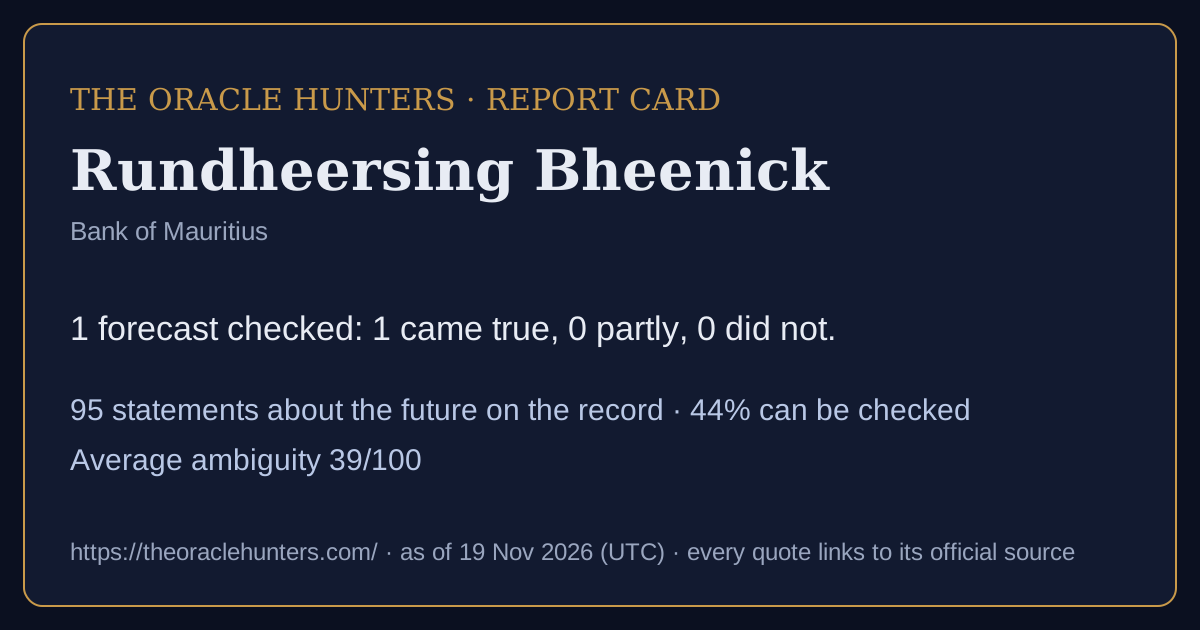
Track record: 1 forecast checked: 1 came true, 0 partly, 0 did not.
95forecasts & commitments on the record
44%can be checked as stated
39average ambiguity (0-100)
0goalpost moves recorded
0confirmed U-turns
Timeline
came true partly did not not due / being checked / too vague
Calibration score: shown after 10 checked forecasts with a stated likelihood (now 1).
How they speak about the future: based on data 63, stated on authority 28, educated guess 4.
Kinds of claim: forecast 82, mixed claim 5, scenario (if… then) 5, commitment 3. · Download this report card as a picture
In the nine words
πρόγνωσιςInference from evidence61 · 64%μαντείαInspired knowledge24 · 25%πρόνοιαPreparing for the future5 · 5%προαναγγελίαPublic pre-announcement3 · 3%φρόνησιςPractical wisdom1 · 1%πρόβλεψιςSeeing the signs1 · 1%
How to read this
Each box is one sentence a public figure or institution said about the future, word for word, with a link to the official text. Can be checked means it names what will happen, by when, and how likely - so it can be compared with official figures later. Too vague to check means it does not. Ambiguity (0-100) is how many different ways the sentence can be read. When the date passes, the forecast is compared with official data and marked came true, partly or did not come true. Labels judge the sentence, never the person. Full guide and glossary.Checked
We expect our economy to grow by about 3.5 per cent in 2014, and inflation to remain below 4.0 percent in 2014.
Came true. Said: inflation below 4% in 2014. Official figure for Mauritius: 3.2% (World Bank open data). On target. official data · checked 14 Nov 2026 · automatic check against official data (rules v3)
On the record (95)
The Bank expects the project to be commissioned by next year.
This facility has been extended up to 31 January 2014, with repayment at latest by 31 May 2014.
The forecast for the savings rate is 14.2 per cent of GDP at market prices in 2013, compared with 15.1 per cent in 2012.
The cut was effected against a backdrop of rising inflation, from 2.9 per cent year-on-year in January 2013 to 3.7 per cent in May, the latest data point available to the June MPC meeting.
The Task Force has been considering the issues raised during the representations and will be releasing a public consultation document this year with a view to ensuring that both consumers and banks have a fair deal.
We shall ensure that the transitional arrangements to implement the new standards allow the banking sector to meet the higher capital standards through adequate earnings retention and capital raising, while still supporting lending to the economy.
This measure will be applicable to banks as from the first quarter of 2016, thus giving them ample time to prepare for the change.
It could possibly reach 5% but this can only happen if strong pro-active policies are taken in five areas.
It concludes that growth will most likely be in the 3-4% range.
It dissects the sources of past growth, and projects growth to 2030.
In what was probably a unique feature, Vision 2020 bridged the party-political divide.
Many of you, present here tonight, contributed to developing Vision 2020 , as we looked ahead to what our country could become in the span of 25 years.
The salary review includes a Performance Management System which will be introduced this year, paving the way for a mechanism that relates work performance and remuneration.
The persistence of low interest rates led to excessive credit growth in some sectors which, if left unchecked, could have resulted in higher non-performing loans.
We followed it up this year by launching a Graduate Trainee Programme which will allow the Bank to spot potential new recruits, enhance its professional competence, and rejuvenate its workforce.
In May 2014, the Bank hosted the IFSB Summit.
The banks, which would be identified as DSIBs, will be subject to a capital surcharge as from March 2016.
We expect our economy to grow by about 3.5 per cent in 2014, and inflation to remain below 4.0 percent in 2014.
Came true. Said: inflation below 4% in 2014. Official figure for Mauritius: 3.2% (World Bank open data). On target. official data · checked 14 Nov 2026 · automatic check against official data (rules v3)
It will be setting up an office in Mauritius this year.
Unlike in the West where interest rates hover at, or near, the zero-bound, with interest rates in Kenya and Nigeria for example between 8% to 14%, there is much scope for compression in Africa as monetary policy gains traction and inflation falls, which will in turn help unlock still more growth.
Its southern African neighbours, Mozambique and Zambia, are likely to clock more than 7% growth.
Africa will issue a record USD7 Billion in Eurobonds this year, more than the cumulative sum of the last five years.
As their largest trading partner, the EU is mired in recession this year, Mauritians can count their blessings as their country happens to be in one of the fastest growing regions of the planet: East Africa will grow by around 6%.
We shall introduce more stringent conditions, including higher capital requirements, as we step up our endeavours to address the risks posed by Domestic-Systemically Important Banks, whose failure might entail widespread consequences for the economy.
The Bank will thus set up and operate a National Payment Switch (NPS) by the end of the year.
When 90% of the people of the south western Indian Ocean are living in poverty -I speak principally of Madagascar and the Comoros -we might ask ourselves, not how we can continue to be in the lead at the top of the Mo Ibrahim Index for Africa, but what have we done with that leadership to secure development in our …
A consultative paper outlining the proposals of the Bank will be issued for consultation by the end of October 2012.
In August 2012, I acceded to the Vice-Chairmanship of the AACB and the Bank will be hosting the 37th Assembly of Governors in August 2013.
So we will be introducing Basel III in a phased manner and by the end of 2018 approximately, we should be there.
We have also initiated the process of compiling Balance of Payments (BoP) statistics in accordance with the sixth edition of the IMF's BoP Manual - an exercise that we expect to complete by 2014.
Growth momentum was maintained in 2011 at 4.1 per cent, not far below trend, and projected to be slightly below 4 per cent in 2012.
Under the Scheme, the 14 participant banks - i.e. all the banks involved in Segment A activity - will provide credit facilities to SMEs at 3 percentage points above the prevailing KRR in an amount of up to Rs3 billion over the next three years.
Barring unforeseen shocks, we expect both year-on-year and headline inflation to moderate this year and gradually move within a narrowing range around our comfort level of 4-6 per cent.
We are, of course, not insulated from the problems affecting the rest of the world and inflationary pressures have increased; but, with well-timed monetary steps, we have succeeded in containing inflation to an expected 5.1% in 2011.
As coincidence will have it, this Annual Dinner comes almost on the eve of the last Monetary Policy Committee Meeting for this year when you can expect some significant developments.
Despite repeated renewals and reconfirmation of commitments to raise ODA flows to 1 per cent of GDP since the so-called First Development Decade, this pledge is unlikely to be redeemed when the source countries are going through such critical times.
We will be launching our fifth edition of MP Challenge at the end of the month, and we hope there will be more participation this year.
Our economy is quite buoyant; we are optimistic that we will go beyond the 4.6 percent growth.
Growth of 4.6 percent is not at all what we could call a stagnant economy.
Presently, the growth forecast of the Central Statistics Office is 4.5 percent, and since March, we at the Central Bank, had forecasted that growth would be 4.6 percent.
We hope that by the end of the year, the Bank of Mauritius will be able to launch a Business Sentiment Survey , targeting a sample of respondents slightly different from that targeted by the Mauritius Chamber of Commerce and Industry, which primarily targets its own members.
this year, about 9,500 jobs will be created, including 500 jobs for foreigners.
In SADC, a number of initiatives have been launched to create a FMI by 2018 on the assumption that there will be monetary convergence and a SADC Central Bank by that date.
It will come as no surprise to close observers of the Mauritian economic scene that, in its last Article IV Consultation Mission conducted early this year, the IMF finds that our currency is broadly in line with economic fundamentals.
After almost two years of hard work and consultation with banks, our framework for assessing the financial strength of banks, the CAMEL Rating has been refined and will be made public at the beginning of next month.
If you are the World Bank, you would probably want greater 'Ease of Doing Business', which means fewer regulations.
At its September 2010 meeting, after weighing the risks to the growth and inflation outlook over the policy-relevant horizon, the MPC decided unanimously to cut the KRR by 100 basis points to support domestic recovery.
This would depend on recovery in our main trading partners but could be faster if we succeed in reducing our export-dependence on slow-growing traditional partners.
We continued to make available to banks the Special Foreign Currency Line of Credit, aggregating USD125 million, which we had introduced in December 2008 for the financing of the country's trade when domestic banks faced unusual conditions and could not rely on traditional trade lines from their correspondent banks overseas.
We expect a growth rate of 4.2 per cent in 2011.
Showing the newest 50 - the ledger has all 95.
Also said - not checkable as stated (12 newest)
Remarks about the future with no date, figure or likelihood that could be checked. They are kept on the record and shown here, but not scored.
We shall soon be opening the club of DSIB's - Domestic Systemically Important Banks.
This is a matter that we shall be discussing with your management and your board of directors in the coming months.
These digital natives will no doubt push AfrAsia to go ever deeper into the world of digital banking.
It may now be the turn of the banking and payments sector to benefit from a similar radical transformation.
It will emerge as the single most important factor driving sustainable topand bottom-line growth in banking.
- We shall have bankless banking, no counters, no backrooms, no paper, no sky- high buildings.
When I tell you what this law says, you will understand why it must be taken with a pinch of salt, preferably a large one:
How will they promote the job-rich and inclusive growth that the head of the IMF, Christine Lagarde, has recently been calling for?
These will lead to greater availability and rapidly declining cost of communication, transport, health care, education and food.
- Mobile may become the main delivery channel for banking and payment services.
- In short banking will be cash-lite, with fewer staff, and still fewer bankers.
When 'tapering' begins in earnest, the world will have to confront the new challenge of returning to a 'normal' monetary policy.