The public record of what the powerful say about the futureAll times UTCYour time ATHENA News Room is liveSealed daily · anchored in BitcoinΕλληνικά A Tekmerion product
THE ORACLE HUNTERS • EVERY PROPHECY ON THE RECORD •AAAWgmp1bWIAAAAeanVtZGMycGEAEQAQgAAAqgA4m3EDYzJwYQAAABZcanVtYgAAAEdqdW1kYzJtYQARABCAAACqADibcQN1cm46YzJwYTo4MTk5ZDlhYi0zYzIzLTQwZDYtYTc1NS04MTM5NWJhODhjMTYAAAADl2p1bWIAAAApanVtZGMyYXMAEQAQgAAAqgA4m3EDYzJwYS5hc3NlcnRpb25zAAAAALxqdW1iAAAARGp1bWRjYm9yABEAEIAAAKoAOJtxE2MycGEuaW5ncmVkaWVudC52MwAAAAAYYzJzaIxn7Lz8d2kiZVLVmLMqjH8AAABwY2JvcqNpZGM6Zm9ybWF0bWltYWdlL3N2Zyt4bWxqaW5zdGFuY2VJRHgseG1wOmlpZDpjNjQzY2M2MC03NmU5LTRkODUtODAzNi04Y2U2YmUwZDA0MzRscmVsYXRpb25zaGlwaHBhcmVudE9mAAAB4mp1bWIAAABBanVtZGNib3IAEQAQgAAAqgA4m3ETYzJwYS5hY3Rpb25zLnYyAAAAABhjMnNoYoNKEfN7QooyLxBggQwrRAAAAZljYm9yomdhY3Rpb25zgqJmYWN0aW9ua2MycGEub3BlbmVkanBhcmFtZXRlcnOha2luZ3JlZGllbnRzgaJjdXJseC1zZWxmI2p1bWJmPWMycGEuYXNzZXJ0aW9ucy9jMnBhLmluZ3JlZGllbnQudjNkaGFzaFggGR++KIZKhTpFlfMpaeP4xKARvK6IpGRCm/JKHJsg8z+kZmFjdGlvbngdY29tLmFudGhyb3BpYy5jbGF1ZGUucHJvdmlkZWRqcGFyYW1ldGVyc6F4H2NvbS5hbnRocm9waWMub3JpZ2luLWNvbmZpZGVuY2VndW5rbm93bmtkZXNjcmlwdGlvbnhmQ2xhdWRlIHByb3ZpZGVkIHRoaXMgZmlsZSBhdCB0aGUgcmVxdWVzdCBvZiBhIHVzZXIgYW5kIG1heSBoYXZlIGNyZWF0ZWQgb3IgbW9kaWZpZWQgdGhlIGZpbGUgY29udGVudHMubXNvZnR3YXJlQWdlbnShZG5hbWVmQ2xhdWRlcmFsbEFjdGlvbnNJbmNsdWRlZPUAAADIanVtYgAAAEBqdW1kY2JvcgARABCAAACqADibcRNjMnBhLmhhc2guZGF0YQAAAAAYYzJzaLTPAMahVK/46OuJ/Q+uuA8AAACAY2JvcqVjYWxnZnNoYTI1NmNwYWRMAAAAAAAAAAAAAAAAZGhhc2hYII7HF9R24wInyRZy4rI4Fw0mI4Rb/ZNxjfxeO7PO35j2ZG5hbWVuanVtYmYgbWFuaWZlc3RqZXhjbHVzaW9uc4GiZXN0YXJ0GQiaZmxlbmd0aBkeBAAAAj5qdW1iAAAAJ2p1bWRjMmNsABEAEIAAAKoAOJtxA2MycGEuY2xhaW0udjIAAAACD2Nib3KlY2FsZ2ZzaGEyNTZpc2lnbmF0dXJleE1zZWxmI2p1bWJmPS9jMnBhL3VybjpjMnBhOjgxOTlkOWFiLTNjMjMtNDBkNi1hNzU1LTgxMzk1YmE4OGMxNi9jMnBhLnNpZ25hdHVyZWppbnN0YW5jZUlEeCx4bXA6aWlkOjljYzUwMDc4LTgzMDctNDI0ZS04NjE4LTVmYTQzMmE1MWJmNHJjcmVhdGVkX2Fzc2VydGlvbnODomN1cmx4LXNlbGYjanVtYmY9YzJwYS5hc3NlcnRpb25zL2MycGEuaW5ncmVkaWVudC52M2RoYXNoWCAZH74ohkqFOkWV8ylp4/jEoBG8roikZEKb8kocmyDzP6JjdXJseCpzZWxmI2p1bWJmPWMycGEuYXNzZXJ0aW9ucy9jMnBhLmFjdGlvbnMudjJkaGFzaFggjvXIkXvJ7aXB5IwuH8TLLMTeq4OAYClzgZHySVCatNCiY3VybHgpc2VsZiNqdW1iZj1jMnBhLmFzc2VydGlvbnMvYzJwYS5oYXNoLmRhdGFkaGFzaFggIhTKhum+9R2LsXAUkQyOeb6aKanhapGjq6FRT3EaJ9V0Y2xhaW1fZ2VuZXJhdG9yX2luZm+jZG5hbWVvQW50aHJvcGljIEZpbGVzZ3ZlcnNpb25lMS4wLjBrc3BlY1ZlcnNpb25lMi40LjAAABA4anVtYgAAAChqdW1kYzJjcwARABCAAACqADibcQNjMnBhLnNpZ25hdHVyZQAAABAIY2JvctKEWQISogEmGCFZAgowggIGMIIBjaADAgECAhRA5aAK7sI50L64g/oGQgU9Z1UTADAKBggqhkjOPQQDAzBJMRcwFQYDVQQKEw5BbnRocm9waWMsIFBCQzEuMCwGA1UEAxMlQW50aHJvcGljIENvbnRlbnQgQ3JlZGVudGlhbHMgUm9vdCBDQTAeFw0yNjA4MDcxODQzNTZaFw0yODA4MDYxOTQzNTZaMEQxFzAVBgNVBAoTDkFudGhyb3BpYywgUEJDMSkwJwYDVQQDEyBBbnRocm9waWMgQ2xhdWRlIENvbnRlbnQgU2lnbmluZzBZMBMGByqGSM49AgEGCCqGSM49AwEHA0IABJh6CmvLUBgFFNU0vUKlOVtE6djd17L5SuwX0LemFisBM3dkd/3cyjxFA3Qo5S46fX0/ihY0VZ7mfb9KF703t5OjWDBWMA4GA1UdDwEB/wQEAwIHgDAVBgNVHSUEDjAMBgorBgEEAYPoXgIBMAwGA1UdEwEB/wQCMAAwHwYDVR0jBBgwFoAUzlHiBIFOZFsj+OPEz5o+nMHXXMIwCgYIKoZIzj0EAwMDZwAwZAIwMXMdFJ4BetLLVY7ORuE9noqbbAZOZn/aArXyTwFAZfKrPzxF2vPoJNf1+UCdg1XGAjBwX1zd9WGqYkqmL5SFqw1QySjr1zJfpJM9+1rdDwSPLMOPOjKuiXjoU/pUUeG9RwmhY3BhZFkNngAAAAAAAAAAAAAAAAAAAAAAAAAAAAAAAAAAAAAAAAAAAAAAAAAAAAAAAAAAAAAAAAAAAAAAAAAAAAAAAAAAAAAAAAAAAAAAAAAAAAAAAAAAAAAAAAAAAAAAAAAAAAAAAAAAAAAAAAAAAAAAAAAAAAAAAAAAAAAAAAAAAAAAAAAAAAAAAAAAAAAAAAAAAAAAAAAAAAAAAAAAAAAAAAAAAAAAAAAAAAAAAAAAAAAAAAAAAAAAAAAAAAAAAAAAAAAAAAAAAAAAAAAAAAAAAAAAAAAAAAAAAAAAAAAAAAAAAAAAAAAAAAAAAAAAAAAAAAAAAAAAAAAAAAAAAAAAAAAAAAAAAAAAAAAAAAAAAAAAAAAAAAAAAAAAAAAAAAAAAAAAAAAAAAAAAAAAAAAAAAAAAAAAAAAAAAAAAAAAAAAAAAAAAAAAAAAAAAAAAAAAAAAAAAAAAAAAAAAAAAAAAAAAAAAAAAAAAAAAAAAAAAAAAAAAAAAAAAAAAAAAAAAAAAAAAAAAAAAAAAAAAAAAAAAAAAAAAAAAAAAAAAAAAAAAAAAAAAAAAAAAAAAAAAAAAAAAAAAAAAAAAAAAAAAAAAAAAAAAAAAAAAAAAAAAAAAAAAAAAAAAAAAAAAAAAAAAAAAAAAAAAAAAAAAAAAAAAAAAAAAAAAAAAAAAAAAAAAAAAAAAAAAAAAAAAAAAAAAAAAAAAAAAAAAAAAAAAAAAAAAAAAAAAAAAAAAAAAAAAAAAAAAAAAAAAAAAAAAAAAAAAAAAAAAAAAAAAAAAAAAAAAAAAAAAAAAAAAAAAAAAAAAAAAAAAAAAAAAAAAAAAAAAAAAAAAAAAAAAAAAAAAAAAAAAAAAAAAAAAAAAAAAAAAAAAAAAAAAAAAAAAAAAAAAAAAAAAAAAAAAAAAAAAAAAAAAAAAAAAAAAAAAAAAAAAAAAAAAAAAAAAAAAAAAAAAAAAAAAAAAAAAAAAAAAAAAAAAAAAAAAAAAAAAAAAAAAAAAAAAAAAAAAAAAAAAAAAAAAAAAAAAAAAAAAAAAAAAAAAAAAAAAAAAAAAAAAAAAAAAAAAAAAAAAAAAAAAAAAAAAAAAAAAAAAAAAAAAAAAAAAAAAAAAAAAAAAAAAAAAAAAAAAAAAAAAAAAAAAAAAAAAAAAAAAAAAAAAAAAAAAAAAAAAAAAAAAAAAAAAAAAAAAAAAAAAAAAAAAAAAAAAAAAAAAAAAAAAAAAAAAAAAAAAAAAAAAAAAAAAAAAAAAAAAAAAAAAAAAAAAAAAAAAAAAAAAAAAAAAAAAAAAAAAAAAAAAAAAAAAAAAAAAAAAAAAAAAAAAAAAAAAAAAAAAAAAAAAAAAAAAAAAAAAAAAAAAAAAAAAAAAAAAAAAAAAAAAAAAAAAAAAAAAAAAAAAAAAAAAAAAAAAAAAAAAAAAAAAAAAAAAAAAAAAAAAAAAAAAAAAAAAAAAAAAAAAAAAAAAAAAAAAAAAAAAAAAAAAAAAAAAAAAAAAAAAAAAAAAAAAAAAAAAAAAAAAAAAAAAAAAAAAAAAAAAAAAAAAAAAAAAAAAAAAAAAAAAAAAAAAAAAAAAAAAAAAAAAAAAAAAAAAAAAAAAAAAAAAAAAAAAAAAAAAAAAAAAAAAAAAAAAAAAAAAAAAAAAAAAAAAAAAAAAAAAAAAAAAAAAAAAAAAAAAAAAAAAAAAAAAAAAAAAAAAAAAAAAAAAAAAAAAAAAAAAAAAAAAAAAAAAAAAAAAAAAAAAAAAAAAAAAAAAAAAAAAAAAAAAAAAAAAAAAAAAAAAAAAAAAAAAAAAAAAAAAAAAAAAAAAAAAAAAAAAAAAAAAAAAAAAAAAAAAAAAAAAAAAAAAAAAAAAAAAAAAAAAAAAAAAAAAAAAAAAAAAAAAAAAAAAAAAAAAAAAAAAAAAAAAAAAAAAAAAAAAAAAAAAAAAAAAAAAAAAAAAAAAAAAAAAAAAAAAAAAAAAAAAAAAAAAAAAAAAAAAAAAAAAAAAAAAAAAAAAAAAAAAAAAAAAAAAAAAAAAAAAAAAAAAAAAAAAAAAAAAAAAAAAAAAAAAAAAAAAAAAAAAAAAAAAAAAAAAAAAAAAAAAAAAAAAAAAAAAAAAAAAAAAAAAAAAAAAAAAAAAAAAAAAAAAAAAAAAAAAAAAAAAAAAAAAAAAAAAAAAAAAAAAAAAAAAAAAAAAAAAAAAAAAAAAAAAAAAAAAAAAAAAAAAAAAAAAAAAAAAAAAAAAAAAAAAAAAAAAAAAAAAAAAAAAAAAAAAAAAAAAAAAAAAAAAAAAAAAAAAAAAAAAAAAAAAAAAAAAAAAAAAAAAAAAAAAAAAAAAAAAAAAAAAAAAAAAAAAAAAAAAAAAAAAAAAAAAAAAAAAAAAAAAAAAAAAAAAAAAAAAAAAAAAAAAAAAAAAAAAAAAAAAAAAAAAAAAAAAAAAAAAAAAAAAAAAAAAAAAAAAAAAAAAAAAAAAAAAAAAAAAAAAAAAAAAAAAAAAAAAAAAAAAAAAAAAAAAAAAAAAAAAAAAAAAAAAAAAAAAAAAAAAAAAAAAAAAAAAAAAAAAAAAAAAAAAAAAAAAAAAAAAAAAAAAAAAAAAAAAAAAAAAAAAAAAAAAAAAAAAAAAAAAAAAAAAAAAAAAAAAAAAAAAAAAAAAAAAAAAAAAAAAAAAAAAAAAAAAAAAAAAAAAAAAAAAAAAAAAAAAAAAAAAAAAAAAAAAAAAAAAAAAAAAAAAAAAAAAAAAAAAAAAAAAAAAAAAAAAAAAAAAAAAAAAAAAAAAAAAAAAAAAAAAAAAAAAAAAAAAAAAAAAAAAAAAAAAAAAAAAAAAAAAAAAAAAAAAAAAAAAAAAAAAAAAAAAAAAAAAAAAAAAAAAAAAAAAAAAAAAAAAAAAAAAAAAAAAAAAAAAAAAAAAAAAAAAAAAAAAAAAAAAAAAAAAAAAAAAAAAAAAAAAAAAAAAAAAAAAAAAAAAAAAAAAAAAAAAAAAAAAAAAAAAAAAAAAAAAAAAAAAAAAAAAAAAAAAAAAAAAAAAAAAAAAAAAAAAAAAAAAAAAAAAAAAAAAAAAAAAAAAAAAAAAAAAAAAAAAAAAAAAAAAAAAAAAAAAAAAAAAAAAAAAAAAAAAAAAAAAAAAAAAAAAAAAAAAAAAAAAAAAAAAAAAAAAAAAAAAAAAAAAAAAAAAAAAAAAAAAAAAAAAAAAAAAAAAAAAAAAAAAAAAAAAAAAAAAAAAAAAAAAAAAAAAAAAAAAAAAAAAAAAAAAAAAAAAAAAAAAAAAAAAAAAAAAAAAAAAAAAAAAAAAAAAAAAAAAAAAAAAAAAAAAAAAAAAAAAAAAAAAAAAAAAAAAAAAAAAAAAAAAAAAAAAAAAAAAAAAAAAAAAAAAAAAAAAAAAAAAAAAAAAAAAAAAAAAAAAAAAAAAAAAAAAAAAAAAAAAAAAAAAAAAAAAAAAAAAAAAAAAAAAAAAAAAAAAAAAAAAAAAAAAAAAAAAAAAAAAAAAAAAAAAAAAAAAAAAAAAAAAAAAAAAAAAAAAAAAAAAAAAAAAAAAAAAAAAAAAAAAAAAAAAAAAAAAAAAAAAAAAAAAAAAAAAAAAAAAAAAAAAAAAAAAAAAAAAAAAAAAAAAAAAAAAAAAAAAAAAAAAAAAAAAAAAAAAAAAAAAAAAAAAAAAAAAAAAAAAAAAAAAAAAAAAAAAAAAAAAAAAAAAAAAAAAAAAAAAAAAAAAAAAAAAAAAAAAAAAAAAAAAAAAAAAAAAAAAAAAAAAAAAAAAAAAAAAAAAAAAAAAAAAAAAAAAAAAAAAAAAAAAAAAAAAAAAAAAAAAAAAAAAAAAAAAAAAAAAAAAAAAAAAAAAAAAAAAAAAAAAAAAAAAAAAAAAAAAAAAAAAAAAAAAAAAAAAAAAAAAAAAAAAAAAAAAAAAAAAAAAAAAAAAAAAAAAAAAAAAAAAAAAAAAAAAAAAAAAAAAAAAAAAAAAAAAAAAAAAAAAAAAAAAAAAAAAAAAAAAAAAAAAAAAAAAAAAAAAAAAAAAAAAAAAAAAAAAAAAAAAAAAAAAAAAAAAAAAAAAAAAAAAAAAAAAAAAAAAAAAAAAAAAAAAAAAAAAAAAAAAAAAAAAAAAAAAAAAAAAAAAAAAAAAAAAAAAAAAAAAAAAAAAAAAAAAAAAAAAAAAAAAAAAAAAAAAAAAAAAAAAAAAAAAAAAAAAAAAAAAAAAAAAAAAAAAAAAAAAAAAAAAAAAAAAAAAAAAAAAAAAAAAAAAAAAAAAAAAAAAAAAAAAAAAAAAAAAAAAAAAAAAAAAAAAAAAAAAAAAAAAAAAAAAAAAAAAAAAAAAAAAAAAAAAAAAAAAAAAAAAAAAAAAAAAAAAAAAAAAAAAAAAAAAAAAAAAAAAAAAAAAAAAAAAAAAAAAAAAAAAAAAAAAAAAAAAAAAAAAAAAAAAAAAAAAAAAAAAAAAAAAAAAAAAAAAAAAAAAAAAAAAAAAAAAAAAAAAAAAAAAAAAAAAAAAAAAAAAAAAAAAAAAAAAAAAAAAAAAAAAAAAAAAAAAAAAAAAAAAAAAAAAAAAAAAAAAAAAAAAAAAAAAAAAAAAAAAAAAAAAAAAAAAAAAAAAAAAAAAAAAAAAAAAAAAAAAAAAAAAAAAAAAAAAAAAAAAAAAAAAAAAAAAAAAAAAAAAAAAAAAAAAAAAAAAAAAAAAAAAAAAAAAAAAAAPZYQLfUpeT/MPsu1gA3RgZ8fvvIDmyZYJDWmz6ftVFNojm4kOQbEdCSTa0XP3aqZnboyhQ+RU/hD3bq8nBGJ+yvrXI=The Oracle HuntersEvery prophecy, on the record. · Οἱ Κυνηγοὶ τῶν ΧρησμῶνUnder development

← Tracking the Prophets

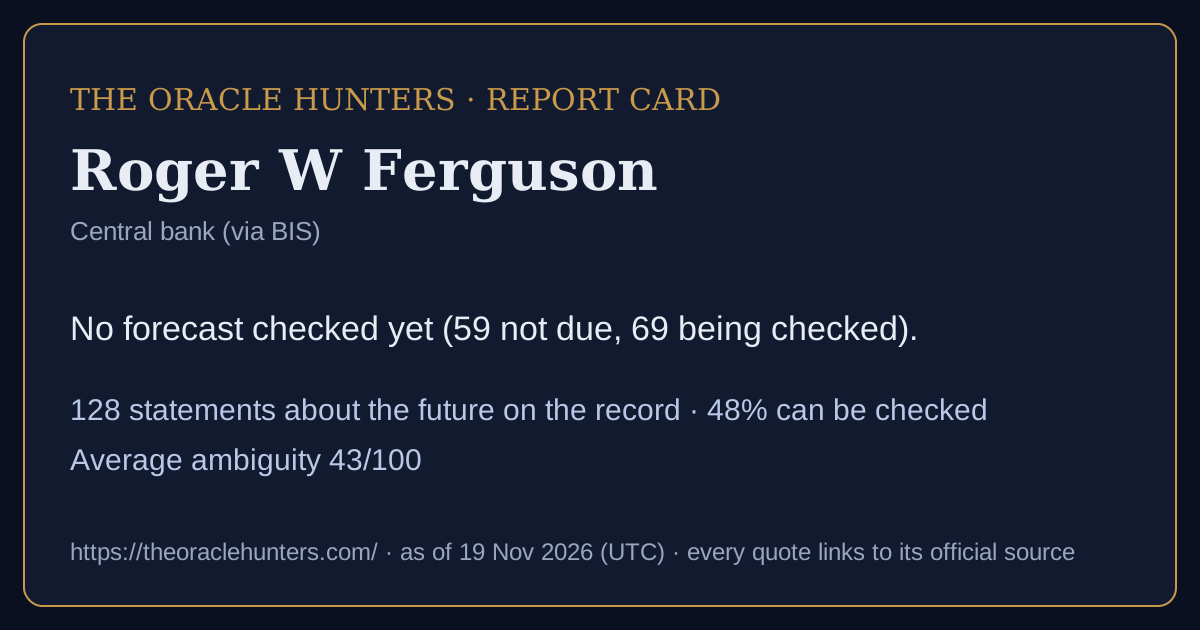
Roger W Ferguson

Central bank (via BIS)

Track record: No forecast checked yet (59 not due, 69 being checked).
128forecasts & commitments on the record
48%can be checked as stated
43average ambiguity (0-100)
0goalpost moves recorded
0confirmed U-turns

Timeline

19981998: Due - being checked1998: Due - being checked1998: Due - being checked1998: Due - being checked1998: Due - being checked1998: Due - being checked1998: Not due yet1998: Not due yet (+5 more)19991999: Not due yet1999: Due - being checked1999: Due - being checked1999: Due - being checked1999: Due - being checked1999: Not due yet1999: Not due yet1999: Due - being checked (+29 more)20002000: Not due yet20012001: Not due yet2001: Due - being checked2001: Not due yet2001: Due - being checked2001: Not due yet20022002: Not due yet2002: Due - being checked2002: Due - being checked2002: Not due yet2002: Not due yet2002: Not due yet2002: Not due yet2002: Not due yet (+5 more)20032003: Not due yet2003: Not due yet2003: Not due yet2003: Not due yet2003: Not due yet2003: Due - being checked2003: Not due yet2003: Not due yet (+19 more)20042004: Not due yet2004: Not due yet2004: Not due yet2004: Not due yet2004: Due - being checked2004: Due - being checked2004: Not due yet2004: Due - being checked (+8 more)20052005: Not due yet2005: Not due yet2005: Due - being checked2005: Due - being checked2005: Due - being checked2005: Due - being checked2005: Not due yet2005: Due - being checked (+5 more)20062006: Due - being checked2006: Due - being checked2006: Due - being checked
came true partly did not not due / being checked / too vague

Calibration score: shown after 10 checked forecasts with a stated likelihood (now 0).
How they speak about the future: based on data 91, educated guess 21, stated on authority 16.
Kinds of claim: forecast 83, scenario (if… then) 21, mixed claim 20, commitment 4. · Download this report card as a picture
In the nine words

πρόγνωσιςInference from evidence78 · 61%πρόνοιαPreparing for the future20 · 16%μαντείαInspired knowledge13 · 10%εἰκασίαConjecture7 · 5%πρόβλεψιςSeeing the signs4 · 3%προαναγγελίαPublic pre-announcement4 · 3%φρόνησιςPractical wisdom2 · 2%
How to read this Each box is one sentence a public figure or institution said about the future, word for word, with a link to the official text. Can be checked means it names what will happen, by when, and how likely - so it can be compared with official figures later. Too vague to check means it does not. Ambiguity (0-100) is how many different ways the sentence can be read. When the date passes, the forecast is compared with official data and marked came true, partly or did not come true. Labels judge the sentence, never the person. Full guide and glossary.

On the record (128)

Given the considerable uncertainties facing the economy and the outlook for policy, policy decisions in coming months will depend heavily on the implications of incoming economic data for future growth and inflation.
Central bank (via BIS) · said 03 Mar 2006 (date) · Economic outlook for the United States · evidence & why
πρόγνωσις · Inference from evidencePartly checkableForecastbased on dataambiguity 56/100implied call / likelihood: Yes · 85% · for the most partbelow the RIM-1 standarddue 30 Aug 2006 (vague)Due - being checkedinflationgrowth
The model suggests the subtraction this year will be about a 1/2 percentage point.
Central bank (via BIS) · said 03 Mar 2006 (date) · Economic outlook for the United States · evidence & why
πρόγνωσις · Inference from evidencePartly checkableForecastbased on dataambiguity 36/100implied call / likelihood: Yes · 85% · for the most partbelow the RIM-1 standarddue 31 Dec 2006Due - being checked
All told, increases in energy prices over the past couple of years probably added about 1/2 percentage point to core inflation in 2005, and the lagged pass-through of past increases in energy prices appears likely to add roughly the same amount this year, provided that energy prices do not rise significantly further.
Central bank (via BIS) · said 03 Mar 2006 (date) · Economic outlook for the United States · evidence & why
πρόγνωσις · Inference from evidenceCan be checkedForecastbased on dataambiguity 36/100implied call / likelihood: Yes · 70% · probablebelow the RIM-1 standarddue 31 Dec 2006Due - being checkedinflationenergy
Conversely, if credibility is lacking and inflation expectations are high, firms will be raising prices, and workers will be demanding large wage increases, making it more costly, in terms of jobs and output, for the central bank to tighten policy sufficiently to achieve low inflation.
US Federal Reserve System · said 03 Nov 2005 (date) · Monetary credibility, inflation and economic growth · evidence & why
πρόνοια · Preparing for the futurePartly checkableScenario (if… then)educated guessambiguity 36/100implied call / likelihood: Yes · 85% · for the most partbelow the RIM-1 standardNot due yetinflationgrowthlabourfinance
Following seminal work by Stanley Fischer, researchers seem to agree that extreme inflation rates, say above 40 percent per year, are associated with reduced economic growth. 8 Such high rates of inflation are often a sign of an economy in or approaching crisis, and once inflation crosses the threshold of 40 percent, inflation is considerably more unstable and likely to …
US Federal Reserve System · said 03 Nov 2005 (date) · Monetary credibility, inflation and economic growth · evidence & why
πρόβλεψις · Seeing the signsPartly checkableForecastbased on dataambiguity 36/100implied call / likelihood: Yes · 70% · probablebelow the RIM-1 standardNot due yetinflationgrowth
According to the latest World Economic Outlook from the International Monetary Fund (IMF), consumer price inflation in the advanced economies over the decade beginning in 1997 and ending next year looks set to come in at an average annual rate of less than 2 percent, down from 31/2 percent for the previous ten years.
US Federal Reserve System · said 03 Nov 2005 (date) · Monetary credibility, inflation and economic growth · evidence & why
πρόγνωσις · Inference from evidencePartly checkableForecastbased on dataambiguity 36/100below the RIM-1 standarddue 31 Dec 2006Due - being checkedinflation
Given the lags in the inflation process, core PCE inflation rises a bit further relative to baseline next year.
US Federal Reserve System · said 18 Oct 2005 (date) · Economic outlook for the United States · evidence & why
μαντεία · Inspired knowledgePartly checkableForecaststated on authorityambiguity 36/100below the RIM-1 standarddue 31 Dec 2006Due - being checkedinflation
The drag on real GDP growth next year would be comparable to that in 2004.
US Federal Reserve System · said 18 Oct 2005 (date) · Economic outlook for the United States · evidence & why
πρόγνωσις · Inference from evidencePartly checkableForecastbased on dataambiguity 36/100below the RIM-1 standarddue 31 Dec 2006Due - being checkedgrowth
But, I think that the bulk of the disruptions from the storms will be felt in the second half of this year.
US Federal Reserve System · said 18 Oct 2005 (date) · Economic outlook for the United States · evidence & why
εἰκασία · ConjecturePartly checkableForecasteducated guessambiguity 36/100implied call / likelihood: Yes · 85% · for the most partbelow the RIM-1 standarddue 31 Dec 2005Due - being checked
On net, real gross domestic product (GDP) looked likely to accelerate somewhat in the third and fourth quarters from the 3-1/2 percent annual rate registered in the first half of the year.
US Federal Reserve System · said 18 Oct 2005 (date) · Economic outlook for the United States · evidence & why
Consumer energy prices are projected to rise substantially in the second half of this year, and some spillover into the prices of non-energy goods and services looks likely as well.
US Federal Reserve System · said 18 Oct 2005 (date) · Economic outlook for the United States · evidence & why
μαντεία · Inspired knowledgeCan be checkedForecaststated on authorityambiguity 36/100implied call / likelihood: Yes · 70% · probablebelow the RIM-1 standarddue 31 Dec 2005Due - being checkedinflationenergy
In 2006, the recovery process is expected to contribute to the growth of real GDP.
US Federal Reserve System · said 18 Oct 2005 (date) · Economic outlook for the United States · evidence & why
πρόγνωσις · Inference from evidenceCan be checkedForecastbased on dataambiguity 0/100implied call / likelihood: Yes · 70% · probablemeets the RIM-1 standarddue 31 Dec 2006Due - being checkedgrowth
(I might add that the correlation with real house prices also holds even if M3 is normalized by prices or gross domestic product.
Central bank (via BIS) · said 27 May 2005 (date) · Asset prices and monetary liquidity · evidence & why
πρόνοια · Preparing for the futurePartly checkableScenario (if… then)based on dataambiguity 56/100implied call / likelihood: No · 35% · probablebelow the RIM-1 standardNot due yetinflation
I should note, however, that just as a decline in the budget deficit is desirable even if it would not substantially reduce the trade deficit, a rise in private saving rates also would be helpful because it would strengthen private balance sheets and provide additional resources for investment and growth.
Central bank (via BIS) · said 20 Apr 2005 (date) · US current account deficit - causes and consequences · evidence & why
εἰκασία · ConjecturePartly checkableMixed claimeducated guessambiguity 56/100below the RIM-1 standardNot due yetgrowthfiscaltrade
I will not discuss yet another factor that undoubtedly has contributed to the widening of the deficit - the rise in oil prices but it is worth noting that our oil import bill has risen by about $110 billion, from $68 billion in 1999 to $180 billion in 2004, and most of this increase reflects higher oil prices.
Central bank (via BIS) · said 20 Apr 2005 (date) · US current account deficit - causes and consequences · evidence & why
πρόγνωσις · Inference from evidencePartly checkableForecastbased on dataambiguity 36/100implied call / likelihood: Yes · 85% · for the most partbelow the RIM-1 standardNot due yetinflationfiscalenergytrade
In that case, if the expected productivity boom does not subsequently materialize, asset prices will fall.
πρόνοια · Preparing for the futurePartly checkableScenario (if… then)educated guessambiguity 36/100implied call / likelihood: Yes · 70% · probablebelow the RIM-1 standardNot due yetinflation
But this criticism has faded with better understanding of the structure of the U.S. banking system: More than two-thirds of the assets of U.S. banking organizations are likely to be covered by Basel II, as well as more than 99 percent of the foreign claims held by U.S. banking organizations.
Central bank (via BIS) · said 20 Nov 2004 23:00 UTC · The proposed U.S. approach to regulatory capital - an update · evidence & why
Nearly 95 percent of all small and medium-sized banks have regulatory capital ratios of at least 10 percent, and thus it is likely that their current ratios would essentially meet or surpass proposed requirements under Basel II.
Central bank (via BIS) · said 20 Nov 2004 23:00 UTC · The proposed U.S. approach to regulatory capital - an update · evidence & why
Clearly, if evidence of that hesitancy remains - for example, if the labor market were to remain sluggish - that might be one indication that the return of the equilibrium rate to its longer-run level is likely to be relatively gradual.
Central bank (via BIS) · said 29 Oct 2004 (date) · Equilibrium real interest rate - theory and application · evidence & why
πρόνοια · Preparing for the futurePartly checkableScenario (if… then)based on dataambiguity 56/100implied call / likelihood: Yes · 70% · probablebelow the RIM-1 standardNot due yetlabour
However, the outlook for outlays on office buildings, which tend to be correlated with activity and hiring in the business services sectors as well as in the finance and insurance industries, is less upbeat: Office rents have continued to fall, and the vacancy rate, at 15 percent, remains elevated.
Central bank (via BIS) · said 26 Oct 2004 (date) · Factors influencing business investment · evidence & why
πρόγνωσις · Inference from evidencePartly checkableForecastbased on dataambiguity 56/100below the RIM-1 standardNot due yethousing
The partial-expensing provision, which provides an incentive to invest in new capital goods, will expire at the end of this year.
Central bank (via BIS) · said 26 Oct 2004 (date) · Factors influencing business investment · evidence & why
μαντεία · Inspired knowledgePartly checkableForecaststated on authorityambiguity 36/100implied call / likelihood: Yes · 85% · for the most partbelow the RIM-1 standarddue 31 Dec 2004Due - being checked
The evidence that partial expensing is having an effect is not clear-cut, but my view is that capital spending is probably being influenced by the tax law and that its expiration in January will probably damp outlays in the early part of next year.
Central bank (via BIS) · said 26 Oct 2004 (date) · Factors influencing business investment · evidence & why
πρόγνωσις · Inference from evidenceCan be checkedForecastbased on dataambiguity 0/100implied call / likelihood: Yes · 70% · probablemeets the RIM-1 standarddue 31 Dec 2005Due - being checkedfiscal
Shipments of long-lived equipment (which should be more favorably affected than demand for short-lived equipment) have increased more than overall capital spending since the passage of the most recent version of the partial-expensing law - the pattern we would expect to see if businesses were taking advantage of the tax incentive.
Central bank (via BIS) · said 26 Oct 2004 (date) · Factors influencing business investment · evidence & why
εἰκασία · ConjecturePartly checkableMixed claimeducated guessambiguity 36/100implied call / likelihood: Yes · 70% · probablebelow the RIM-1 standardNot due yetfiscal
In contrast, a recent special question in the Philadelphia Fed's Business Outlook Survey showed that about one-quarter of respondents thought that the tax provision was likely to boost their spending this year.
Central bank (via BIS) · said 26 Oct 2004 (date) · Factors influencing business investment · evidence & why
πρόγνωσις · Inference from evidencePartly checkableForecastbased on dataambiguity 36/100implied call / likelihood: Yes · 70% · probablebelow the RIM-1 standarddue 31 Dec 2004Due - being checkedfiscal
The impending expiration is probably boosting investment spending in the second half of this year as firms rush to take the tax advantage before it disappears; however, at this point the evidence is not conclusive.
Central bank (via BIS) · said 26 Oct 2004 (date) · Factors influencing business investment · evidence & why
πρόγνωσις · Inference from evidencePartly checkableForecastbased on dataambiguity 36/100implied call / likelihood: Yes · 70% · probablebelow the RIM-1 standarddue 31 Dec 2004Due - being checkedfiscal
Moreover, the declining share of manufacturing in U.S. employment most likely stems less from import competition than it does from the rapid pace of productivity growth in manufacturing; this growth outpaced the productivity growth of the overall economy by about 1-1/4 percentage points annually from 1973 to 1994 and by 1-1/2 percentage points from 1994 to 2000.
Central bank (via BIS) · said 07 Oct 2004 (date) · Free trade - what do economists really know? · evidence & why
18 This is based on widely cited results from the technology research firm Forrester, which predicts that 3.4 million U.S. service jobs will have been moved offshore by 2015.
Central bank (via BIS) · said 07 Oct 2004 (date) · Free trade - what do economists really know? · evidence & why
πρόγνωσις · Inference from evidenceCan be checkedForecastbased on dataambiguity 0/100implied call / likelihood: Yes · 85% · for the most partmeets the RIM-1 standarddue 31 Dec 2015Due - being checkedlabour
In addition, if policymakers are particularly concerned about improbable but highly costly events, they might well wish to consider market stress in their monetary policy deliberations even when the modal forecasts for macroeconomic variables such as inflation and economic growth have not changed much.
πρόνοια · Preparing for the futurePartly checkableScenario (if… then)educated guessambiguity 56/100implied call / likelihood: No · 35% · probablebelow the RIM-1 standardNot due yetinflationgrowth
For example, recognizing that the central bank will seek to counter adverse demand shocks, investors will anticipate an easing in monetary policy if they observe aggregate demand weakening; in turn, that anticipation would soon be reflected in lower long-term interest rates that would cushion the drop in demand even before a change in policy is made.
πρόνοια · Preparing for the futurePartly checkableScenario (if… then)educated guessambiguity 36/100implied call / likelihood: Yes · 70% · probablebelow the RIM-1 standardNot due yetfinance
And in Asia, a revival of domestic demand could give the authorities confidence that, if they allow capital inflows to strengthen their currencies and narrow their current account surpluses, high rates of economic growth will be maintained.
Central bank (via BIS) · said 23 Apr 2004 (date) · Global imbalances · evidence & why
πρόνοια · Preparing for the futurePartly checkableScenario (if… then)educated guessambiguity 56/100implied call / likelihood: Yes · 85% · for the most partbelow the RIM-1 standardNot due yetgrowth
The consensus in the forecasting community is that GDP growth will not continue at the 6 percent pace posted in the second half of last year.
Central bank (via BIS) · said 08 Apr 2004 (date) · Macroeconomic outlook and uncertainties · evidence & why
Using the Kendrick data as a guide and recognizing that the choice of any particular period is somewhat subjective, we take as the first episode of strong productivity growth - or productivity boom, if you will - roughly the period from 1873 to 1890.
Central bank (via BIS) · said 04 Jan 2004 (date) · Lessons from past productivity booms · evidence & why
πρόνοια · Preparing for the futurePartly checkableScenario (if… then)based on dataambiguity 71/100implied call / likelihood: Yes · 85% · for the most partbelow the RIM-1 standardNot due yetgrowth
But if a bank chooses not to meet this test or not to adopt Basel II, it will remain under the current, unchanged, capital regime.
πρόνοια · Preparing for the futurePartly checkableScenario (if… then)educated guessambiguity 36/100implied call / likelihood: Yes · 85% · for the most partbelow the RIM-1 standardNot due yetfinance
Nearly 95 percent of U.S. small and medium-sized banks have capital ratios in excess of 10 percent and most likely would not be required to hold more under Basel II.
In addition, any banking organization with consolidated assets of at least $250 billion will similarly be required to adopt Basel II.
Specifically, the argument goes, Basel II will give the largest banks, if not a lower overall capital requirement, then lower capital charges on certain credits with which banks not adopting Basel II will have to compete.
εἰκασία · ConjecturePartly checkableMixed claimeducated guessambiguity 36/100implied call / likelihood: Yes · 85% · for the most partbelow the RIM-1 standardNot due yetfinance
Even if the growth is sufficient to make meaningful progress in reducing the slack in our nation's labor and capital resources, that pool of underutilized resources is large and it will take some time to be worked off completely.
Central bank (via BIS) · said 21 Nov 2003 (date) · Economic outlook · evidence & why
πρόνοια · Preparing for the futurePartly checkableScenario (if… then)educated guessambiguity 56/100implied call / likelihood: Yes · 85% · for the most partbelow the RIM-1 standardNot due yetgrowth
While the consensus forecast for next year calls for a growth rate of 4 percent (on a fourth-quarter-to-fourth-quarter basis), which seems reasonable, a weaker outcome than that is not hard to imagine.
Central bank (via BIS) · said 21 Nov 2003 (date) · Economic outlook · evidence & why
πρόγνωσις · Inference from evidenceCan be checkedForecastbased on dataambiguity 0/100implied call / likelihood: Yes · 70% · probablemeets the RIM-1 standarddue 31 Dec 2004Due - being checkedgrowth
By way of illustration, the pickup in productivity growth from an average of just under 1-1/2 percent from 1973 to 1995 to about 2-3/4 percent from 1995 to 2002, if maintained, suggests that living standards could double in twenty-five years rather than fifty years at the lower rate.
Central bank (via BIS) · said 08 Oct 2003 (date) · The New England Economic Adventure · evidence & why
But a concern remains about competitive equity in our proposed scope of application, one that could present some difficult trade-offs if the competitive issue is real and significant.
Central bank (via BIS) · said 18 Jun 2003 (date) · Basel II - discussion of complex issues · evidence & why
φρόνησις · Practical wisdomPartly checkableScenario (if… then)educated guessambiguity 71/100implied call / likelihood: No · 35% · probablebelow the RIM-1 standardNot due yettrade
That is why we anticipate that the U.S. authorities would conduct a Quantitative Impact Study (QIS) in 2004 to supplement the one conducted late last year;
Central bank (via BIS) · said 18 Jun 2003 (date) · Basel II - discussion of complex issues · evidence & why
πρόγνωσις · Inference from evidencePartly checkableForecastbased on dataambiguity 36/100implied call / likelihood: Yes · 70% · probablebelow the RIM-1 standarddue 31 Dec 2004Due - being checked
Implementation by the end of 2006 would be desirable, but each bank's plan will be based on a joint assessment by the individual bank and its relevant supervisors of a realistic schedule; for some banks the adoption date may be beyond the end of 2006 because of the complexity of the required changes in systems.
Central bank (via BIS) · said 18 Jun 2003 (date) · Basel II - discussion of complex issues · evidence & why
πρόγνωσις · Inference from evidencePartly checkableForecastbased on dataambiguity 71/100implied call / likelihood: Yes · 85% · for the most partbelow the RIM-1 standarddue 31 Dec 2006Due - being checkedfinance
As it stands now, core and opt-in banks will be asked by the fall of 2004 to develop an action plan leading up to final implementation.
Central bank (via BIS) · said 18 Jun 2003 (date) · Basel II - discussion of complex issues · evidence & why
πρόγνωσις · Inference from evidencePartly checkableForecastbased on dataambiguity 0/100implied call / likelihood: Yes · 85% · for the most partbelow the RIM-1 standarddue 31 Dec 2004Due - being checkedfinance
On a parallel track, core banks and potential opt-in banks in the United States will be having preliminary discussions with their relevant supervisors in 2003 and 2004 to develop a work plan and schedule.
Central bank (via BIS) · said 18 Jun 2003 (date) · Basel II - discussion of complex issues · evidence & why
πρόγνωσις · Inference from evidencePartly checkableForecastbased on dataambiguity 36/100implied call / likelihood: Yes · 85% · for the most partbelow the RIM-1 standarddue 31 Dec 2004Due - being checkedfinance
The twenty or so U.S. banks that we expect to operate in the near future under Basel II - the ten mandatory core banks and the ten banks choosing Basel II account today for 99 percent of U.S. bank foreign assets and two-thirds of total domestic consolidated assets of all U.S. banking organizations.
Central bank (via BIS) · said 17 Jun 2003 (date) · Basel II - some issues for implementation · evidence & why
For example, if a central bank tried to cap a longer-term yield below the prevailing market rate, it would, to be most effective, need to convince market participants that it was committed to keeping the short-term policy interest rate low for an extended period.
εἰκασία · ConjecturePartly checkableMixed claimeducated guessambiguity 56/100below the RIM-1 standardNot due yetinterest ratesfinance
A central bank could expand its open market purchases of longer-term government securities, in sizable quantities if necessary, to drive term premiums lower.
πρόνοια · Preparing for the futurePartly checkableScenario (if… then)educated guessambiguity 56/100implied call / likelihood: No · 35% · probablebelow the RIM-1 standardNot due yetfinance
Even if debtors can refinance existing loans at zero (or very low) nominal interest rates, a sustained fall in prices will transform what might otherwise be a manageable level of nominal debt accumulated by businesses and households into a rising and potentially debilitating level of real debt and real debt service costs.
πρόνοια · Preparing for the futurePartly checkableScenario (if… then)educated guessambiguity 56/100implied call / likelihood: Yes · 85% · for the most partbelow the RIM-1 standardNot due yetinflationinterest ratesfiscal
If this commitment was not viewed as credible, the central bank's purchases of securities to lower longerterm yields would likely have to be massive, given that the term premium component of longer-term interest rates appears rather insensitive to the outstanding supply of various securities.
εἰκασία · ConjecturePartly checkableMixed claimeducated guessambiguity 36/100implied call / likelihood: Yes · 70% · probablebelow the RIM-1 standardNot due yetinterest ratesfinance
We do not intend to require the thousands of other banking organizations in the United States, including U.S. subsidiaries of foreign banks that do not meet the mandatory criteria, to adopt Basel II. 1 Unless they choose to adopt Basel II, they will remain under our current regulatory capital rules, which are based on Basel I.
Central bank (via BIS) · said 10 Jun 2003 (date) · Basel II - scope of application in the United States · evidence & why
πρόνοια · Preparing for the futurePartly checkableScenario (if… then)based on dataambiguity 36/100implied call / likelihood: Yes · 85% · for the most partbelow the RIM-1 standardNot due yetfinance

Showing the newest 50 - the ledger has all 128.

Also said - not checkable as stated (12 newest)

Remarks about the future with no date, figure or likelihood that could be checked. They are kept on the record and shown here, but not scored.

If inflation seems contained and the prospects for economic growth are good, then it's unclear why the policymaker should set aside these direct signals in preference for signals from asset prices that may or may not be out of line with their historical relationships to fundamentals--the very fundamentals, I should add, that we look at directly in judging the health …
Central bank (via BIS) · said 17 Apr 2006 (date) · Thoughts on financial stability and central banking · evidence & why
πρόνοια · Preparing for the futurePartly checkableCall for actionstated on authorityambiguity 71/100implied call / likelihood: No · 40% · probablebelow the RIM-1 standardinflationgrowthhealth
This development should increase financial stability, because market pricing and the management of credit risk via marketable securities would be expected to promote a more robust system for risk management.
Central bank (via BIS) · said 17 Apr 2006 (date) · Thoughts on financial stability and central banking · evidence & why
I tend to adopt the more optimistic view, but in any case the central bank will need to maintain its focus on markets as more credit is intermediated through them.
Central bank (via BIS) · said 17 Apr 2006 (date) · Thoughts on financial stability and central banking · evidence & why
Additionally, in the current conjuncture, some have expressed a concern that an unwinding of global imbalances, should it occur, might be disorderly and associated with financial instability.
Central bank (via BIS) · said 17 Apr 2006 (date) · Thoughts on financial stability and central banking · evidence & why
We must always ask: Do our potential actions credibly mitigate a risk of inflation or a threat to the real economy?
Central bank (via BIS) · said 17 Apr 2006 (date) · Thoughts on financial stability and central banking · evidence & why
πρόνοια · Preparing for the futureToo vague to checkCall for actionstated on authorityambiguity 71/100below the RIM-1 standardinflation
Prudent central bankers must be forward-looking, searching for developments that might become significant problems under some circumstances.
Central bank (via BIS) · said 17 Apr 2006 (date) · Thoughts on financial stability and central banking · evidence & why
Of course, we should not want to prevent rapid price changes or changes in investment flows, as such changes may be appropriate as new information about fundamentals emerges.
Central bank (via BIS) · said 31 Mar 2006 (date) · Financial regulation - seeking the middle way · evidence & why
Although counterparties in wholesale markets should generally be expected to demand and obtain the information they need to evaluate their risks, policymakers can no doubt help establish high standards.
Central bank (via BIS) · said 31 Mar 2006 (date) · Financial regulation - seeking the middle way · evidence & why
In such cases, policymakers may need to work with markets and their participants, and on occasion regulate them, to achieve the desired outcomes.
Central bank (via BIS) · said 31 Mar 2006 (date) · Financial regulation - seeking the middle way · evidence & why
However, policymakers should, wherever possible, avoid premature regulation that could stifle innovation.
Central bank (via BIS) · said 31 Mar 2006 (date) · Financial regulation - seeking the middle way · evidence & why
The entry of those new institutions into new markets can, so long as the institutions prove resilient, increase the availability of funds to borrowers in times of stress and may thus reduce the likelihood of credit crunches.
Central bank (via BIS) · said 31 Mar 2006 (date) · Financial regulation - seeking the middle way · evidence & why
Market participants estimate how prices and investment flows are likely to behave for new instruments, but their understanding becomes more detailed and more accurate only as behavior under a variety of economic conditions is observed, and the development of that understanding obviously takes time.
Central bank (via BIS) · said 31 Mar 2006 (date) · Financial regulation - seeking the middle way · evidence & why