Rodrigo Vergara
Central Bank of Chile
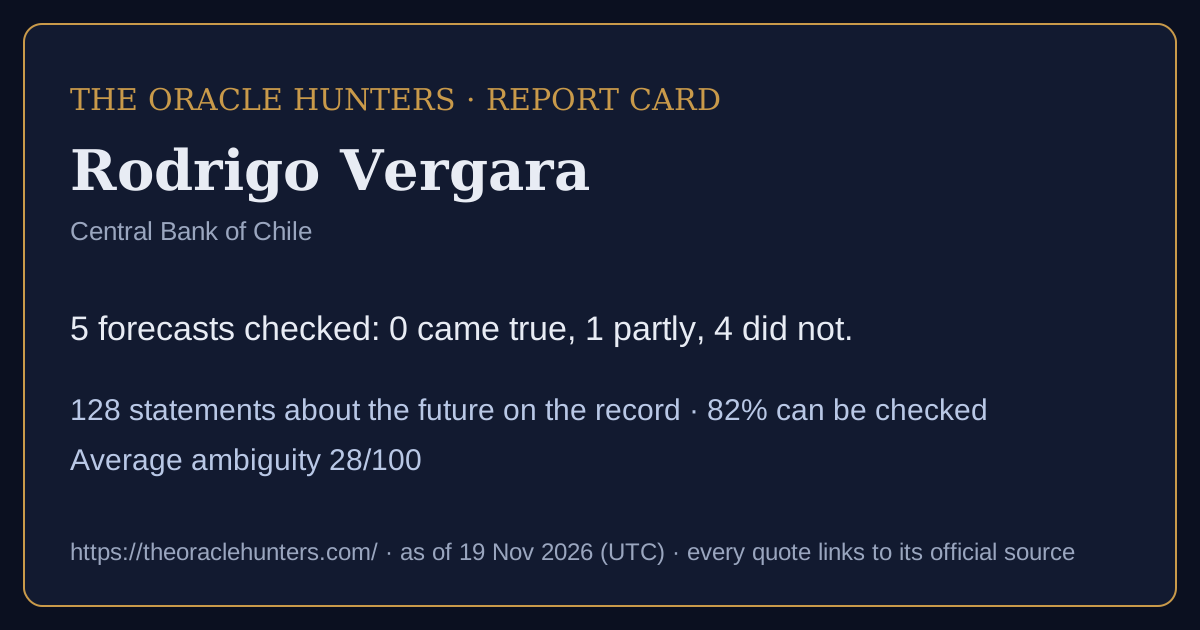
Track record: 5 forecasts checked: 0 came true, 1 partly, 4 did not.
128forecasts & commitments on the record
82%can be checked as stated
28average ambiguity (0-100)
0goalpost moves recorded
0confirmed U-turns
Timeline
came true partly did not not due / being checked / too vague
Calibration score: shown after 10 checked forecasts with a stated likelihood (now 5).
How they speak about the future: based on data 114, stated on authority 11, educated guess 3.
Kinds of claim: forecast 109, mixed claim 18, scenario (if… then) 1. · Download this report card as a picture
In the nine words
πρόγνωσιςInference from evidence107 · 84%μαντείαInspired knowledge11 · 9%πρόβλεψιςSeeing the signs7 · 5%εἰκασίαConjecture2 · 2%πρόνοιαPreparing for the future1 · 1%
How to read this
Each box is one sentence a public figure or institution said about the future, word for word, with a link to the official text. Can be checked means it names what will happen, by when, and how likely - so it can be compared with official figures later. Too vague to check means it does not. Ambiguity (0-100) is how many different ways the sentence can be read. When the date passes, the forecast is compared with official data and marked came true, partly or did not come true. Labels judge the sentence, never the person. Full guide and glossary.Checked
Although we are convinced that inflation will return to near 3 percent over the course of 2015, we cannot rule out that this convergence is slower than expected.
Did not come true. Said: inflation around 3% in 2015. Official figure for Chile: 4.3% (World Bank open data). Missed. Off by 1.4 points. official data · checked 14 Nov 2026 · automatic check against official data (rules v3)
The baseline scenario assumes that inflation will be temporarily above 4 percent and will return to 3 percent over the course of 2015.
Did not come true. Said: inflation around 3% in 2015. Official figure for Chile: 4.3% (World Bank open data). Missed. Off by 1.4 points. official data · checked 14 Nov 2026 · automatic check against official data (rules v3)
The baseline scenario assumes that Chile's GDP will grow between 4.0 and 4.5% this year.
Did not come true. Said: economic growth between 4% and 4.5% in 2013. Official figure for Chile: 3.3% (World Bank open data). Missed. Off by 0.7 points. official data · checked 14 Nov 2026 · automatic check against official data (rules v3)
In the baseline scenario, the Board estimates that GDP will grow 5.5 percent this year.
Partly came true. Said: economic growth around 5.5% in 2012. Official figure for Chile: 6.2% (World Bank open data). Close: outside the margin, but within one more half point. Off by 0.7 points. official data · checked 14 Nov 2026 · automatic check against official data (rules v3)
In this Report's baseline scenario we foresee that GDP will grow this year between 4% and 5%.
Did not come true. Said: economic growth between 4% and 5% in 2012. Official figure for Chile: 6.2% (World Bank open data). Missed. Off by 1.2 points. official data · checked 14 Nov 2026 · automatic check against official data (rules v3)
On the record (128)
For 2017, a range is projected for GDP between 1.75% and 2.75%, down from expectations in June.
In this context, this Report's baseline scenario assumes that GDP will rise between 1.5% and 2.0% this year, considering that the information reviewed for the first half of the year brings no surprise with respect to our June projections.
The CPIEFE will descend to 3% faster than will headline CPI, and by early 2017 it will be below this mark (figure 3).
The baseline scenario of the September Report assumes that the CPI's annual inflation will continue to approach 3% in the coming months, closing 2016 at 3.5%.
For the 2016-2017 biennium average growth in the world economy is expected to stand at 3.2%, while Chile's trading partners should grow by 3.0%, also fairly unchanged from June.
For this year we expect growth to be in the 1.5% to 2% range, and for next year it should be between 1.75% and 2.75%.
If this is so, we will have ended quite a long period during which inflation was at or above 4 percent and monetary policy-making has been particularly complex, as we have had to deal with a significant depreciation of our currency and the ensuing rise in prices, aside from the economic slowdown.
Inflation will return to the target range in the coming months and output will continue to post bounded growth.
About the current account, we believe that this year's deficit will be smaller than we thought in March and will show no big changes in 2017.
Thus, if new indicators point at higher expected inflation, monetary policy will need to be tightened, and vice-versa.
In our baseline scenario, 2017 will be the fourth year in a row with annual growth around 2 percent, which is far from satisfactory.
So, in our most likely scenario, annual CPI inflation will enter the tolerance range in the third quarter of this year and will approach 3 percent during the first half of 2017 (figure 2).
However, by 2017 some recovery of this variable is expected, thanks to a gradual improvement in its fundamentals, particularly, moderate growth in the wage bill and a slight improvement in consumer expectations.
On the consumption side, in the last two years the real wage bill has been outgrowing private consumption, leading us to expect a somewhat stronger recovery of the latter during this year.
It should be noted that private inflation expectations are consistent with this scenario, assuming that it will stand somewhat above 3 percent in one year and at 3 percent in two years.
Thus, by December this year we expect inflation to be at 3.6 percent, two tenths of a point less than what we thought in December.
Given these developments, the baseline scenario in this Report assumes that GDP will grow between 1.25 and 2.25 percent in 2016, less than was expected in December, and in 2017 it will grow between 2 and 3 percent (table 2).
In this trajectory, core inflation - the CPIEFE - will be less than 4 percent towards the fourth quarter, and the more volatile prices not included in the CPIEFE - mainly foodstuffs - should help headline inflation to converge to 3 percent slightly faster than we expected in December.
With respect to domestic demand, the persistently low confidence indicators and the downsized public investment plans for 2016 means lowering the growth forecast for gross fixed capital formation.
Accordingly, we believe that output gaps will exhibit limited growth in 2016 and will begin narrowing towards 2017.
However, both our baseline scenario and the market's projections expect it to rise again above 4 percent and to stay in the neighborhood for the larger part of 2016.
In this context, in the baseline scenario that I will be presenting in a moment, the growth outlook for 2016 is revised downward and the convergence of inflation with the target is pushed back somewhat.
The worsening of the external scenario, as I will detail later, has a significant effect on the larger current account deficit of 2015 and 2016: 1.7 and 2.6 percent of GDP, respectively (0.7
The baseline scenario assumes that GDP will grow between 2 and 3 percent in 2016, a lower range than forecast in September.
And while the current conditions make it more likely that the gradual withdrawal of the monetary stimulus will take place in the first months of 2016, I want to emphasize that it will depend on actual and inflation projected for the months ahead behaving in line with our estimates.
Accordingly, we have adjusted our growth forecast for this year downward, by one fourth of a point.
The CPIEFE is expected to post an annual variation of close to 3 percent in 2016 and stay near that figure until the end of the projection horizon, this time the second quarter of 2017 (figure 7).
In the baseline scenario, in 2015 and 2016 copper and oil are expected to trade at somewhat higher prices than we thought in March (table 2).
On the external front, our projection assumes trading partners' growth to drop by one tenth of a point in 2015 and 2016, to 3.3% and 3.7%, respectively.
As for the MPR, the working assumption is that the gradual withdrawal of the monetary impulse will be similar to what is suggested by surveys over a one-year horizon, meaning that monetary policy should start normalizing by the turn of next year (figure 8).
The baseline scenario assumes that copper will trade at an average of 280 dollar cents per pound in 2015-2016.
So while the main economies in the region grew on average nearly 4 percent between 2010 and 2013, in 2014 they barely grew 0.7 percent in 2014 and are expected to grow by 0.8 percent this year.
In our baseline scenario, we expect the Eurozone to grow 1.5 percent this year, up from 1 percent in December.
This helped the current account deficit, which in mid-2013 was thought to be around 5 percent of GDP to drop to 1.2 percent of GDP the past year and is projected to nearly attain equilibrium by 2015.
Turning to inflation, in the baseline scenario the CPI will stay above 4 percent annually for some more months, approaching 3 percent over the course of 2016.
Accordingly, we estimate that this year it will be near 0 percent of GDP (table 1).
Although we are convinced that inflation will return to near 3 percent over the course of 2015, we cannot rule out that this convergence is slower than expected.
Did not come true. Said: inflation around 3% in 2015. Official figure for Chile: 4.3% (World Bank open data). Missed. Off by 1.4 points. official data · checked 14 Nov 2026 · automatic check against official data (rules v3)
Then it should hover around 3 percent until the last quarter of 2016, i.e., the end of the projection horizon (figure 9).
Still, the mix of high comparison basis in 2014, the evolution of fuel prices and the accumulation of capacity gaps in the economy will pull it down towards 3 per cent over the course of 2015.
For 2015, the Board estimates that GDP growth will be in the 2.5 to 3.5 percent range, so the economy is expected to continue growing below its mediumterm rate, which the Board estimates to lie between 4 and 4.5 percent.
These increases reversed somewhat in November, helped by the drop in fuel prices, which should continue to play a part in lowering inflation over the coming months.
In the projection scenario that I will be presenting shortly, we have revised upward our inflation forecast for the coming months, although we continue to estimate that it will converge to 3 percent during 2015.
Our baseline scenario assumes that our trading partners will grow an average 3.6 percent in 2014 and 2015, two tenths of a point less than foreseen in June (table 1).
In Latin America, the growth forecast has been lowered for this year and next in most countries, although with some heterogeneity.
The growth outlook of our trading partners lost some strength since June, and we continue to expect higher growth in 2015 than in 2014.
Long-term interest rates have receded in the developed world since June, with unprecedented performance in the case of the U.S. given its stronger economy and expectations that the benchmark rate will begin to rise by the middle of next year.
Today, as I will detail in a moment, we estimate that growth will be between 1.75 and 2.25 percent this year and between 3 and 4 percent in 2015, that is, less than our estimate for medium-term growth in our economy.
In this sense, our growth forecast revision for this year takes this into account and assumes that, towards the end of this year, we will see some recovery, though small and gradual.
This, plus the changes in parities mean that foreign dollar inflation this year and next will be somewhat higher than forecast in the last Report.
The terms of trade would fall this year slightly less than projected the March IPoM, but somewhat deeper in 2015 (table 1).
Showing the newest 50 - the ledger has all 128.
Also said - not checkable as stated (12 newest)
Remarks about the future with no date, figure or likelihood that could be checked. They are kept on the record and shown here, but not scored.
If this is so, then it is more likely that we will run into the ZLB in future business cycles, forcing central banks to tap upon these so-called unconventional measures time and again.
Here we will have an interesting discussion including papers by Stephen Morris, Michael Woodford, and Gustavo Suarez, which will enlighten us about the theoretical aspects to keep in mind when evaluating the broader consequences of asset purchase programs, as well as the empirical evidence regarding the effects of the risk-taking channel on the quality of loans originated.
But we can probably say, with little risk of overstating reality, that the ways of achieving changes in the cost of credit through monetary policy has changed significantly since the global financial crisis.
In the aftermath of the global crisis, it soon became clear that traditional MP was simply not going to cut it, especially given the limitations of other policy options, such as fiscal expansion, to reactivate the global economy after the major blow it suffered.
When nominal rates reached the ZLB, and particularly due to the low inflation environments, traditional monetary policy became very constrained -fully constrained by definition, one might say, given the impossibility of lowering short term rates any further.
However, to the extent that one can credibly influence the expected path of future monetary policy actions, risk-neutral rates at different horizons can be lowered, perhaps even significantly so.
While this requirement does not apply where such participation is achieved organically, something that probably should be examined, it is a disincentive to the rapid growth of an institution that resembles charges to systemic banks that have been promoted in other jurisdictions as a partial solution to the 'too big to fail' problem.
The regulations on required credit risk provisions also introduce some macroprudential aspects as they establish that these must be forward-looking and based on the expected probability of future repayment, not the current level of default or delay, and consider the sensitivity to the cycle of the industry where the debtor operates.
the efficiency and costs of different tools accumulates, it will be important that we assess their efficiency and carefully study if we should introduce additional tools in our general framework.
may affect the macroeconomic environment or the situation of a specific economic sector, and that such provisions, and I quote from Spanish, 'should anticipate situations of reversal of expansionary economic cycles that, going forward, could end up in a worsening of the conditions of the economic environment.
Rather, its implementation has been motivated by the perception that the dynamics of some financial prices or ratios are indications of vulnerabilities in all or part of the financial system that could create problems upon the occurrence of one or more shocks.
Nor is it clear that raising interest rates will necessary work in containing the expansion of the financial system: after all, a larger interest rate differential also attracts foreign capital.