Robert Jenrick
Infrastructure and Projects Authority · GBR
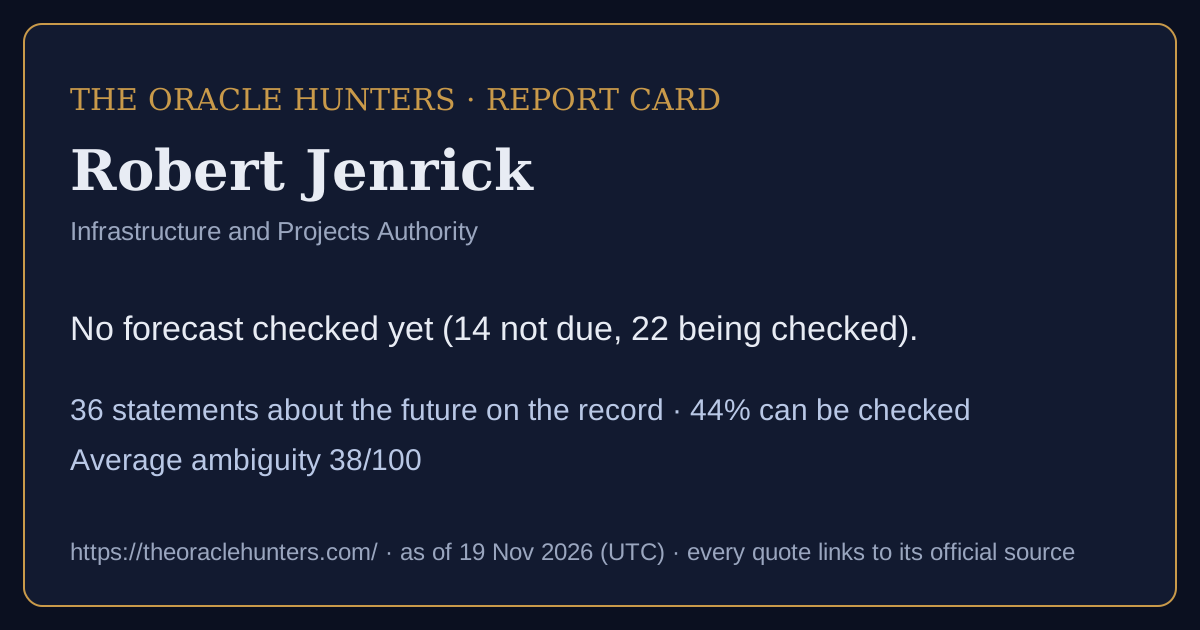
Track record: No forecast checked yet (14 not due, 22 being checked).
36forecasts & commitments on the record
44%can be checked as stated
38average ambiguity (0-100)
0goalpost moves recorded
0confirmed U-turns
Timeline
came true partly did not not due / being checked / too vague
Calibration score: shown after 10 checked forecasts with a stated likelihood (now 0).
How they speak about the future: based on data 26, stated on authority 10.
Kinds of claim: forecast 27, mixed claim 8, commitment 1. · Download this report card as a picture
In the nine words
πρόγνωσιςInference from evidence25 · 69%μαντείαInspired knowledge10 · 28%προαναγγελίαPublic pre-announcement1 · 3%
How to read this
Each box is one sentence a public figure or institution said about the future, word for word, with a link to the official text. Can be checked means it names what will happen, by when, and how likely - so it can be compared with official figures later. Too vague to check means it does not. Ambiguity (0-100) is how many different ways the sentence can be read. When the date passes, the forecast is compared with official data and marked came true, partly or did not come true. Labels judge the sentence, never the person. Full guide and glossary.On the record (36)
It will help us to ensure, not only do we build hundreds of thousands of affordable homes across all tenures throughout the country – with a greater weighting outside London reflecting our commitment to levelling up – it will also unlock £38 billion of private sector investment for housing.
Another focus for my department over the course of this year will be re-establishing those bonds, seeing it’s mission as levelling-up Swansea as much as Southport or Southampton.
Our Future Homes Standard will help us meet this by ensuring that, from 2025, all new homes will be expected to have at least 75% lower carbon emissions and be zero carbon ready without the need for expensive retrofitting.
But the one principle I will stick to is that central government should be working directly with councils and we should avoid filters wherever possible, including Local Enterprise Partnerships that I want to reform over the course of this year.
And 10% of the new homes delivered through the programme will also be for supported housing – helping those with physical or mental health challenges.
Mindful of these challenges, the Programme aims to deliver up to 180,000 affordable homes over five years from 2021 to 2026 – the first from next year – and these will be built across the country; in fact with a greater weighting beyond London than we have seen in previous years reflecting our commitment to levelling-up and ensuring quality, affordable …
It’s a pleasure to be here albeit only virtually and I am sorry I wasn’t able to join you at last year’s conference and I very much hope that next year, we will be all in person meeting once again.
Some are and we continue to hear welcoming stories of developers stepping up now, like Persimmon and Taylor Wimpey recently, but far more needs to be done so, we are introducing a new gateway 2 developer levy and a new tax for the UK residential property development sector which will be in place in 2022 at the earliest opportunity once …
At the Home Office, Priti Patel shares my commitment to supporting victims of domestic abuse and together we have seen the Domestic Abuse Act implemented and fully funded with £120 million of financial support for local councils next year.
So we’re utilising the expertise of all government departments from the Ministry of Justice and the Home Office to the Departments of Health and of Work and Pensions, investing over £750 million next year to continue to reduce homelessness and rough sleeping and invest in preventative programmes which tackle the underlying issues early.
We’ve already brought forward a lot of investment since our pandemic, through our Getting Building Fund which has committed £900 million to ‘shovel ready’ projects in this financial year – bringing with it much needed investment and jobs as they try to adapt and evolve to new circumstances.
Where property prices are highest, the discount could be as high as 50%.
Earlier this year the Law Commission published a number of reports setting out how we could make the process of enfranchisement simpler and easier, improve the position of leaseholders more generally and embed commonhold as a more established tenure.
From 2025, we expect new homes to produce 75-80% lower CO2 emissions compared to current levels.
We’ve made an extra £1 billion available, thanks to the Chancellor’s support in the Budget, to make buildings safe and are introducing the biggest change to building safety in a generation through the Building Safety Bill, which is now being scrutinised by parliament and will be brough forward for debate and legislation very soon.
Under the this model, I have lowered the initial stake from 25% to 10%, and reduced the minimum staircasing requirements to 1%, or as low as £1000, which will make it easier for people to get onto and climb the housing ladder.
Around half of the homes delivered will be available to own, with the rest available for discounted rent, including 10% for supported housing – to help those with physical or mental health challenges.
To keep up the momentum on delivery, we will set an expectation that 25% of the affordable homes delivered through developer contributions will be First Homes.
But lost months this year due to the pandemic will set us back significantly.
From 2025 all new homes will be expected to have at least 75% lower carbon emissions and be zero carbon ready without the need for expensive retrofitting – representing real action to protect our environment and tackle climate change.
The £105 million in additional funding we made available last week will support councils to ensure longer-term solutions are put in place instead of simply the emergency accommodation that we’ve used during the pandemic.
This means that if your council has a car park or a museum, a theatre or a leisure centre you run directly, we will support you and meet 75% of your costs.
And we will continue to keep under review local authorities’ cashflow position for the rest of 2020 to 2021, as the impact of existing cashflow measures becomes apparent.
No one knows today with certainty how much tax loss will materialise, which is why at the Spending Review, the government will agree a fair apportionment of irrecoverable council tax and business rates losses, between central and local government, for 2020 to 2021.
3,300 of these new homes will become available in the next 12 months, and £160 million will be spent this year to deliver that.
Something that our ambitious First Homes programme will do later this year, with a 30% discount on new homes for key workers including nurses and teachers and police officers as well as local first time buyers.
This year likely it will be the year we build more homes than any year, bar-one, in my adult lifetime.
The consultation we’re running here, which will last until the beginning of next year, will have stronger building regulations to ensure that every new home that’s built in this country from 2025 will have low or zero-carbon emissions and the highest levels of energy efficiency.
They’ll be reporting back later this year and I’m confident that we will be taking forward their recommendations.
I was persuaded by their case and spoke to the Chancellor who was very supportive and as such we responded at the most recent Budget, providing £3 million pilot funding for grants equivalent to the VAT chargeable on such refurbishment projects.
The £20 million invested in this project in last year’s Budget alone, stands for the creation of an ecosystem of exchange that will empower entrepreneurs to harness the skills of both institutions – and the communities that lie between.
While the British Business Bank’s commitment of up to £200 million of additional investment in UK venture capital and growth finance in 2019-20 will tie over businesses in the short term, we will shortly be opening a review of longer term options to finance infrastructure and new technologies as we leave the EIB and EIF.
second, we announced that the DWP will consult next year on making the pension charge cap flexible enough to accommodate performance fees, often associated with patient capital investment
first, we announced that the FCA will be carrying out a consultation on reforming their permitted links rules, and will publish by the end of the year
By 2025, we expect the overall pot will swell to £1 trillion…
This year will be a pivotal one for the economy as we seek to define the new economic relationship between the UK and European Union.
Also said - not checkable as stated (12 newest)
Remarks about the future with no date, figure or likelihood that could be checked. They are kept on the record and shown here, but not scored.
The Office for Place will improve our understanding of people’s preferences about places – what makes them popular or not – and how this relates to public health, well-being and sustainability.
We will be opening our office later this summer, not just hundreds of jobs in investment to that city, but greater diversity of thought in decision-making.
I will be working ok with him and the Chancellor to ensure your views and concerns are at the very heart of the reforms as they come forward and crystalise and to ensure that those reforms are funded so that councils have the resources they need to do the job.
When things go wrong, as they inevitably sometimes do, tenants should be able to seek redress in reasonable time without an uphill struggle and know that they will be heard.
It was the largest-ever government investment in building safety, ensuring that no leaseholder will have to pay for the removal of unsafe cladding in high rise buildings where this issue began following the Grenfell tragedy.
Sajid started the Housing First pilot – work that as we will hear today, the CSJ has proved so vital in spearheading.
And together we will use the new freedoms we have as a sovereign country, to create a better and fairer immigration system, so that fewer foreign nationals end up on our streets and those that do can be compassionately and considerately returned to their home countries.
I want to be unequivocal in stating that we will use every mechanism at our disposal to achieve our goal.
Our strategy will be refined, with the guidance and support of all those willing to offer it to us, but our objective is clear, that no one should have to sleep rough in this country.
But although we are building more homes and mortgage applications in the UK have surged to a 12-month high, we will continue to work with the sector to develop more products for first time buyers.
This will also be the first programme following the introduction of the Right to Shared Ownership – our new scheme which will give most housing association tenants the opportunity to buy a stake in their home using the new model for Shared Ownership, should their personal circumstances allow.
I have every confidence we will do so again; with the housing market once again leading the charge, backed by a once in a generation set of planning reforms that promise to transform, backed by greater investment.