Robert Holzmann
Oesterreichische Nationalbank
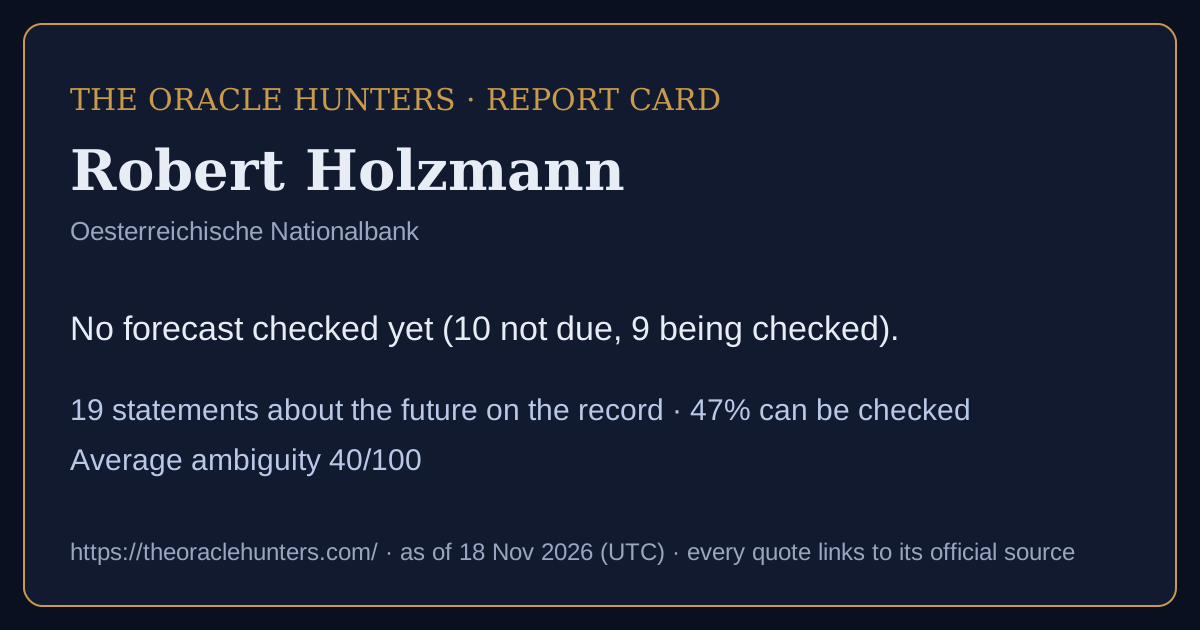
Track record: No forecast checked yet (10 not due, 9 being checked).
19forecasts & commitments on the record
47%can be checked as stated
40average ambiguity (0-100)
0goalpost moves recorded
0confirmed U-turns
Timeline
came true partly did not not due / being checked / too vague
Calibration score: shown after 10 checked forecasts with a stated likelihood (now 0).
How they speak about the future: based on data 17, educated guess 2.
Kinds of claim: forecast 15, mixed claim 3, scenario (if… then) 1. · Download this report card as a picture
In the nine words
πρόγνωσιςInference from evidence17 · 89%εἰκασίαConjecture1 · 5%πρόνοιαPreparing for the future1 · 5%
How to read this
Each box is one sentence a public figure or institution said about the future, word for word, with a link to the official text. Can be checked means it names what will happen, by when, and how likely - so it can be compared with official figures later. Too vague to check means it does not. Ambiguity (0-100) is how many different ways the sentence can be read. When the date passes, the forecast is compared with official data and marked came true, partly or did not come true. Labels judge the sentence, never the person. Full guide and glossary.On the record (19)
Overall, the IMF projects growth to amount to 3.2% on a global level in 2024, with the euro area at 0.8% and the UK at 0.5%, respectively.
As you all probably know, the Eurosystem increased interest rates 10 times to 450 basis points in the last two years to fight exceptionally high inflation.
The latest inflation results, e.g. for the US and the UK, point toward fewer rate cuts in 2024, and some market participants in the US even told us that they expect no rate cuts by the Fed in 2024 at all.
The Eurosystem's latest inflation number is 2.4% (Eurostat flash estimate for March) and a recent ECB forecast assumes inflation rates of 2.0% and 1.9% for 2025/26.
Inflation is receding, and most advanced economies are forecast to reach 2% by 2025 by the IMF.
The 17" General Review of Quotas in 2028 will be the next potential opportunity since 2010 for the IMF to introduce changes to both voting shares and the quota formula.
The investment needs for the green transition may sound overwhelming, but the private and public funds to be mobilized only amount to about 2% of global GDP per year. 8 This sum roughly corresponds to the estimated investment gap that advanced economies have accumulated over several decades, and it is dwarfed by military expenditures in war times.
The Ukrainian economy might, however, grow again in 2023. 5
It will take huge efforts at both the national and international level to achieve the goal of a low-carbon world economy by 2050 as internationally agreed.
Still, Russian GDP is set to contract by 3.5% this year and by a similar amount next year, when the impact of the Western high-tech embargo will be felt more strongly.
At t his year's conference , we are going to discuss a topic that has been foremost on our minds for the past nine months: 'Economic and monetary policy under wartime conditions . ' Since February 24 of this year, we have been witnessing something that used to be unimaginable over the past decades: outright war in Europe.
In case of a further economic shock more of the same would need to be applied if inflation stays low.
In its projections for six CESEE EU Member States, the OeNB expects a downturn similar to that forecast by the IMF for 2020, but a more protracted recovery in 2021 and 2022.
According to the latest IMF outlook, real GDP in the three CESEE subregions, the EU Member States, the Western Balkans and Russia, will decline by around 5% in 2020.
Pursuant to the invitation by the European Council and with a view to supporting a common broad-based recovery within the EU, the European Commission complemented its previous budgetary proposals for the next multiannual financial framework (MFF) for the period from 2021 to 2027 with a 'recovery package' at the end of May.
Each plan will have to dedicate a minimum of 37% of expenditure to climate-related (green) investment and a minimum of 20% of expenditure to digital investment (on both infrastructure and capacities).
If this were to be the case, expansive monetary policy could weaken productivity and potential growth in the long run -despite the growth-enhancing demand-side effects it has in the short term.
Funding will be facilitated through joint borrowing covered by future contributions, with debt redemption scheduled to start in 2028.
The ECB's current strategy review pro vides a good and welcome opportunity to dive deeper into the matter, with the recently concluded review of the monetary policy framework in the U.S.A. serving as a source of potentially valuable input. 8 The Governing Council of the ECB has announced that the results of the strategy review will be presented to the …
Also said - not checkable as stated (12 newest)
Remarks about the future with no date, figure or likelihood that could be checked. They are kept on the record and shown here, but not scored.
At the same time, we must remain flexible and open to new ideas, recognizing that the path toward deeper integration will require ongoing reform and adaptation.
More specifically, the Eurosystem's swap and repo lines are monetary policy instruments which help prevent tensions in international funding markets that could otherwise hamper the effective transmission of monetary policy within the euro area.
This raises important questions: How should non-euro area countries - especially highly euroized ones - balance the related benefits and risks?
Yet, it is important to emphasize that the aftereffects of the extraordinary fiscal and monetary measures implemented during the pandemic now need to be carefully contained, unwound but also critically evaluated to ensure long-term stability.
As we look ahead, one of the key challenges facing the euro area is the need to complete the Single Market, particularly in the areas of banking and capital markets union.
And we must complete the banking union and build a capital markets union.
Second, while we will listen to some new ideas during this conference, also concepts that were treated somewhat neglectfully during the past episode of very low interest rates, are welcome.
We should therefore be open to concepts that are probably of less importance today but might be helpful after a regime change in the near future.
Furthermore, we must not overlook neglected relationships, such as the link between money growth and inflation, as they may offer valuable insights in different economic regimes.
Though these losses may not immediately harm the functionality of central banks, they do raise some questions.
Scenarios may emerge where central bank independence may come under threat due to financial strains.
The crucial question whether central bank finances are relevant for fulfilling our mandate will be rigorously debated in tomorrow's policy session.