Robert Buckland
Attorney General's Office · GBR
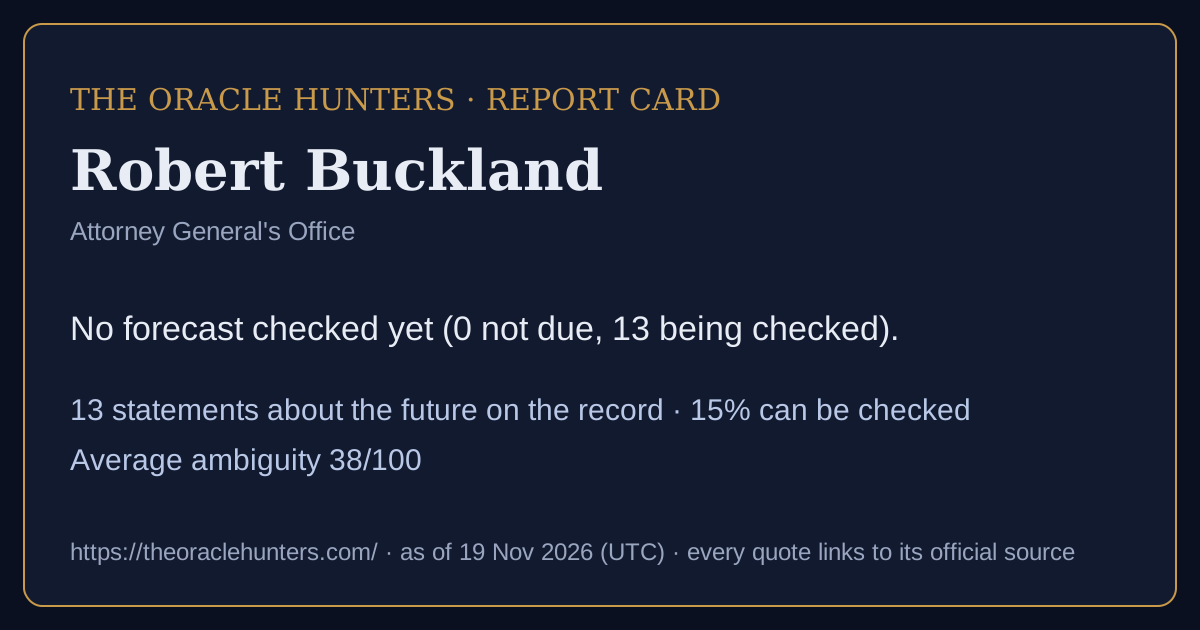
Track record: No forecast checked yet (0 not due, 13 being checked).
13forecasts & commitments on the record
15%can be checked as stated
38average ambiguity (0-100)
0goalpost moves recorded
0confirmed U-turns
Timeline
came true partly did not not due / being checked / too vague
Calibration score: shown after 10 checked forecasts with a stated likelihood (now 0).
How they speak about the future: stated on authority 9, based on data 4.
Kinds of claim: forecast 8, mixed claim 5. · Download this report card as a picture
In the nine words
How to read this
Each box is one sentence a public figure or institution said about the future, word for word, with a link to the official text. Can be checked means it names what will happen, by when, and how likely - so it can be compared with official figures later. Too vague to check means it does not. Ambiguity (0-100) is how many different ways the sentence can be read. When the date passes, the forecast is compared with official data and marked came true, partly or did not come true. Labels judge the sentence, never the person. Full guide and glossary.On the record (13)
The responses to this will inform the Law Commission’s options paper that will be provided to the Government by the end of this year or early next.
The Victims’ Code that we brought in earlier this year was all about simplifying the process – setting out exactly the kind of input that victims can expect to receive from the moment they report a crime all the way through the system and beyond.
After the announcement on Monday, we can be quite sure that there will be many more of us here in person at these illustrious surroundings next year.
The Lord Chief Justice and I recently committed, for the next year at least, that our crown courts will be authorised to work at full throttle, to their maximum capacity.
So, later this year we will publish a new strategy for tackling Violence Against Women and Girls, so that we can get a grip on those men who would seek to use their power and privilege to abuse women and girls in our country.
The ongoing Independent Review of the Human Rights Act chaired by Sir Peter Gross that was established earlier this year recently held a call for evidence, as many of you will know.
With that in mind, in July this year I announced a major £142 million investment in the courts system to speed up technological improvements and modernise courtrooms, which will bring particular benefits to Wales.
This will of course require funding, which we will make available this year alongside the significant injection of resources already allocated by NHS England and Improvement for the CSTR Programme in their 2019 Long Term Plan.
I am pleased to say that we will be publishing a White Paper in response to the review as soon as possible this year.
So this year, for example, we will spend an additional £22 million supporting offenders as they move through the prison gate into the community.
This year’s Symposium addresses the question ‘Preventing and Controlling Economic Crime in the modern world – whose responsibility and are they really up to it?’ It is an important question that we constantly need to be asking ourselves and addressing it will make our response even more effective.
In May of this year, following the General Election, I was delighted to be re-appointed as Solicitor General for the new Conservative Government.
For the UK Government, the issue of remedies for human rights abuses by business is going to be a key area for consideration as the National Action Plan is reviewed next year.
Also said - not checkable as stated (12 newest)
Remarks about the future with no date, figure or likelihood that could be checked. They are kept on the record and shown here, but not scored.
At the same time, it is of course important to ensure that any reform does not impose an undue burden of compliance on companies – so it must also take account of the impact of increased costs on law-abiding corporations to ensure they are not overburdened by processes they are expected to follow.
The instability this sort of crime poses both to our economy and in terms of our national security, mean that if we do not get it under control then we will all pay a much bigger price than we are already paying now.
By working with the technology, financial, telecommunications, and accountancy sectors we are going to agree sector charters that I believe will make people more safe and secure, as well as looking again at the case for additional regulation in paid-for advertising online, which we know is a conduit for fraud.
If the public and private sectors can continue to work in tandem, then it will be possible to improve our response – both at the source where these crimes are committed and operationally where they must be met with every resource of the law.
Back in 2018 when I was Solicitor General, I posed the question about whether a new corporate offence of failing to prevent economic crime, similar to those already put on the statute book by this government concerning failure to prevent bribery and tax evasion, could be helpful.
The argument seems to be, there are borderline cases and there will be disagreement about how these should be decided; that’s unexceptional.
But we shouldn’t be lulled by this into a false sense of security, and we must be watchful for those cases which might demonstrate a change in conceptual growth, or indeed overgrowth.
But while some are clearly useful – for example that there are always limits to discretion – and undoubtedly enhance Judicial Review, there are other developments which could take Judicial Review in more worrying directions and so we must be cautious.
Because Parliament does not specify in exact detail all the necessary requirements and ways a power it grants should be used, the courts must fall back on certain assumptions about how Parliament generally expects decision makers to act.
The court chose not to interpret the decisions about jurisdiction might be implicit in the determination of the IPT – that is that they must have decided they had jurisdiction to make the determination they were making.
Of course, for this to work, the courts would have to faithfully respect the distinctions drawn and I am confident that they will do that.
What’s clear is that we will feel the after-effects of the pandemic for quite some time to come and, in many ways, we will need to learn to live with it.