Ritt Bjerregaard Member
European Commission · EU
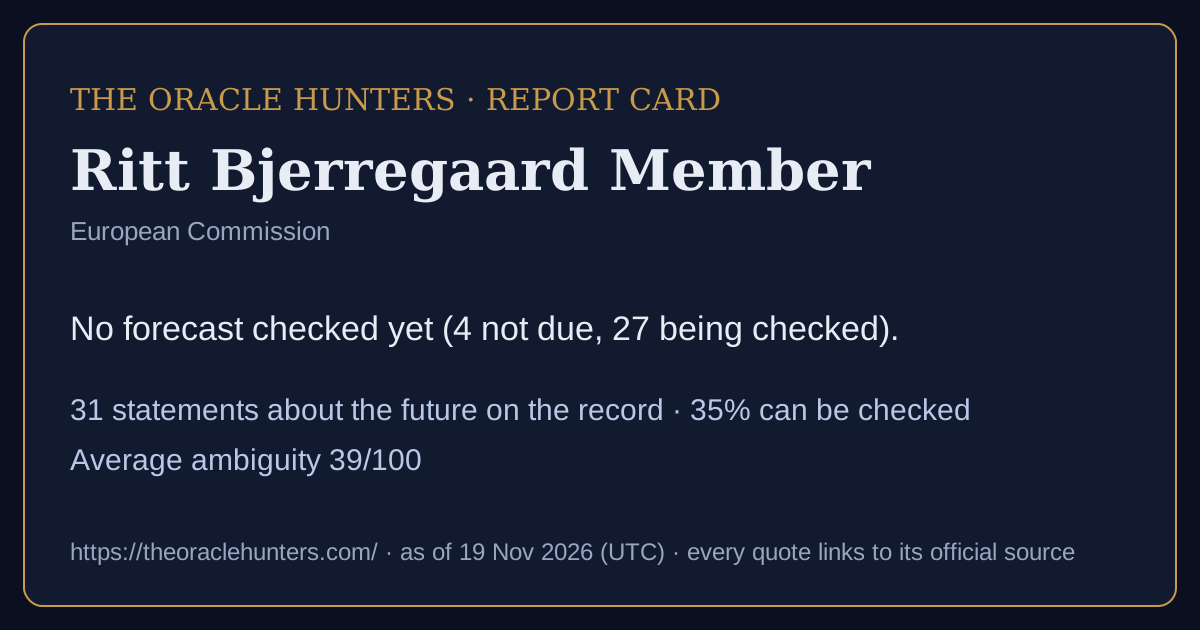
Track record: No forecast checked yet (4 not due, 27 being checked).
31forecasts & commitments on the record
35%can be checked as stated
39average ambiguity (0-100)
0goalpost moves recorded
0confirmed U-turns
Timeline
came true partly did not not due / being checked / too vague
Calibration score: shown after 10 checked forecasts with a stated likelihood (now 0).
How they speak about the future: based on data 25, stated on authority 5, educated guess 1.
Kinds of claim: forecast 22, mixed claim 7, scenario (if… then) 1, commitment 1. · Download this report card as a picture
In the nine words
πρόγνωσιςInference from evidence25 · 81%μαντείαInspired knowledge4 · 13%προαναγγελίαPublic pre-announcement1 · 3%πρόνοιαPreparing for the future1 · 3%
How to read this
Each box is one sentence a public figure or institution said about the future, word for word, with a link to the official text. Can be checked means it names what will happen, by when, and how likely - so it can be compared with official figures later. Too vague to check means it does not. Ambiguity (0-100) is how many different ways the sentence can be read. When the date passes, the forecast is compared with official data and marked came true, partly or did not come true. Labels judge the sentence, never the person. Full guide and glossary.On the record (31)
But this can only be an intermediate objective: some experts now estimate that the amount of land managed organically could amount to 15%-25% at Community level by 2010.
The question we are facing is how we will be able to sustain this growth and to ensure that organic farming becomes popular in all Member States and not only concentrated in a few 'hot spots'.
It should also look into how the organic sector could profit most from the new rural development policy agreed as a part of Agenda 2000.
These issues will be discussed in the Council of Ministers on 25 June in Luxembourg, and be taken on board later this year in a Commission Communication to the Council and European Parliament, which will set out a strategy for future chemicals policy, including possible legislative options.
If we do not establish a coherent, international policy in these areas then piecemeal and punctual restrictions will be the result, threatening jobs, investment and growth and poisoning the negotiating climate.
In December this year Heads of State and government will receive reports on how environment considerations could be brought to bear on emissions policies (climate change), on development co-operation, industry and on the internal market.
The adopted (and in the case of Heavy Duty Vehicles nearly adopted) standards for 2005 (and 2008) will of course reduce emissions even further.
The improved standards, up to and including those for 2000, are expected to reduce total emissions by approximately 70 % from 1990 to 2010, even taking into account the expected growth in traffic.
The new directive on the landfill of waste which I expect to be adopted this year, has two main purposes.
Reports will be sent to the European Summit in June this year.
The achievement of the ambitious Kyoto agreement to reduce greenhouse gas emissions by 8% by the 2010 will lead to a creation of additional jobs of 1-2 million by the year 2010.
Therefore, we will see under Agenda 2000 that employment and environment have been linked closer than during the previous period for the Structural Funds.
Environment plays an important role within Agenda 2000, and the Member States will have to ensure that the environment is integrated in projects eligible for funding.
This will allow the Commission to compile a report in the year 2000, which will reflect the Community situation more extensively than ever before.
As promised during the meeting of NGOs for the welfare of animals and the Commission in March this year, we will also hold a special consultation with representatives of the main NGOs once a preliminary draft is available.
Together, these initiatives should reduce emissions by 60 - 75 %, even taking into account the expected growth in traffic.
However, taking into account the fact that CO2 emissions from energy use alone are expected to increase by 8% between 1990 and 2010 in the absence of new policy actions, the real challenge is much greater.
The resistance from several lobbies in those Member States may be linked to insufficient understanding about the aims and the consequences of Natura 2000 and the lack of explainations.
I can quite understand that the owner of a quarry or a farm, for example, could be seriously concerned about the threat to his livelihood posed by the possible designation of a Natura 2000 site on or near his property.
Gathered here today is a wealth of experience from Europe, which will demonstrate how Natura 2000 can co-habit with social and economic interests.
The proposed measures under Agenda 2000 and the renewal of the Life instrument will also contribute to this goal, if they are picked up by the Member States, and used positively.
Agenda 2000 will build on developments resulting from the 1992 review of the Common Agricultural Policy, encouraging integration of environmental measures into farming and afforestation.
It is possible that some activities may have to be curtailed in the process of constructing the Natura 2000 network.
These are elements of a new environmental orientation for Tacis which will be detailed in the forthcoming "Tacis environmental strategy" and which we hope will be reflected in the new Tacis Regulation from 2000 onwards.
To illustrate this point, let me just mention that a recent study from the World Bank on the situation in one of the eastern Baltic countries - I shall not say which indicated that environmental damage meant that the GDP of the country was some 5-6% lower than it would otherwise have been.
As recognised in the Commission's Agenda 2000 from last year, the environmental dimension of this enlargement is going to be more important than in any previous enlargement of the European Union.
Nevertheless, in some areas a meaningful start has been made and I am sure you will see a stronger environment component in the proposals the Commission will be shortly making on Agriculture, Structural Funds and Enlargement in its Agenda 2000 package.
The strategy will focus on a number of important policy areas, some of which are on the Commission's agenda right now, for example with the Agenda 2000 package, including:-
This study identifies a list of win-win measures by which the US could save up to 1,430 million tonnes of CO2 by 2010 without even using emission trading.
The US's own latest forecasts which seem to be revised upwards every month, show CO2 emissions in 2000 to be 17 per cent higher than they were in 1990 and 34 per cent higher by 2010.
It will not be too costly: the cost of compliance is approximately 0.3 per cent of GDP - less than 1 per cent of the expected increase in GDP between now and 2010.
Also said - not checkable as stated (12 newest)
Remarks about the future with no date, figure or likelihood that could be checked. They are kept on the record and shown here, but not scored.
The strategy should set clear and ambitious targets for organic farming it should tell us how much land should be farmed organically in 5 and in 10 years time and how we are going to achieve it.
This is just one example - I hope that this afternoon's session will be able to further explore these and other benefits giving us the solid arguments that we need to increase the interest of going organic.
Intensive agriculture will have to respect minimum environmental standards to get full support.
The effects may cause adverse health effects such as cancer, behavioural changes and reproductive abnormalities
This breadth of interest, I feel, reflects the importance of the chemicals issue and the growing need to strengthen the transatlantic dialogue.
While it is vital that the chemical industry itself remains healthy, it is equally important that it contributes in a sustainable way to social and economic development by minimising the impact of chemicals on the environment and human health.
And lastly, we need to avoid trade conflicts in order to ensure that the contribution of the industry to the economic and social wellbeing of our citizens is not undermined.
In summary, we need to ensure that the objectives of environmental and human health protection as well as consumer protection are met.
So I am looking for US /European Union leadership and creativity concerning transparency, labelling, the precautionary principle, which could move the agenda forward and allow more environmentally friendly trade rules.
And obviously this will have a direct impact on our CAP reform and on the world trade talks in agricultural products.
Verdicts of the Court may lead to sanctions such as pecuniary penalties and redress in a uniform manner across the whole of the European Union.
It will develop common approaches on trade and environment issues and keep trade negotiators informed of the likely political impact of their decisions on health, safety and environmental standards.