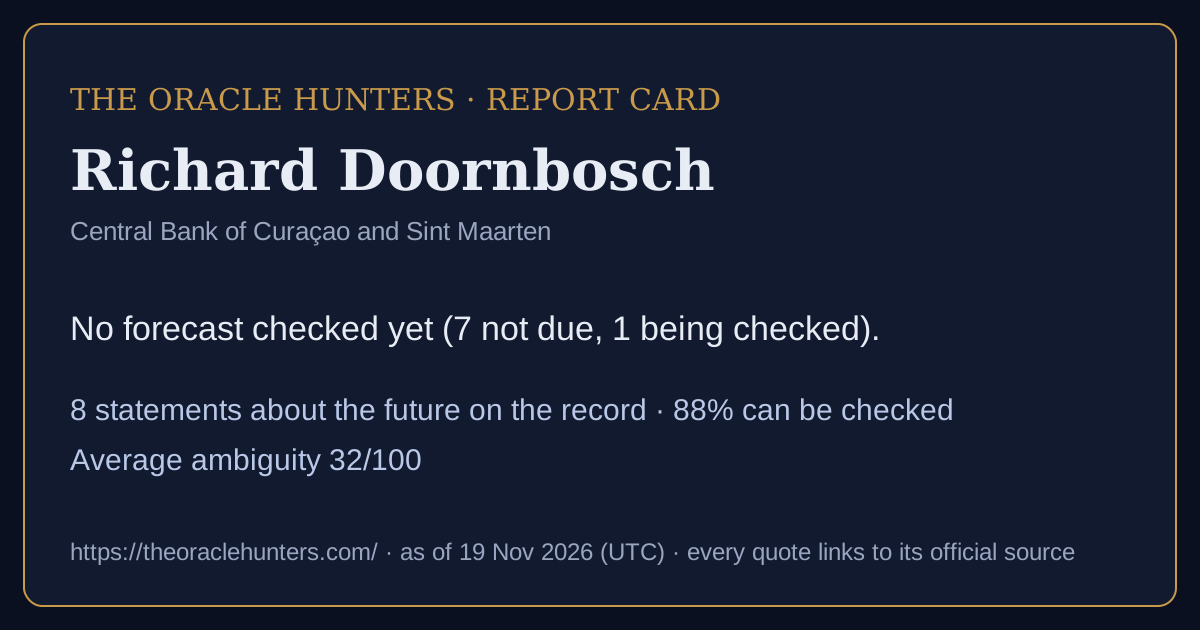
Richard Doornbosch
Central Bank of Curaçao and Sint Maarten
Track record: No forecast checked yet (7 not due, 1 being checked).
8forecasts & commitments on the record
88%can be checked as stated
32average ambiguity (0-100)
0goalpost moves recorded
0confirmed U-turns
Timeline
came true partly did not not due / being checked / too vague
Calibration score: shown after 10 checked forecasts with a stated likelihood (now 0).
How they speak about the future: based on data 6, educated guess 1, stated on authority 1.
Kinds of claim: forecast 6, scenario (if… then) 1, commitment 1. · Download this report card as a picture
In the nine words
πρόγνωσιςInference from evidence6 · 75%προαναγγελίαPublic pre-announcement1 · 12%πρόνοιαPreparing for the future1 · 12%
How to read this
Each box is one sentence a public figure or institution said about the future, word for word, with a link to the official text. Can be checked means it names what will happen, by when, and how likely - so it can be compared with official figures later. Too vague to check means it does not. Ambiguity (0-100) is how many different ways the sentence can be read. When the date passes, the forecast is compared with official data and marked came true, partly or did not come true. Labels judge the sentence, never the person. Full guide and glossary.On the record (8)
The assumed 8% annual increase in the total number of visitors is based on the forecast for 2025 and 2026 outlined in Curaçao's Strategic Tourism Destination Development Plan.
With the projected sea level rise of 0.5-0.6 meter and up to 1.2 meters, which is likely to impact beachfront real estate and bustling business and administrative areas, putting estimates at a permanent loss in GDP of between 7.5% and 14%.
With average temperatures increases of around 2 degrees Celsius by 2050, Curaçao and Sint Maarten can expect loss of biodiversity, negative impact on health and productivity, and deterioration of coral reefs.
For the rest of 2023 and into 2024, the CBCS will be conducting a research project to tackle the gaps in data.
We will also continue strengthening our expertise on instruments to contribute to climate change resilience of the financial sector.
The total expected investment cost is US$5.4 billion and will feature LNG facilities and a special economic zone, among other things.
The emphasis on measures protecting the integrity of the financial system is here to stay and - if any - will only increase in intensity and importance.
The Bank of England estimated that the total value of global cross-border payments will continue to rise to over $250 trillion in 2027, from approximately $150 trillion in 2017.
Also said - not checkable as stated (12 newest)
Remarks about the future with no date, figure or likelihood that could be checked. They are kept on the record and shown here, but not scored.
We also know that shocks from climate change will be as impactful for small islands as these global shocks.
To secure financial stability, we must continuously invest in the monitoring of systemic risk, conduct research, and apply measures appropriately.
Accounting for climate risk - both physical and transition risk - should gear investments towards projects, capital goods and activities that are more climate resilient.
For central banks in the Caribbean, operational preparedness of the financial system increasingly revolves around three priorities: Climate, Connectivity, and Cybersecurity, which you could call the three Cs of Caribbean operational resilience.
The taxonomy will help companies and financial institutions in the Caribbean to design bankable climate projects by standardization of definitions and by exploring sectors and investment opportunities with a high potential for reducing emissions and - more importantly - increasing resilience.
Emergency access to finance and liquidity through Catastrophe bonds and private insurance might well become prohibitively expensive for climate vulnerable countries.
The COP-30 that is being held at this very moment in Belem, Brazil, will hopefully agree on concrete steps to scale up climate finance.
Stablecoins and tokenized payments more broadly have the potential to enhance speed and inclusion of cross border payments, but if unregulated, they may undermine financial stability and the integrity of fixed exchange rate regimes.
During this conference you will delve into the strategies credit unions need to thrive in today's financial world.
What I will do is ask three hard questions you need to be able to answer or at least consider when formulating your strategies.
It might be ensuring access to basic financial services to your membership, or enhancing financial literacy, or guaranteeing access to finance to ensure growth opportunities to small and medium sized businesses.
When "financial health" of your members is your mission, you probably will have different priorities as when "access to finance" is in your primary mission statement.