Richard Byles
Bank of Jamaica
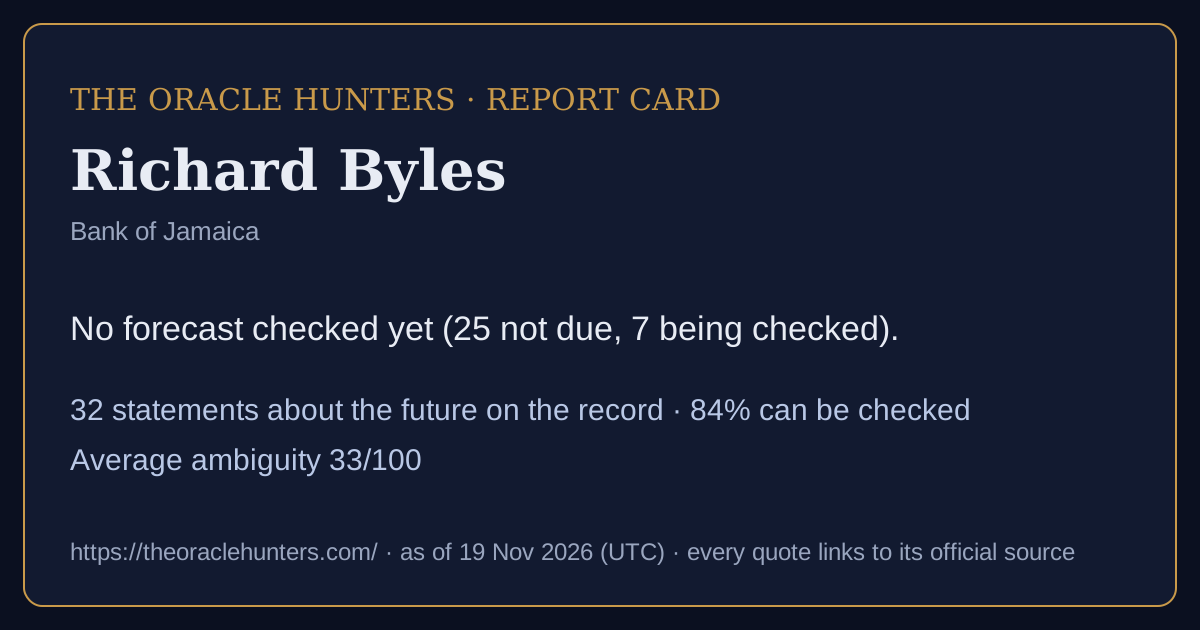
Track record: No forecast checked yet (25 not due, 7 being checked).
32forecasts & commitments on the record
84%can be checked as stated
33average ambiguity (0-100)
0goalpost moves recorded
0confirmed U-turns
Timeline
came true partly did not not due / being checked / too vague
Calibration score: shown after 10 checked forecasts with a stated likelihood (now 0).
How they speak about the future: based on data 25, stated on authority 7.
Kinds of claim: forecast 30, commitment 2. · Download this report card as a picture
In the nine words
πρόγνωσιςInference from evidence24 · 75%μαντείαInspired knowledge6 · 19%προαναγγελίαPublic pre-announcement2 · 6%
How to read this
Each box is one sentence a public figure or institution said about the future, word for word, with a link to the official text. Can be checked means it names what will happen, by when, and how likely - so it can be compared with official figures later. Too vague to check means it does not. Ambiguity (0-100) is how many different ways the sentence can be read. When the date passes, the forecast is compared with official data and marked came true, partly or did not come true. Labels judge the sentence, never the person. Full guide and glossary.On the record (32)
For Financial Year 2026/27, real GDP growth is projected in the range of minus one (-1.0) to one (1.0) per cent, reflecting the start of recovery efforts, which will pick up pace in ensuing years.
While economic activity will contract in the immediate aftermath of the hurricane, the Bank projects that the funding inflows from multilateral and private sources will support spending in the economy over the next three years, to the extent that the capacity exists to execute planned projects.
Inflation is projected to rise above the Bank's target range over the next four quarters, peaking in the June 2026 quarter and, as supply conditions improve along with the appropriate monetary policy response, will moderate back to the target range in early 2027.
Going forward, the Bank will continue to proactively take steps to maintain orderly conditions in the foreign exchange market as instability in this market can fuel higher prices throughout the economy.
Core inflation (which excludes the prices of agricultural food items and fuel from the consumer price index (CPI)) will also rise over the next 12 months breaching the inflation target range in early 2026.
First, annual headline inflation will rise sharply over the next few months from the 4.4 per cent recorded in November 2025, and will exceed the Bank's inflation target range of 4.0 to 6.0 per cent by early 2026.
The Bank projects that gross reserves will improve further over the medium-term, remaining above the Assessing Reserve Adequacy (ARA) 100 per cent benchmark.
Against this background, and factoring domestic demand conditions, for FY2025/26 real GDP is projected to recover in the range of 1.0 to 3.0 per cent, largely reflecting normalisation in the mining, tourism and construction sectors.
We note that the Fed maintained its interest rate target in the range of 4.25 to 4.50 per cent in May 2025 and is likely to continue to maintain rates for an extended period of time in 2025.
On the 15th of May, the Statistical Institute of Jamaica (STATIN) reported that headline inflation at April 2025 was 5.3 per cent, in-line with the outturn for April 2024.
(i) reduce the policy rate (the rate offered to deposit-taking institutions (DTIs) on overnight placements with Bank of Jamaica) by 25 basis points from 6.00 per cent to 5.75 per cent per annum, effective 21 May 2025 and (ii) preserve relative stability in the foreign exchange market.
In this context, the outlook is for inflation to remain within the Bank's target range of 4 to 6 per cent over the next two years, notwithstanding some upside risk.
It also important to note that the country's public debt reduction path, which, before the crises, aimed to lower debt to 60.0 per cent of GDP or less by the end of FY2025/26, was temporarily disturbed by them.
As we will recall, the Brazilian currency, an outlier benchmark, lost more than 30% of its value during the year.
Real GDP for FY2025/26 is therefore projected to grow by between 1.0 and 3.0 per cent.
As expected, the US Federal Reserve (Fed) maintained its policy rate in January 2025 at the range of 4.25 per cent to 4.50 per cent.
The gross international reserves of the Bank are healthy and are projected to improve even further over the next two years.
In addition, average oil prices for the December 2024 quarter was lower relative to the previous year and are projected to increase only marginally over the next two years.
Over the next two years, inflation is projected to remain well anchored within the Bank's target range of between 4.0 and 6.0 per cent.
In relation to demand conditions, for FY2024/25, the Bank projects that the change in real economic activity will fall in the range of -1.0 to 0.5 per cent, while real GDP for FY2025/26 is projected to grow by between 1.0 and 3.0 per cent.
Inflation is projected to broadly remain within the Bank's target range over the next two years.
The sources of inflation in the economy have been moderating and inflation is projected to remain broadly within the Bank's target range over the next two years.
- (1) Highlighting the positive development of inflation being lowered firmly within the target range of 4.0 to 6.0 per cent with the expectation that Jamaicans will benefit from a stable and predictable rate of price increases over the next two years.
This increase in the surplus, which was primarily associated with growth in tourism-related earnings, along with a positive outlook for the balance of payments over the next year, underpins the relatively strong flows in the foreign exchange market.
Another measure of core inflation that excludes just the prices of agricultural food items and fuel prices was 4.6% at June 2024, also below the outturn at May 2024 and that for June 2023.
The 12-month point-to-point inflation rate at June 2024 was 5.4%, slightly above the outturn for May 2024 but remained within Bank of Jamaica's inflation target of 4.0 to 6.0% for the fourth consecutive month.
Jamaica's gross international reserves at end-June 2024 amounted to US$5.2 billion and, notwithstanding the passage of Hurricane Beryl, are projected to remain adequate over the medium term.
Inflation is however expected to return to the target range towards the end of the year as the agriculture sector rebounds, and inflation will generally remain in that corridor.
Ladies and gentlemen, in April 2024, Bank of Jamaica received written confirmation from the Minister of Finance and the Public Service that the inflation target for Jamaica will be maintained at 4.0 to 6.0 per cent for the next three years.
We expected deposit and lending rates to respond to the increase in the policy rate with a 1 to 3 months lag after the policy adjustments and the pass-through to range between 40% and 90% over the period.
- The US Federal Reserve not exceeding its projected rate increases for 2022 and 2023.
Looking ahead, Bank of Jamaica expects that, consistent with consensus forecast for a fall in commodity prices and the Bank's overall monetary policy stance, inflation is projected to decline to single digits in early 2023 and return to the 4% to 6% target range by December 2023.
Also said - not checkable as stated (12 newest)
Remarks about the future with no date, figure or likelihood that could be checked. They are kept on the record and shown here, but not scored.
Boards should include a strong presence of independent directors - individuals free from conflicts that may impair objective judgement.
You can therefore appreciate any shocks to the global economy that affects remittances is expected to have a large impact on consumption and welfare, Jamaica's balance of payments, growth, fiscal dynamics and inflation.
This was due mainly to a fall in imports (given the decline in economic activity) and a stronger than expected rise in remittance inflows that offset the fall in tourism receipts.
I will now briefly summarise the impact on the economy of the monetary and fiscal responses.
The strong and resolute policy interventions of the BOJ, as a new inflation targeting central bank, served to improve the credibility of Jamaica's the monetary regime and will help in the future to better anchor inflation expectations.
Last Thursday, the Bank's Monetary Policy Committee (MPC) deliberated on its policy stance in the context of a set of favourable macroeconomic data and forecast for Jamaica, albeit coloured by uncertainties relating to the economic policies of Jamaica's main trading partners and their potential impact on Jamaica and the rest of the World.
However, in the context of some emerging uncertainties, the MPC also noted that future interest rate adjustments will, of necessity, be gradual and will continue to depend on the incoming data.
I will now briefly discuss the factors underpinning the MPC's monetary policy decision, starting with the most recent inflation data.
My brief remarks will be focussed on Jamaica's experience with the transmission mechanism during the tightening cycle following the inflation shock.
In this regard, I will be spending a moment discussing the challenges with the credit channel and the relative dominance of the exchange rate channel.
This will provide insights on the Bank of Jamaica's policy response which continues to be geared at ensuring price and financial system stability.
In addition, given the time-consuming process of switching financial interests from one private financial institution to another due to Know Your Customer (KYC) requirements, customers may become discouraged from changing institutions even if they believe they are not receiving the best prices and/or services.