Ric Battellino
Reserve Bank of Australia
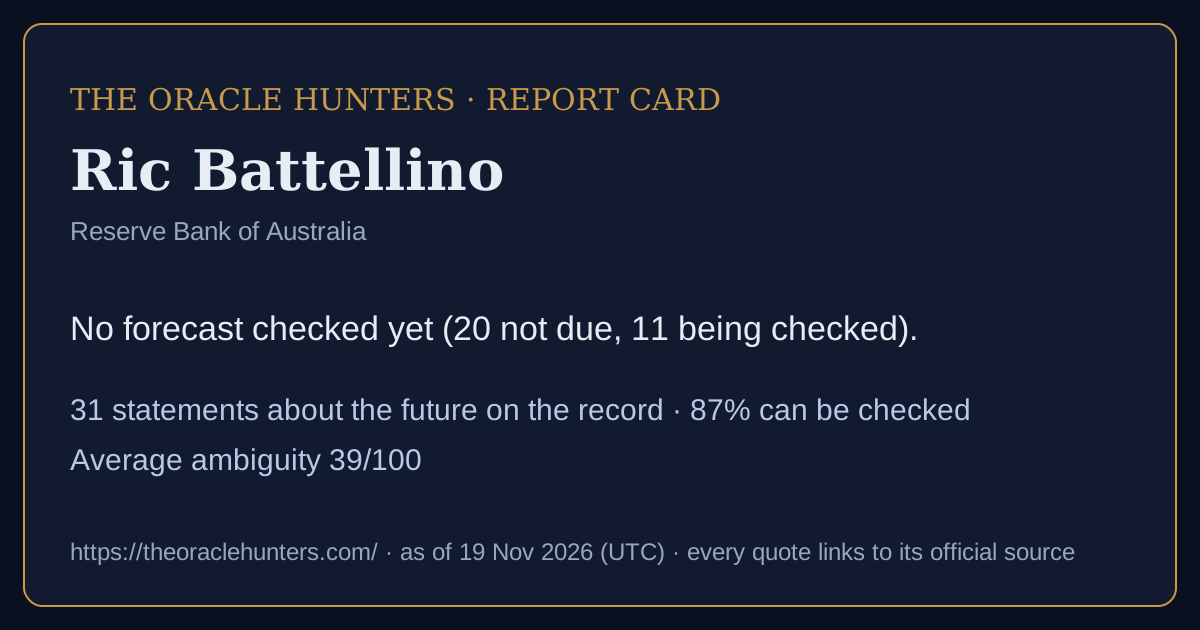
Track record: No forecast checked yet (20 not due, 11 being checked).
31forecasts & commitments on the record
87%can be checked as stated
39average ambiguity (0-100)
0goalpost moves recorded
0confirmed U-turns
Timeline
came true partly did not not due / being checked / too vague
Calibration score: shown after 10 checked forecasts with a stated likelihood (now 0).
How they speak about the future: educated guess 12, based on data 12, stated on authority 7.
Kinds of claim: forecast 19, scenario (if… then) 9, mixed claim 2, commitment 1. · Download this report card as a picture
In the nine words
πρόγνωσιςInference from evidence11 · 35%πρόνοιαPreparing for the future9 · 29%μαντείαInspired knowledge6 · 19%εἰκασίαConjecture4 · 13%προαναγγελίαPublic pre-announcement1 · 3%
How to read this
Each box is one sentence a public figure or institution said about the future, word for word, with a link to the official text. Can be checked means it names what will happen, by when, and how likely - so it can be compared with official figures later. Too vague to check means it does not. Ambiguity (0-100) is how many different ways the sentence can be read. When the date passes, the forecast is compared with official data and marked came true, partly or did not come true. Labels judge the sentence, never the person. Full guide and glossary.On the record (31)
While the forecast for overall growth for the world economy in 2011 was reduced to 4 per cent, that figure is still a healthy outcome.
The Bank's view has been that, if this is to be accommodated without generating undue inflationary pressures, other components of spending would need to grow less than might otherwise be the case.
Therefore, while the Board saw the existing mildly restrictive stance of monetary policy as appropriate for the time being, its assessment was that if conditions evolved in line with the outlook, another rise in interest rates would likely be required, at some point, if inflation was to remain consistent with the medium-term target.
In these circumstances, the Board continued to hold rates steady, noting that the CPI outcome to be published in the next month would provide an update on inflation.
Employment was growing very quickly, unemployment had fallen back to just above 5 per cent, and inflation was forecast to reach the top end of the target range over the subsequent couple of years.
If the current diversified pattern of capital inflow continues, this too will add to deposit growth as these inflows find their way into bank deposits.
In addition, if household saving continues at its recent higher level, it will sustain deposit growth.
The question that arises is what will happen to bank funding if, as expected, credit growth picks up over the next few years?
The current account deficit in the December quarter fell to 2 per cent of GDP, and is likely to move lower in the immediate future.
Inflation could become a significant policy issue in Asia if growth remains strong.
If, as expected, growth in Australia increases to an above-trend pace, it is likely that in due course underlying inflation will pick up from its current level of 2¾ per cent.
From Australia's perspective, this would represent a favourable outcome, resulting in commodity prices remaining at relatively high levels compared with earlier decades, even if, as we forecast, they decline somewhat from their current elevated levels.
We are currently forecasting it to rise to around 3 per cent by the first half of 2012 (Graph 4).
Income growth will add to spending capacity; over the past year, reflecting the rise in the terms of trade, nominal GDP in Australia rose by 10 per cent.
Over the next couple of years, we expect economic growth in Australia to pick up from its current rate of 3¼ per cent, to closer to 4 per cent.
Our central scenario is for growth to continue at around this pace over the next year or so.
We expect that it will stay around its current rate for the next year or so but, after that, upward pressure on inflation is again likely to emerge with a strongly growing economy.
This is generating a large increase in income for the country: we are forecasting that Australia's gross income (in nominal terms) will rise by about 10 per cent this year.
Growth in our major trading partners, a group that is more heavily weighted to the fastgrowing economies of Asia, is expected to be even stronger this year.
If as a nation we want to continue to do this, while at the same time providing enough dwellings for the growing population, the overall amount of dwelling investment undertaken will need to increase relative to GDP.
With the economy having only recently entered a new upswing, it is reasonable to assume that we will see this growth extended for a few more years yet.
If, as has occurred over the past five years, the supply chain involved in the production of resources in Australia (and elsewhere) struggles to keep up with rising Chinese demand, commodity prices will remain high.
The result is that the share of our exports going to the Asian region, which was already high, has risen further, to around 70 per cent.
While China is not going to return to a 12 per cent growth rate any time soon, it is quite possible that the past six months will turn out to have been the period of maximum weakness in the Chinese economy.
Now they are forecasting that global GDP will fall by around 1 per cent in 2009, the weakest outcome in the post-war period.
This year, it is estimated there will be a deficit of 2½ per cent of GDP.
There is no reason to assume that the next year or two will not do the same.
Nobody knows how significant they will turn out to be but it would be reasonable to assume that income growth for the household sector will be noticeably below average over the next year or two.
I think it is now widely accepted that growth in real incomes over the next year or two will be more subdued than over the past five years.
I'm sure this year will be no exception.
It is a matter of arithmetic that if credit is growing faster than GDP, then the ratio of credit outstanding to GDP will rise.
Also said - not checkable as stated (12 newest)
Remarks about the future with no date, figure or likelihood that could be checked. They are kept on the record and shown here, but not scored.
At this stage, most forecasters think that growth in the world economy will be only a little below trend in the coming year, though with the risk of a significantly worse outcome.
Australia, like other countries, will be affected by the events in Europe, but its strong government finances, healthy banking sector and relatively limited direct trade and financial exposures to Europe make it one of the countries best placed to weather the situation.
In the short term, it is highly likely that part of the solution will involve substantial financial assistance from outside the region or the purchase of sovereign debt by the ECB, or some combination of both.
This will add to the general tightening of global credit conditions.
Table 2 Share of Merchandise Exports going to Euro Area (2010)
While the direct exposure of Australia to a slowing in European demand is low, the indirect exposure, through the effect on some of our important trading partners, could be significant.
As we have seen from last weekend's events in Europe, much still needs to be done to deal with the challenges these countries are facing, and further market volatility is therefore to be expected.
It was always expected that economic growth in 2011 would not be as strong.
Subsequent to this, the marked increase in financial market volatility that occurred in the third quarter caused analysts to expect further weakening in the global economy, due to the sharp falls in consumer and business sentiment that occurred in most countries and the significant reduction in wealth caused by the falls in share prices.
Although growth forecasts for Asia and Latin America were also revised down somewhat, the forecast outcomes for these countries remained quite robust.
The disparate outcomes between the advanced economies and the emerging economies, however, mean that the growth is very unbalanced and there is a sense that the forecast is fragile because of possible severe downside risks.
For growth in the non-mining economy to pick up, it is likely that these trends will need to reverse.