Rebecca Pow
Department for Environment, Food & Rural Affairs · GBR
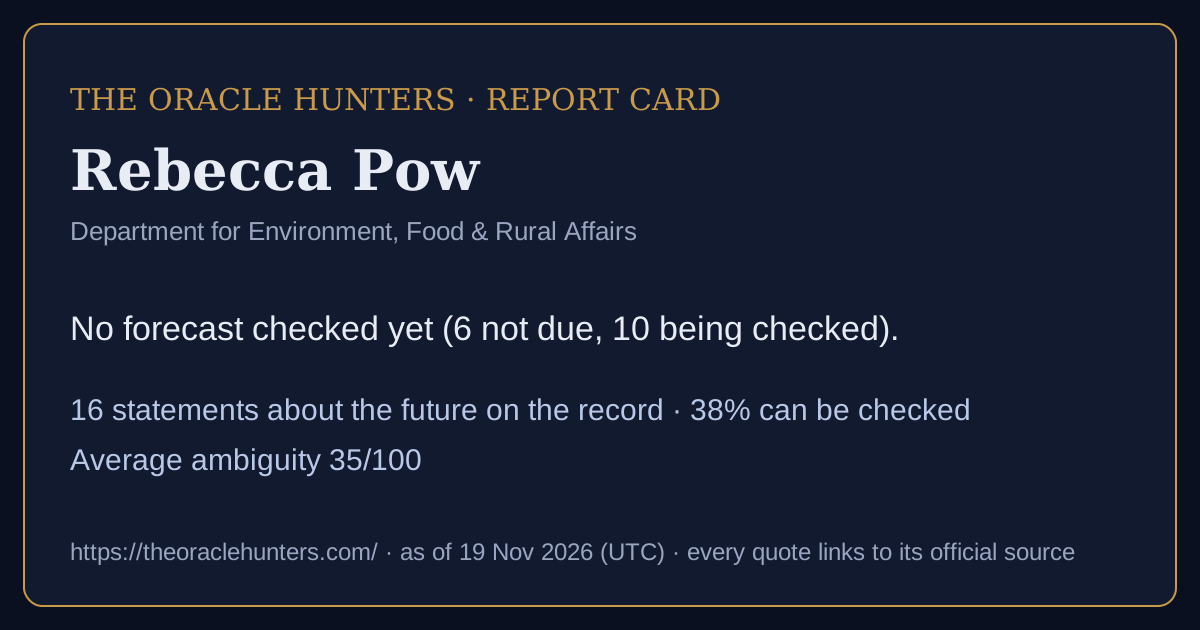
Track record: No forecast checked yet (6 not due, 10 being checked).
16forecasts & commitments on the record
38%can be checked as stated
35average ambiguity (0-100)
0goalpost moves recorded
0confirmed U-turns
Timeline
came true partly did not not due / being checked / too vague
Calibration score: shown after 10 checked forecasts with a stated likelihood (now 0).
How they speak about the future: based on data 11, stated on authority 5.
Kinds of claim: mixed claim 9, forecast 7. · Download this report card as a picture
In the nine words
πρόγνωσιςInference from evidence10 · 62%μαντείαInspired knowledge5 · 31%πρόβλεψιςSeeing the signs1 · 6%
How to read this
Each box is one sentence a public figure or institution said about the future, word for word, with a link to the official text. Can be checked means it names what will happen, by when, and how likely - so it can be compared with official figures later. Too vague to check means it does not. Ambiguity (0-100) is how many different ways the sentence can be read. When the date passes, the forecast is compared with official data and marked came true, partly or did not come true. Labels judge the sentence, never the person. Full guide and glossary.On the record (16)
We recently led the way in securing an incredibly stretching package for protecting nature globally – which includes a new international fund to tackle the nature crisis; and an expectation that $30 billion a year of international nature finance will flow into developing countries by 2030.
Nearly 43,000 solar modules will generate over 26% of the energy used by the works; so that’s enough electricity to supply 3,000 houses.
For the next price review period, 2025-2030, we expect water companies and regulators to be outcome-focused, innovative and integrate actions across catchments, working in partnership with other organisations.
We know that an additional 4 billion litres of water a day will be needed in England by 2050 to meet future pressures on public water supply.
By 2050, all remaining storm sewage overflows covered by our targets will also have to meet the new requirements on rainfall and environmental impact, regardless of location.
Companies should also make use of Ofwat’s new fund, of up to £100 million pounds, to encourage and support the development of a range of new approaches to water efficiency between 2025-2030, so more tech and innovation will obviously be needed in that space too.
By 2035, water companies will have to improve all storm sewage overflows discharging into or near every designated bathing water; and improve 75% of overflows discharging to high-priority nature sites.
This year, colleagues across the Defra Group will continue working towards our vision of clean, healthy, safe, productive and biologically diverse seas, which are used sustainably.
This year, we will strengthen the marine protections already in place by continuing work to ensure our network of Marine Protected Areas are effectively protected.
This year we will continue to develop Fisheries Management Plans, working in partnership with stakeholders.
Recognising this, the Government announced a Green Recovery Challenge Fund in September which is now worth £80m, to kick-start a pipeline of nature-based projects to restore nature, tackle climate change and connect people with the natural environment.
Meanwhile, we all know the challenges the pandemic has posed this year, and the future will be very different as a result of COVID-19.
Today, to mark my commitment delivering our agenda and leaving the environment in a better state for future generations, I am delighted to announce that this year we will be developing and publishing a comprehensive Seabird Conservation Strategy for England.
Our marine licensing process also supports sustainable marine development and we will continue to work with local authorities to encourage all of them to sign up to the Coastal Concordat by 2021 – ensuring that the process of applying for a licence is as smooth as possible.
The Environment Agency is updating its national strategy for flood and coastal erosion risk management and, later this year, The government will set out the action it is taking to better prepare the country for the future.
We will better protect 170,000 homes on the coast before 2021, using £1.2 billion from our current £2.6bn six year capital investment programme – and our manifesto also committed significant investments to flood defences.
Also said - not checkable as stated (12 newest)
Remarks about the future with no date, figure or likelihood that could be checked. They are kept on the record and shown here, but not scored.
Building on the progress we made during our COP and G7 presidencies, we will continue to display strong global leadership on air quality, climate change and nature.
But the action that has got us this far simply will not get us where we need to be now and in the future.
This is how we will achieve what we know is necessary to protect our citizens and our environment from the harmful effects of pollution.
It is only with the valued input of all of these people that we will be able to work together to find new solutions that can be implemented across the international community.
International co-operation continues to be as important now as it was back in 1979 – you all look a bit young here but 1979, some people will remember that – when the Convention on Long Range Transboundary Air Pollution was signed.
In the next few months, we will also be conducting a formal consultation on potential Highly Protected Marine Area sites, which will have the highest protection in our seas.
We are currently updating Part Three of the Strategy, which sets out the programme of measures we will implement to help us achieve our vision for our seas.
We will also need to take a look strategically how we use our seas.
Through the UK’s COP26 Presidency this November in partnership with Italy, we will place Nature at the core of our approach to the Conference, recognising the crucial role of Nature-based Solutions for climate mitigation, adaptation and resilience, and working closely with governments, businesses and civic organisations.
I am pleased that we will be supporting the RSPB’s vital work improving island biosecurity measures that will help safeguard the UK’s internationally-important seabird islands.
This will be followed by the update to Part Three, which sets out the programme of measures we will implement in order to achieve or maintain Good Environmental Status for UK seas.
We will be collaborating closely with stakeholders – including conservation organisations, scientists and industry as these plans develop.