Rashad Cassim
South African Reserve Bank
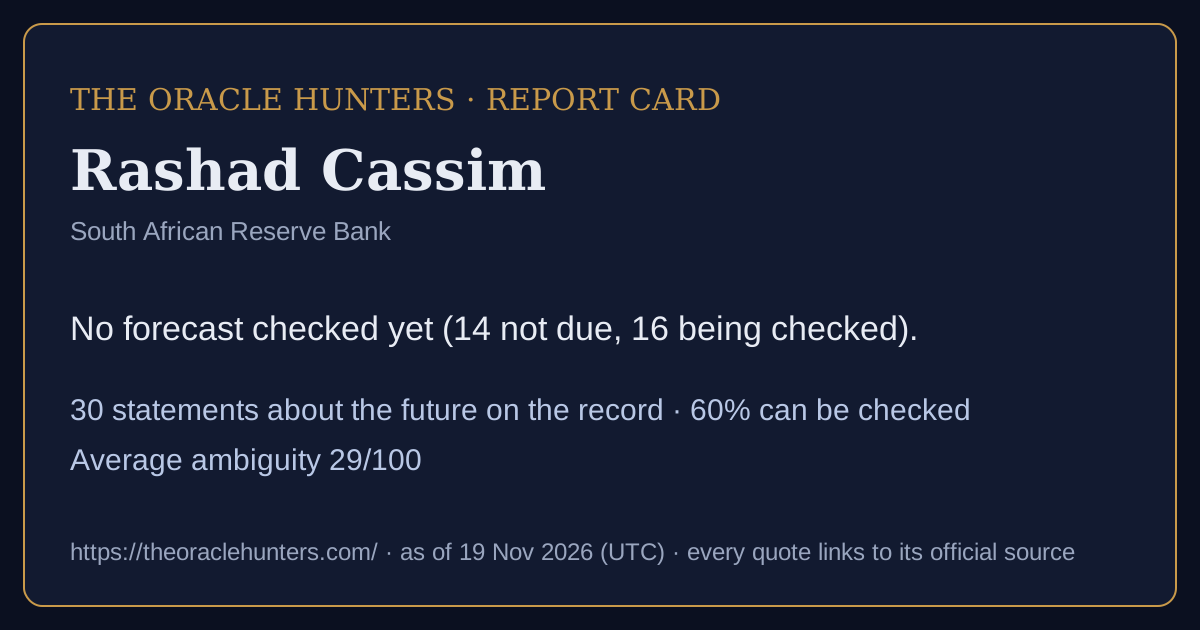
Track record: No forecast checked yet (14 not due, 16 being checked).
30forecasts & commitments on the record
60%can be checked as stated
29average ambiguity (0-100)
0goalpost moves recorded
0confirmed U-turns
Timeline
came true partly did not not due / being checked / too vague
Calibration score: shown after 10 checked forecasts with a stated likelihood (now 0).
How they speak about the future: based on data 21, stated on authority 6, educated guess 3.
Kinds of claim: forecast 22, mixed claim 4, commitment 2, scenario (if… then) 2. · Download this report card as a picture
In the nine words
πρόγνωσιςInference from evidence20 · 67%μαντείαInspired knowledge5 · 17%πρόνοιαPreparing for the future2 · 7%προαναγγελίαPublic pre-announcement2 · 7%εἰκασίαConjecture1 · 3%
How to read this
Each box is one sentence a public figure or institution said about the future, word for word, with a link to the official text. Can be checked means it names what will happen, by when, and how likely - so it can be compared with official figures later. Too vague to check means it does not. Ambiguity (0-100) is how many different ways the sentence can be read. When the date passes, the forecast is compared with official data and marked came true, partly or did not come true. Labels judge the sentence, never the person. Full guide and glossary.On the record (30)
We recognise that, given how events have played out, we are better off doing Jibar cessation in May next year rather than sticking to December of this year.
We are now moving that date five months later, to 31 May 2027.
An important example is inflation risk: if investors feel unsure about the outlook for inflation, they will probably want higher yields to compensate.
Anchoring inflation expectations close to 3% will allow us to set lower short-term rates, probably closer to 6% than 7%.
During last year and early this year, our assessment was that financial conditions were broadly easing. 6 This made it easier for us to proceed cautiously with rate cuts: we could move in increments of 25 basis points, and not at every meeting, reassured that the economy was also being supported by looser financial conditions.
We are working to find a benchmark administrator that will calculate and publish forward-looking term ZARONIA rates by April 2026.
However, these spreads will not be applied until after 31 December 2026, as the Jibar rates are expected to remain representative until that point.
Jibar will be discontinued from 31 December 2026.
The MPG's recent 'Update on the Jibar transition plan' indicates that Jibar will cease towards the end of 2026. 1 The SARB intends to announce the precise Jibar cessation date in December 2025.
We look forward to a proof of concept this year, and hopefully this system will be up and running in 2026.
Hopefully we will not have to wait until 2029 for our next engagement.
FRAs that are denominated in sterling, the Japanese yen and Swiss franc have virtually ceased trading, with their turnover having declined by more than 90%. 16 Therefore, it is likely that we will see the domestic FRA market decline, and those that wish to speculate on future short rate movements will likely have to use forward-starting OISs as a replacement …
We are expecting growth rates of 0.3%, 0.7% and 1.0% over the next three years.
On current forecasts, we anticipate inflation will be back at the midpoint of our target range towards the end of this year.
For this reason, potential growth rises over the forecast period, reaching 1% in 2025.
Of course, if we do not see services coming down later this year, then we will have a problem.
We anticipate that the peak for core is still ahead of us, with the January MPC forecast projecting core inflation of 5.4% in the second quarter of this year.
For this reason, the extent to which the policy rate will change from the current 7.25% will depend on whether we feel confident that disinflation is proceeding and we will get to 4.5% this year.
If expectations do not come back to our target, that means price setters will build in higher prices in their contracts.
over 7% and declining to just under 6% next year, we still clearly have a negative real policy rate.
When we look at different measures of inflation expectations, respondents rationally - expect higher inflation this year.
Inflation is expected to be above targets in most advanced and emerging market economies, both this year and next year.
For instance, nominal wages are forecast to rise from 5.6% in 2022 to 7.3% in 2023.
Our forecast indicates that we will be back below 6% around mid-2023, and we will reach the midpoint of our target only late in 2024.
However, we noted that evidence points to this reduction as temporary and likely to reverse in 2022.
A key consideration in this regard is whether we will see investor differentiation between emerging markets, with preference for those with strong growth and fiscal metrics.
The main drag on medium-term growth is that we expect negative growth in investment this year and next year in both the public and the private sector.
Our Quarterly Projection Model (QPM) also points to a large output gap that will only narrow over the remainder of the forecast period but still remain negative in 2022.
We further expect the economy to grow by 3.5% and 2.4% in 2021 and 2022 respectively.
We revised our 2020 growth forecast marginally upwards from a contraction of 8.2% projected at our September meeting to a contraction of 8% on the assumption of a stronger recovery in the third quarter of this year.
Also said - not checkable as stated (12 newest)
Remarks about the future with no date, figure or likelihood that could be checked. They are kept on the record and shown here, but not scored.
Together with National Treasury and the Financial Sector Conduct Authority, we will work hard to support the relevant parliamentary processes and finalise the legislation as quickly as is possible.
It’s a disappointment that we will not be able to meet the original Jibar cessation date.
It was never clear why it should be at a fixed spread of 350 basis points over the SARB rate, permanently, and banks always had freedom to price loans at varying spreads to Prime.
In making this transition, the lessons from Jibar will be very important.
We therefore need to monitor market changes closely so that we understand what is driving the shifts and how they affect the monetary policy outlook.
About midway through the second half of the 20th century, it was fashionable to make monetary policy using many different tools, such as rules for how much credit could be extended to different sectors, or what reserve requirements banks had to hold for different kinds of liabilities.
For example, if government's debt trajectory is seen as unsustainable, markets will charge a risk premium.
It also surfaced important governance and legal questions related to DLT-enabled tokenisation and settlement that would need to be resolved before any policy decisions could be taken.
One important initiative was Project Khokha, launched in 2018, to test what the technology could do in practice - and where its limits lay.
Project Khokha 1 demonstrated that a permissioned DLT network could move tokenised central bank money and settle trades in a controlled environment.
The SARB's exploratory work on retail central bank digital currency is part of a broader effort to understand how public digital money might function in a modernised economy.
In essence, our view is that, while a retail CBDC is technically feasible and could support innovation while ensuring continued public access to central bank money, there is no compelling need for its immediate implementation.