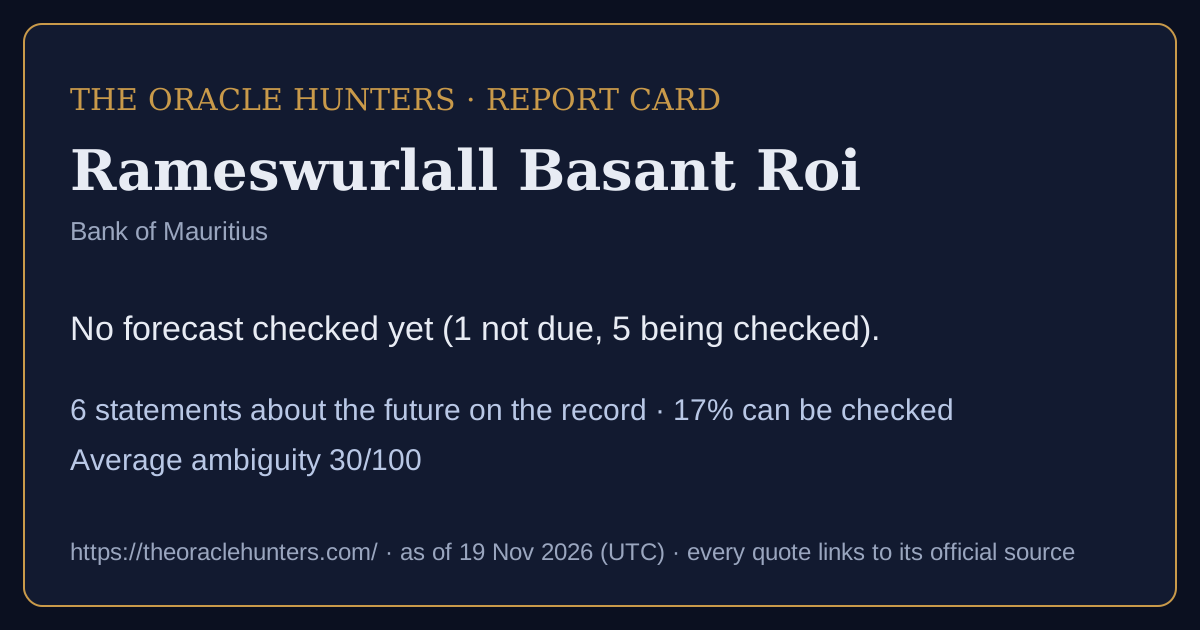
Rameswurlall Basant Roi
Bank of Mauritius
Track record: No forecast checked yet (1 not due, 5 being checked).
6forecasts & commitments on the record
17%can be checked as stated
30average ambiguity (0-100)
0goalpost moves recorded
0confirmed U-turns
Timeline
came true partly did not not due / being checked / too vague
Calibration score: shown after 10 checked forecasts with a stated likelihood (now 0).
How they speak about the future: stated on authority 4, based on data 2.
Kinds of claim: forecast 5, mixed claim 1. · Download this report card as a picture
In the nine words
How to read this
Each box is one sentence a public figure or institution said about the future, word for word, with a link to the official text. Can be checked means it names what will happen, by when, and how likely - so it can be compared with official figures later. Too vague to check means it does not. Ambiguity (0-100) is how many different ways the sentence can be read. When the date passes, the forecast is compared with official data and marked came true, partly or did not come true. Labels judge the sentence, never the person. Full guide and glossary.On the record (6)
The National Payment Switch which will be launched next year will become a pillar of the Mauritian digital economy.
By October this year, the Guideline is expected to become effective.
The capital framework included the conservation buffer of 2.5 per cent which is graduated for full implementation by 2020 when banks will need to maintain a ratio of 12.5 per cent.
The draft guideline on Liquidity Coverage Ratio (LCR) has already been released to the banking industry for consultation and will be issued to the industry this year.
Jobs are being lost to automation at a rate faster than we had imagined in the early years of the 21st century and 50 per cent of the jobs we have today will be gone by the year 2030 according to certain credible estimates.
The loss of wealth seems to have had a dampening effect on consumption of non-essential items this year and is likely to last in the months ahead.
Also said - not checkable as stated (12 newest)
Remarks about the future with no date, figure or likelihood that could be checked. They are kept on the record and shown here, but not scored.
In today's free market context, one would have ordinarily expected the cost bank credit to go up, meaning that interest rates would have had to be stepped up.
The devaluation was expected to restore the profitability and external competitiveness of Mauritian exports and to encourage import substitutions in the economy.
But, against all principles of good economics, the government had decided to grant a massive across-the-board increase in wages and salaries thus mitigating the positive outcome expected of the devaluation of the rupee.
There are risks of instability in the offing that hopefully will be effectively tackled by the Bank and other agencies in the years ahead.
They are expected to change soon with the Bank's risk-based supervision approach.
It does not necessarily go to say that the Bank will be regulating for zero failures.
It is expected of me to look back with you all into the 50 years of history of central banking in Mauritius on this very special occasion.
I will limit my address to some key institutional aspects of the Bank over its 50-year history.
But before I do so, let me go back to the first half of the 19 century when Mauritius had entertained a regime of free banking, meaning that anybody could start a banking business with limited capital in an environment free of regulation.
Whereas in the previous Act, the Minister of Finance could give directives to the Bank, in the new Act, this power to issue directives to the Bank was done away with.
You might be wondering why I have chosen to focus on the evolution of the organisational structure of the Bank and the regular amendments of the Bank of Mauritius Act and the Banking Act.
Questions were vigorously set as to how monetary policy could be better applied to forestall booms and busts.