The public record of what the powerful say about the futureAll times UTCYour time ATHENA News Room is liveSealed daily · anchored in BitcoinΕλληνικά A Tekmerion product
THE ORACLE HUNTERS • EVERY PROPHECY ON THE RECORD •AAAWgmp1bWIAAAAeanVtZGMycGEAEQAQgAAAqgA4m3EDYzJwYQAAABZcanVtYgAAAEdqdW1kYzJtYQARABCAAACqADibcQN1cm46YzJwYTo4MTk5ZDlhYi0zYzIzLTQwZDYtYTc1NS04MTM5NWJhODhjMTYAAAADl2p1bWIAAAApanVtZGMyYXMAEQAQgAAAqgA4m3EDYzJwYS5hc3NlcnRpb25zAAAAALxqdW1iAAAARGp1bWRjYm9yABEAEIAAAKoAOJtxE2MycGEuaW5ncmVkaWVudC52MwAAAAAYYzJzaIxn7Lz8d2kiZVLVmLMqjH8AAABwY2JvcqNpZGM6Zm9ybWF0bWltYWdlL3N2Zyt4bWxqaW5zdGFuY2VJRHgseG1wOmlpZDpjNjQzY2M2MC03NmU5LTRkODUtODAzNi04Y2U2YmUwZDA0MzRscmVsYXRpb25zaGlwaHBhcmVudE9mAAAB4mp1bWIAAABBanVtZGNib3IAEQAQgAAAqgA4m3ETYzJwYS5hY3Rpb25zLnYyAAAAABhjMnNoYoNKEfN7QooyLxBggQwrRAAAAZljYm9yomdhY3Rpb25zgqJmYWN0aW9ua2MycGEub3BlbmVkanBhcmFtZXRlcnOha2luZ3JlZGllbnRzgaJjdXJseC1zZWxmI2p1bWJmPWMycGEuYXNzZXJ0aW9ucy9jMnBhLmluZ3JlZGllbnQudjNkaGFzaFggGR++KIZKhTpFlfMpaeP4xKARvK6IpGRCm/JKHJsg8z+kZmFjdGlvbngdY29tLmFudGhyb3BpYy5jbGF1ZGUucHJvdmlkZWRqcGFyYW1ldGVyc6F4H2NvbS5hbnRocm9waWMub3JpZ2luLWNvbmZpZGVuY2VndW5rbm93bmtkZXNjcmlwdGlvbnhmQ2xhdWRlIHByb3ZpZGVkIHRoaXMgZmlsZSBhdCB0aGUgcmVxdWVzdCBvZiBhIHVzZXIgYW5kIG1heSBoYXZlIGNyZWF0ZWQgb3IgbW9kaWZpZWQgdGhlIGZpbGUgY29udGVudHMubXNvZnR3YXJlQWdlbnShZG5hbWVmQ2xhdWRlcmFsbEFjdGlvbnNJbmNsdWRlZPUAAADIanVtYgAAAEBqdW1kY2JvcgARABCAAACqADibcRNjMnBhLmhhc2guZGF0YQAAAAAYYzJzaLTPAMahVK/46OuJ/Q+uuA8AAACAY2JvcqVjYWxnZnNoYTI1NmNwYWRMAAAAAAAAAAAAAAAAZGhhc2hYII7HF9R24wInyRZy4rI4Fw0mI4Rb/ZNxjfxeO7PO35j2ZG5hbWVuanVtYmYgbWFuaWZlc3RqZXhjbHVzaW9uc4GiZXN0YXJ0GQiaZmxlbmd0aBkeBAAAAj5qdW1iAAAAJ2p1bWRjMmNsABEAEIAAAKoAOJtxA2MycGEuY2xhaW0udjIAAAACD2Nib3KlY2FsZ2ZzaGEyNTZpc2lnbmF0dXJleE1zZWxmI2p1bWJmPS9jMnBhL3VybjpjMnBhOjgxOTlkOWFiLTNjMjMtNDBkNi1hNzU1LTgxMzk1YmE4OGMxNi9jMnBhLnNpZ25hdHVyZWppbnN0YW5jZUlEeCx4bXA6aWlkOjljYzUwMDc4LTgzMDctNDI0ZS04NjE4LTVmYTQzMmE1MWJmNHJjcmVhdGVkX2Fzc2VydGlvbnODomN1cmx4LXNlbGYjanVtYmY9YzJwYS5hc3NlcnRpb25zL2MycGEuaW5ncmVkaWVudC52M2RoYXNoWCAZH74ohkqFOkWV8ylp4/jEoBG8roikZEKb8kocmyDzP6JjdXJseCpzZWxmI2p1bWJmPWMycGEuYXNzZXJ0aW9ucy9jMnBhLmFjdGlvbnMudjJkaGFzaFggjvXIkXvJ7aXB5IwuH8TLLMTeq4OAYClzgZHySVCatNCiY3VybHgpc2VsZiNqdW1iZj1jMnBhLmFzc2VydGlvbnMvYzJwYS5oYXNoLmRhdGFkaGFzaFggIhTKhum+9R2LsXAUkQyOeb6aKanhapGjq6FRT3EaJ9V0Y2xhaW1fZ2VuZXJhdG9yX2luZm+jZG5hbWVvQW50aHJvcGljIEZpbGVzZ3ZlcnNpb25lMS4wLjBrc3BlY1ZlcnNpb25lMi40LjAAABA4anVtYgAAAChqdW1kYzJjcwARABCAAACqADibcQNjMnBhLnNpZ25hdHVyZQAAABAIY2JvctKEWQISogEmGCFZAgowggIGMIIBjaADAgECAhRA5aAK7sI50L64g/oGQgU9Z1UTADAKBggqhkjOPQQDAzBJMRcwFQYDVQQKEw5BbnRocm9waWMsIFBCQzEuMCwGA1UEAxMlQW50aHJvcGljIENvbnRlbnQgQ3JlZGVudGlhbHMgUm9vdCBDQTAeFw0yNjA4MDcxODQzNTZaFw0yODA4MDYxOTQzNTZaMEQxFzAVBgNVBAoTDkFudGhyb3BpYywgUEJDMSkwJwYDVQQDEyBBbnRocm9waWMgQ2xhdWRlIENvbnRlbnQgU2lnbmluZzBZMBMGByqGSM49AgEGCCqGSM49AwEHA0IABJh6CmvLUBgFFNU0vUKlOVtE6djd17L5SuwX0LemFisBM3dkd/3cyjxFA3Qo5S46fX0/ihY0VZ7mfb9KF703t5OjWDBWMA4GA1UdDwEB/wQEAwIHgDAVBgNVHSUEDjAMBgorBgEEAYPoXgIBMAwGA1UdEwEB/wQCMAAwHwYDVR0jBBgwFoAUzlHiBIFOZFsj+OPEz5o+nMHXXMIwCgYIKoZIzj0EAwMDZwAwZAIwMXMdFJ4BetLLVY7ORuE9noqbbAZOZn/aArXyTwFAZfKrPzxF2vPoJNf1+UCdg1XGAjBwX1zd9WGqYkqmL5SFqw1QySjr1zJfpJM9+1rdDwSPLMOPOjKuiXjoU/pUUeG9RwmhY3BhZFkNngAAAAAAAAAAAAAAAAAAAAAAAAAAAAAAAAAAAAAAAAAAAAAAAAAAAAAAAAAAAAAAAAAAAAAAAAAAAAAAAAAAAAAAAAAAAAAAAAAAAAAAAAAAAAAAAAAAAAAAAAAAAAAAAAAAAAAAAAAAAAAAAAAAAAAAAAAAAAAAAAAAAAAAAAAAAAAAAAAAAAAAAAAAAAAAAAAAAAAAAAAAAAAAAAAAAAAAAAAAAAAAAAAAAAAAAAAAAAAAAAAAAAAAAAAAAAAAAAAAAAAAAAAAAAAAAAAAAAAAAAAAAAAAAAAAAAAAAAAAAAAAAAAAAAAAAAAAAAAAAAAAAAAAAAAAAAAAAAAAAAAAAAAAAAAAAAAAAAAAAAAAAAAAAAAAAAAAAAAAAAAAAAAAAAAAAAAAAAAAAAAAAAAAAAAAAAAAAAAAAAAAAAAAAAAAAAAAAAAAAAAAAAAAAAAAAAAAAAAAAAAAAAAAAAAAAAAAAAAAAAAAAAAAAAAAAAAAAAAAAAAAAAAAAAAAAAAAAAAAAAAAAAAAAAAAAAAAAAAAAAAAAAAAAAAAAAAAAAAAAAAAAAAAAAAAAAAAAAAAAAAAAAAAAAAAAAAAAAAAAAAAAAAAAAAAAAAAAAAAAAAAAAAAAAAAAAAAAAAAAAAAAAAAAAAAAAAAAAAAAAAAAAAAAAAAAAAAAAAAAAAAAAAAAAAAAAAAAAAAAAAAAAAAAAAAAAAAAAAAAAAAAAAAAAAAAAAAAAAAAAAAAAAAAAAAAAAAAAAAAAAAAAAAAAAAAAAAAAAAAAAAAAAAAAAAAAAAAAAAAAAAAAAAAAAAAAAAAAAAAAAAAAAAAAAAAAAAAAAAAAAAAAAAAAAAAAAAAAAAAAAAAAAAAAAAAAAAAAAAAAAAAAAAAAAAAAAAAAAAAAAAAAAAAAAAAAAAAAAAAAAAAAAAAAAAAAAAAAAAAAAAAAAAAAAAAAAAAAAAAAAAAAAAAAAAAAAAAAAAAAAAAAAAAAAAAAAAAAAAAAAAAAAAAAAAAAAAAAAAAAAAAAAAAAAAAAAAAAAAAAAAAAAAAAAAAAAAAAAAAAAAAAAAAAAAAAAAAAAAAAAAAAAAAAAAAAAAAAAAAAAAAAAAAAAAAAAAAAAAAAAAAAAAAAAAAAAAAAAAAAAAAAAAAAAAAAAAAAAAAAAAAAAAAAAAAAAAAAAAAAAAAAAAAAAAAAAAAAAAAAAAAAAAAAAAAAAAAAAAAAAAAAAAAAAAAAAAAAAAAAAAAAAAAAAAAAAAAAAAAAAAAAAAAAAAAAAAAAAAAAAAAAAAAAAAAAAAAAAAAAAAAAAAAAAAAAAAAAAAAAAAAAAAAAAAAAAAAAAAAAAAAAAAAAAAAAAAAAAAAAAAAAAAAAAAAAAAAAAAAAAAAAAAAAAAAAAAAAAAAAAAAAAAAAAAAAAAAAAAAAAAAAAAAAAAAAAAAAAAAAAAAAAAAAAAAAAAAAAAAAAAAAAAAAAAAAAAAAAAAAAAAAAAAAAAAAAAAAAAAAAAAAAAAAAAAAAAAAAAAAAAAAAAAAAAAAAAAAAAAAAAAAAAAAAAAAAAAAAAAAAAAAAAAAAAAAAAAAAAAAAAAAAAAAAAAAAAAAAAAAAAAAAAAAAAAAAAAAAAAAAAAAAAAAAAAAAAAAAAAAAAAAAAAAAAAAAAAAAAAAAAAAAAAAAAAAAAAAAAAAAAAAAAAAAAAAAAAAAAAAAAAAAAAAAAAAAAAAAAAAAAAAAAAAAAAAAAAAAAAAAAAAAAAAAAAAAAAAAAAAAAAAAAAAAAAAAAAAAAAAAAAAAAAAAAAAAAAAAAAAAAAAAAAAAAAAAAAAAAAAAAAAAAAAAAAAAAAAAAAAAAAAAAAAAAAAAAAAAAAAAAAAAAAAAAAAAAAAAAAAAAAAAAAAAAAAAAAAAAAAAAAAAAAAAAAAAAAAAAAAAAAAAAAAAAAAAAAAAAAAAAAAAAAAAAAAAAAAAAAAAAAAAAAAAAAAAAAAAAAAAAAAAAAAAAAAAAAAAAAAAAAAAAAAAAAAAAAAAAAAAAAAAAAAAAAAAAAAAAAAAAAAAAAAAAAAAAAAAAAAAAAAAAAAAAAAAAAAAAAAAAAAAAAAAAAAAAAAAAAAAAAAAAAAAAAAAAAAAAAAAAAAAAAAAAAAAAAAAAAAAAAAAAAAAAAAAAAAAAAAAAAAAAAAAAAAAAAAAAAAAAAAAAAAAAAAAAAAAAAAAAAAAAAAAAAAAAAAAAAAAAAAAAAAAAAAAAAAAAAAAAAAAAAAAAAAAAAAAAAAAAAAAAAAAAAAAAAAAAAAAAAAAAAAAAAAAAAAAAAAAAAAAAAAAAAAAAAAAAAAAAAAAAAAAAAAAAAAAAAAAAAAAAAAAAAAAAAAAAAAAAAAAAAAAAAAAAAAAAAAAAAAAAAAAAAAAAAAAAAAAAAAAAAAAAAAAAAAAAAAAAAAAAAAAAAAAAAAAAAAAAAAAAAAAAAAAAAAAAAAAAAAAAAAAAAAAAAAAAAAAAAAAAAAAAAAAAAAAAAAAAAAAAAAAAAAAAAAAAAAAAAAAAAAAAAAAAAAAAAAAAAAAAAAAAAAAAAAAAAAAAAAAAAAAAAAAAAAAAAAAAAAAAAAAAAAAAAAAAAAAAAAAAAAAAAAAAAAAAAAAAAAAAAAAAAAAAAAAAAAAAAAAAAAAAAAAAAAAAAAAAAAAAAAAAAAAAAAAAAAAAAAAAAAAAAAAAAAAAAAAAAAAAAAAAAAAAAAAAAAAAAAAAAAAAAAAAAAAAAAAAAAAAAAAAAAAAAAAAAAAAAAAAAAAAAAAAAAAAAAAAAAAAAAAAAAAAAAAAAAAAAAAAAAAAAAAAAAAAAAAAAAAAAAAAAAAAAAAAAAAAAAAAAAAAAAAAAAAAAAAAAAAAAAAAAAAAAAAAAAAAAAAAAAAAAAAAAAAAAAAAAAAAAAAAAAAAAAAAAAAAAAAAAAAAAAAAAAAAAAAAAAAAAAAAAAAAAAAAAAAAAAAAAAAAAAAAAAAAAAAAAAAAAAAAAAAAAAAAAAAAAAAAAAAAAAAAAAAAAAAAAAAAAAAAAAAAAAAAAAAAAAAAAAAAAAAAAAAAAAAAAAAAAAAAAAAAAAAAAAAAAAAAAAAAAAAAAAAAAAAAAAAAAAAAAAAAAAAAAAAAAAAAAAAAAAAAAAAAAAAAAAAAAAAAAAAAAAAAAAAAAAAAAAAAAAAAAAAAAAAAAAAAAAAAAAAAAAAAAAAAAAAAAAAAAAAAAAAAAAAAAAAAAAAAAAAAAAAAAAAAAAAAAAAAAAAAAAAAAAAAAAAAAAAAAAAAAAAAAAAAAAAAAAAAAAAAAAAAAAAAAAAAAAAAAAAAAAAAAAAAAAAAAAAAAAAAAAAAAAAAAAAAAAAAAAAAAAAAAAAAAAAAAAAAAAAAAAAAAAAAAAAAAAAAAAAAAAAAAAAAAAAAAAAAAAAAAAAAAAAAAAAAAAAAAAAAAAAAAAAAAAAAAAAAAAAAAAAAAAAAAAAAAAAAAAAAAAAAAAAAAAAAAAAAAAAAAAAAAAAAAAAAAAAAAAAAAAAAAAAAAAAAAAAAAAAAAAAAAAAAAAAAAAAAAAAAAAAAAAAAAAAAAAAAAAAAAAAAAAAAAAAAAAAAAAAAAAAAAAAAAAAAAAAAAAAAAAAAAAAAAAAAAAAAAAAAAAAAAAAAAAAAAAAAAAAAAAAAAAAAAAAAAAAAAAAAAAAAAAAAAAAAAAAAAAAAAAAAAAAAAAAAAAAAAAAAAAAAAAAAAAAAAAAAAAAAAAAAAAAAAAAAAAAAAAAAAAAAAAAAAAAAAAAAAAAAAAAAAAAAAAAAAAAAAAAAAAAAAAAAAAAAAAAAAAAAAAAAAAAAAAAAAAAAAAAAAAAAAAAAAAAAAAAAAAAAAAAAAAAAAAAAAAAAAAAAAAAAAAAAAAAAAAAAAAAAAAAAAAAAAAAAAAAAAAAAAAAAAAAAAAAAAAAAAAAAAAAAAAAAAAAAAAAAAAAAAAAAAAAAAAAAAAAAAAAAAAAAAAAAAAAAAAAAAAAAAAAAAAAAAAAAAAAAAAAAAAAAAAAAAAAAAAAAAAAAAAAAAAAAAAAAAAAAAAAAAAAAAAAAAAAAAAAAAAAAAAAAAAAAAAAAAAAAAAAAAAAAAAAAAAAAAAAAAAAAAAAAAAAAAAAAAAAAAAAAAAAAAAAAAAAAAAAAAAAAAAAAAAAAAAAAAAAAAAAAAAAAAAAAAAAAAAAAAAAAAAAAAAAAAAAAAAAAAAAAAAAAAAAAAAAAAAAAAAAAAAAAAAAAAAAAAAAAAAAAAAAAAAAAAAAAAAAAAAAAAAAAAAAAAAAAAAAAAAAAAAAAAAAAAAAAAAAAAAAAAAAAAAAAAAAAAAAAAAAAAAAAAAAAAAAAAAAAAAAAAAAAAAAAAAAAAAAAAAAAAAAAAAAAAAAAAAAAAAAAAAAAAAAAAAAAAAAAAAAAAAAAAAAAAAAAAAAAAAAAAAAAAAAAAAAAAAAAAAAAAAAAAAAAAAAAAAAAAAAAAAAAAAAAAAAAAAAAAAAAAAAAAAAAAAAAAAAAAAAAAAAAAAAAAAAAAAAAAAAAAAAAAAAAAAAAAAAAAAAAAAAAAAAAAAAAAAAAAAAAAAAAAAAAAAAAAAAAAAAAAAAAAAAAAAAAAAAAAAAAAAAAAAAAAAAAAAAAAAAAAAAAAAAAAAAAAPZYQLfUpeT/MPsu1gA3RgZ8fvvIDmyZYJDWmz6ftVFNojm4kOQbEdCSTa0XP3aqZnboyhQ+RU/hD3bq8nBGJ+yvrXI=The Oracle HuntersEvery prophecy, on the record. · Οἱ Κυνηγοὶ τῶν ΧρησμῶνUnder development

← Tracking the Prophets

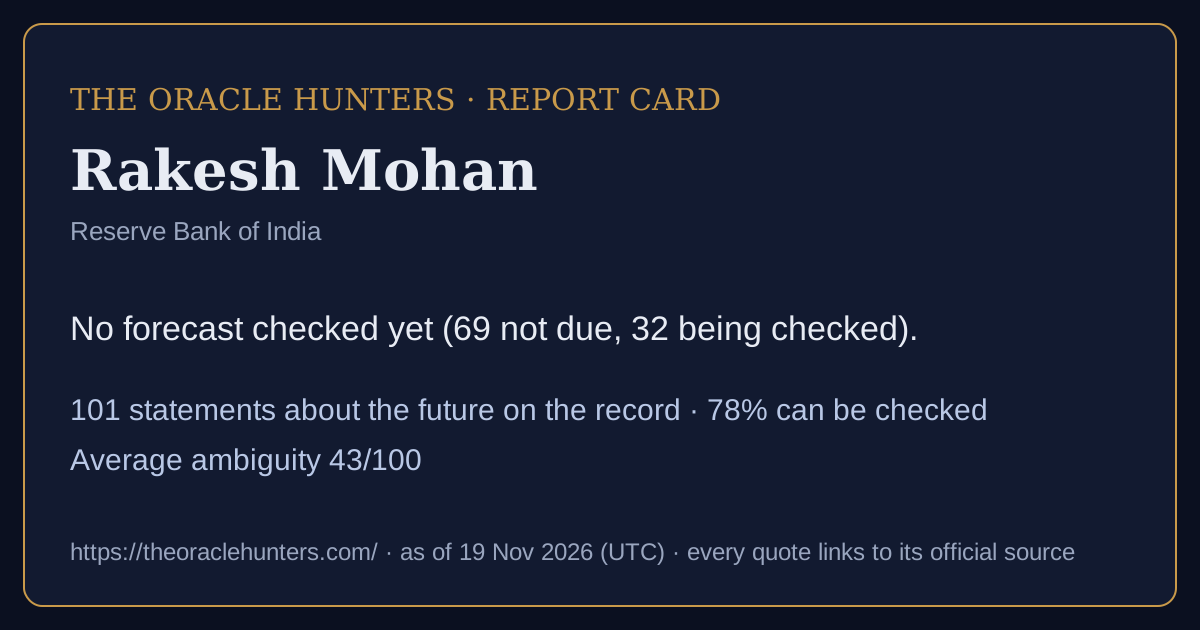
Rakesh Mohan

Reserve Bank of India

Track record: No forecast checked yet (69 not due, 32 being checked).
101forecasts & commitments on the record
78%can be checked as stated
43average ambiguity (0-100)
0goalpost moves recorded
0confirmed U-turns

Timeline

20032003: Not due yet2003: Due - being checked2003: Not due yet2003: Due - being checked2003: Due - being checked2003: Due - being checked20042004: Not due yet2004: Not due yet2004: Not due yet2004: Not due yet2004: Not due yet2004: Due - being checked2004: Due - being checked2004: Due - being checked (+3 more)20052005: Not due yet2005: Due - being checked2005: Due - being checked2005: Not due yet2005: Not due yet2005: Due - being checked2005: Due - being checked2005: Not due yet20062006: Not due yet2006: Not due yet2006: Not due yet2006: Due - being checked2006: Due - being checked2006: Not due yet2006: Not due yet2006: Not due yet (+25 more)20072007: Not due yet2007: Not due yet2007: Not due yet2007: Not due yet2007: Not due yet2007: Not due yet2007: Not due yet2007: Not due yet (+12 more)20082008: Not due yet2008: Not due yet2008: Not due yet2008: Not due yet2008: Due - being checked2008: Due - being checked2008: Not due yet2008: Not due yet (+8 more)20092009: Not due yet2009: Not due yet2009: Due - being checked2009: Not due yet2009: Not due yet2009: Due - being checked2009: Due - being checked
came true partly did not not due / being checked / too vague

Calibration score: shown after 10 checked forecasts with a stated likelihood (now 0).
How they speak about the future: based on data 86, educated guess 8, stated on authority 7.
Kinds of claim: forecast 77, mixed claim 12, scenario (if… then) 8, commitment 4. · Download this report card as a picture
In the nine words

πρόγνωσιςInference from evidence83 · 82%πρόνοιαPreparing for the future8 · 8%προαναγγελίαPublic pre-announcement4 · 4%μαντείαInspired knowledge3 · 3%εἰκασίαConjecture2 · 2%φρόνησιςPractical wisdom1 · 1%
How to read this Each box is one sentence a public figure or institution said about the future, word for word, with a link to the official text. Can be checked means it names what will happen, by when, and how likely - so it can be compared with official figures later. Too vague to check means it does not. Ambiguity (0-100) is how many different ways the sentence can be read. When the date passes, the forecast is compared with official data and marked came true, partly or did not come true. Labels judge the sentence, never the person. Full guide and glossary.

On the record (101)

Global growth for 2009, which was seen at a healthy 3.8 per cent in April 2008, is now expected by the IMF to contract by 1.3 per cent.
Reserve Bank of India · said 10 Jun 2009 (date) · Emerging contours of financial regulation - challenges and dynamics · evidence & why
The revenue deficit at 4.4 per cent of GDP will be at its previous peak touched during 2001-02 and 2002-03.
Reserve Bank of India · said 23 Apr 2009 (date) · Global financial crisis - causes, impact, policy responses and lessons · evidence & why
Thus, balances under MSS rose from around Rs.39,000 crore at end-January 2007 to around Rs.1,75,000 crore by end-May 2008 in the face of large capital flows; in the subsequent period, with reversals in capital flows, MSS balances came down to around Rs. 88,000 crore by end-March 2009 and helped maintain adequate rupee liquidity in the system.
Reserve Bank of India · said 23 Apr 2009 (date) · Global financial crisis - causes, impact, policy responses and lessons · evidence & why
πρόγνωσις · Inference from evidencePartly checkableForecastbased on dataambiguity 83/100implied call / likelihood: No · 40% · probablebelow the RIM-1 standarddue 31 Dec 2009Due - being checked
Global trade volume (goods and services) is also expected to contract by 11 per cent during 2009 as against the robust growth of 8.2 per cent during 2006-2007.
Reserve Bank of India · said 23 Apr 2009 (date) · Global financial crisis - causes, impact, policy responses and lessons · evidence & why
Global growth for 2009, which was seen at a healthy 3.8 per cent in April 2008, is now projected to contract by 1.3 per cent (IMF, 2009c) (Table 2).
Reserve Bank of India · said 23 Apr 2009 (date) · Global financial crisis - causes, impact, policy responses and lessons · evidence & why
First, while headline inflation in terms of wholesale price index has seen a significant easing over the past few months (from around 12 per cent in September 2008 to 0.3 per cent by end-March 2009), it is largely due to the substantial decline in international crude oil prices and some reduction in domestic prices of administered oil products.
Reserve Bank of India · said 23 Apr 2009 (date) · Global financial crisis - causes, impact, policy responses and lessons · evidence & why
πρόγνωσις · Inference from evidencePartly checkableForecastbased on dataambiguity 71/100below the RIM-1 standarddue 31 Dec 2009Due - being checkedinflationenergy
Non-food bank credit growth has, however, moderated from the peak of around 30 per cent in October 2008 to around 18 per cent by end-March 2009.
Reserve Bank of India · said 23 Apr 2009 (date) · Global financial crisis - causes, impact, policy responses and lessons · evidence & why
πρόγνωσις · Inference from evidencePartly checkableForecastbased on dataambiguity 71/100below the RIM-1 standarddue 31 Dec 2009Due - being checkedgrowthfinance
For East Asian economies, since most of these economies are small and their trade sector (export plus imports) as proportion of GDP varies at a significantly higher level between over 200 per cent and 60 per cent as opposed to the weight of domestic demand as in India, it could be an area of concern for these countries.
Reserve Bank of India · said 09 Oct 2008 (date) · Global financial crisis and key risks … impact on India and Asia · evidence & why
Thus, banks held nearly 1.7 per cent excess SLR securities - equivalent to Rs. 700 billion - which could be used by banks to avail of liquidity from the Reserve Bank under the daily LAF operations.
Reserve Bank of India · said 09 Oct 2008 (date) · Global financial crisis and key risks … impact on India and Asia · evidence & why
Thus, one can expect more demand for bank credit, and non-food credit growth has indeed accelerated in the current year (26.2 per cent on a year-on-year basis as on September 12, 2008 as compared with 23.3 per cent a year ago).
Reserve Bank of India · said 09 Oct 2008 (date) · Global financial crisis and key risks … impact on India and Asia · evidence & why
1 It may be noted that India is more open as compared to the US: the ratio of current receipts and current payments was 41 per cent of GDP in the US in 2007, while capital inflows and capital outflows were around 15 per cent and 10 per cent, respectively.
Reserve Bank of India · said 09 Oct 2008 (date) · Global financial crisis and key risks … impact on India and Asia · evidence & why
Growth in advanced economies is projected to decelerate from an average of 2.8 per cent during 2006-2007 to 1.5 per cent in 2008 and only 0.5 per cent in 2009.
Reserve Bank of India · said 09 Oct 2008 (date) · Global financial crisis and key risks … impact on India and Asia · evidence & why
πρόγνωσις · Inference from evidenceCan be checkedForecastbased on dataambiguity 0/100implied call / likelihood: Yes · 70% · probablemeets the RIM-1 standarddue 31 Dec 2009Due - being checkedgrowth
Global output growth (at purchasing power parity (PPP) exchange rates) is now seen at 3.0 per cent in 2009, down from the likely 3.9 per cent in 2008 and the robust growth of almost 5 per cent each during 2006 and 2007.
Reserve Bank of India · said 09 Oct 2008 (date) · Global financial crisis and key risks … impact on India and Asia · evidence & why
πρόγνωσις · Inference from evidenceCan be checkedForecastbased on dataambiguity 0/100implied call / likelihood: Yes · 70% · probablemeets the RIM-1 standarddue 31 Dec 2009Due - being checkedgrowth
While the Reserve Bank does not target an explicit inflation rate as some countries do, the objective currently is to contain the inflation rate within an upper bound of 5 percent and attempt to reduce it further in the medium term.
Reserve Bank of India · said 28 Mar 2008 (date) · Innovation and growth - role of the financial sector · evidence & why
πρόγνωσις · Inference from evidencePartly checkableForecastbased on dataambiguity 71/100below the RIM-1 standardNot due yetinflationfinance
The present domestic investment rate of around 36-37 per cent is expected to help sustain the current growth momentum.
Reserve Bank of India · said 28 Mar 2008 (date) · Innovation and growth - role of the financial sector · evidence & why
The introduction of mobile banking has just begun: now that there almost 300 million cell phones in the country we can expect a huge transformation in the delivery of banking services as this technology takes root.
Reserve Bank of India · said 28 Mar 2008 (date) · Innovation and growth - role of the financial sector · evidence & why
the step up in growth since 2003-04, it will be interesting to study the growth accounting analysis for the period since 2003-04 onwards to find out the comparative contributions of capital deepening and productivity to the acceleration in real GDP growth: but for this we will now have to wait for a few years.
Reserve Bank of India · said 28 Mar 2008 (date) · Innovation and growth - role of the financial sector · evidence & why
The saving-investment gap was projected to be financed through an increase in household financial savings rate by around 1 percentage point, i.e., to 11.4 per cent of GDP from 10.3 per cent in 2004-05.
This Group projected that sustaining a real GDP growth in the range of 8-9 per cent would require investment rate to accelerate to 36-38 per cent of GDP and gross domestic savings (GDS) rate to a range of 34-35 per cent of GDP based on the then prevailing GDS rate of 29.1 per cent and investment rate of 30.1 per …
Subsequently, this was reassessed by the Working Group on Savings for the Eleventh Five Year Plan (2007-08 to 2011-12) (Chairman: Dr. Rakesh Mohan) (May 2007).
πρόγνωσις · Inference from evidencePartly checkableForecastbased on dataambiguity 56/100implied call / likelihood: No · 40% · probablebelow the RIM-1 standarddue 31 Dec 2011Due - being checked
We may also note that the two decades, 1960s and 1980s, when the current account deficit increased marginally towards 2 per cent of GDP, were followed by significant balance of payments and economic crisis.
Hence, in order to achieve 10 per cent+ growth, we will need to encourage the continuation of growth in savings in each of the sectors: households, private corporate sector, public corporate sector and the government.
Thus, it may be reasonable to assume that the corporate savings rate, which had doubled to 7.8 per cent of GDP during the period 2002-2007, may exhibit some plateauing in the coming few years but should not be expected to fall.
Arguably, the outcome could have been quite different if, for instance, interest rates declined on the back of ebbing inflation but there was no accommodation in monetary policy and therefore no excess liquidity.
πρόνοια · Preparing for the futurePartly checkableScenario (if… then)educated guessambiguity 56/100implied call / likelihood: No · 35% · probablebelow the RIM-1 standardNot due yetinflationinterest rates
According to some estimates, total losses related to sub-prime could exceed US $ 200 billion (The Economist, 2007), over a fifth of India's GDP measured at market exchange rates.
A recent survey by McKinsey and Company of CEOs across the world, in both developed countries and Emerging Market Economies (EMEs), found that among all the countries surveyed, India had the highest proportion of CEOs, 40 per cent, who did not expect inflation to increase in coming years (McKinsey Quarterly, 2007).
On another plane, there is a view that turbulence would be restricted to the credit market and its impact on consumer spending and overall economic growth may be muted as credit worthiness would remain intact if, for instance, leveraged mortgage backed securities are held to maturity and not sold in distress.
πρόνοια · Preparing for the futurePartly checkableScenario (if… then)educated guessambiguity 56/100implied call / likelihood: No · 40% · probablebelow the RIM-1 standardNot due yetgrowthfinancehousing
Arguably, the outcome could have been quite different if, for instance, interest rates declined on the back of ebbing inflation but there was no accommodation in monetary policy and therefore no excess liquidity.
πρόνοια · Preparing for the futurePartly checkableScenario (if… then)educated guessambiguity 56/100implied call / likelihood: No · 35% · probablebelow the RIM-1 standardNot due yetinflation
It is our firm judgement that low and stable inflation is essential to maintenance of the growth process and we are determined to achieve this continuing goal.
Central bank (via BIS) · said 03 Aug 2007 (date) · First quarter review of monetary policy ¿ underlying macroeconomics · evidence & why
προαναγγελία · Public pre-announcementPartly checkableCommitmentstated on authorityambiguity 56/100below the RIM-1 standardNot due yetinflationgrowth
While the outlook for inflation remains unchanged, the policy priority in the first quarter review is to hold headline inflation within 5 per cent in 2007-08 and within 4.0 - 4.5 per cent over the medium term.
Central bank (via BIS) · said 03 Aug 2007 (date) · First quarter review of monetary policy ¿ underlying macroeconomics · evidence & why
πρόγνωσις · Inference from evidencePartly checkableForecastbased on dataambiguity 56/100below the RIM-1 standardNot due yetinflation
Against this backdrop and a careful assessment of the balance of risks, the projection of real GDP growth for 2007-08 has been retained around at 8.5 per cent as in the Annual Policy Statement.
Central bank (via BIS) · said 03 Aug 2007 (date) · First quarter review of monetary policy ¿ underlying macroeconomics · evidence & why
φρόνησις · Practical wisdomPartly checkableForecastbased on dataambiguity 71/100below the RIM-1 standardNot due yetgrowth
The key change in the global outlook between April and July is the upward revision by the IMF in global growth forecasts for 2007 and 2008 from 4.9 per cent to 5.2 per cent.
Central bank (via BIS) · said 03 Aug 2007 (date) · First quarter review of monetary policy ¿ underlying macroeconomics · evidence & why
πρόγνωσις · Inference from evidencePartly checkableForecastbased on dataambiguity 36/100below the RIM-1 standarddue 31 Dec 2008Due - being checkedgrowth
Although implementation of Basel II will require more capital for banks in India, the cushion available in the system - at present, the Capital to Risk Assets Ratio (CRAR) is over 12 per cent - provides some comfort.
As we ascend to a higher growth path, and as we have fuller capital account convertibility, we will face newer challenges and will have to continue to adapt.
μαντεία · Inspired knowledgePartly checkableMixed claimstated on authorityambiguity 36/100implied call / likelihood: Yes · 85% · for the most partbelow the RIM-1 standardNot due yetgrowth
As has been the case in some developed markets, with growth in securitization and expansion of credit derivatives, if banks which are now the storehouse of credit risks are to significantly abandon this space, what implication could this have for financial stability.
Reserve Bank of India · said 04 Jun 2007 (date) · Risk management in an open market economy · evidence & why
πρόνοια · Preparing for the futurePartly checkableScenario (if… then)educated guessambiguity 71/100implied call / likelihood: No · 35% · probablebelow the RIM-1 standardNot due yetgrowthfinance
We remain committed to economic reforms, fiscal prudence and monetary stability.
προαναγγελία · Public pre-announcementPartly checkableCommitmentstated on authorityambiguity 56/100below the RIM-1 standardNot due yetfiscal
As Tala came on stream in July 2006, GDP is expected to increase by nearly 14 percent in 2006-07.
Currently hovering above 6 per cent, inflation, in terms of the wholesale price index, is ruling above indicative projections and represents a key concern in the evolving macroeconomic outlook.
Reserve Bank of India · said 13 Feb 2007 (date) · Current challenges to monetary policy making in India · evidence & why
πρόγνωσις · Inference from evidencePartly checkableForecastbased on dataambiguity 56/100below the RIM-1 standardNot due yetinflation
For instance, real GDP growth projections of the Reserve Bank were raised from 7.5-8.0 per cent in the Annual Policy Statement of April, 2006 to 8.0 per cent in the Mid Term Review of October and further to 8.5-9.0 per cent in the Third Quarter Review.
Reserve Bank of India · said 13 Feb 2007 (date) · Current challenges to monetary policy making in India · evidence & why
πρόγνωσις · Inference from evidencePartly checkableForecastbased on dataambiguity 56/100below the RIM-1 standardNot due yetgrowthfinance
Our assessment is that while expansion of capacity is underway, the realisation, particularly in sectors like infrastructure could be constrained over the next two years.
Reserve Bank of India · said 13 Feb 2007 (date) · Current challenges to monetary policy making in India · evidence & why
εἰκασία · ConjecturePartly checkableForecasteducated guessambiguity 56/100implied call / likelihood: No · 35% · probablebelow the RIM-1 standarddue 31 Dec 2009Due - being checked
With a current account deficit of below 2 per cent of GDP, GDI could rise to a range of 36-37 per cent.
Reserve Bank of India · said 13 Feb 2007 (date) · Current challenges to monetary policy making in India · evidence & why
Global real GDP growth on a purchasing power parity basis is expected to have accelerated to above 5 per cent in 2006 but with a shift away from the US and towards Europe, Japan and the emerging world, all of which have distinctive features.
Reserve Bank of India · said 13 Feb 2007 (date) · Current challenges to monetary policy making in India · evidence & why
Against the background of these developments, it is plausible that GDS could rise to a range of 34-35 per cent of GDP by 2007-08.
Reserve Bank of India · said 13 Feb 2007 (date) · Current challenges to monetary policy making in India · evidence & why
πρόγνωσις · Inference from evidenceCan be checkedForecastbased on dataambiguity 36/100implied call / likelihood: No · 35% · probablebelow the RIM-1 standarddue 31 Dec 2007Due - being checkedgrowth
If exchange rate depreciation (appreciation) does not appreciably increase (decrease) domestic prices of imported goods, there would be little reason to expect a reduction (increase) in demand for imported products.
Reserve Bank of India · said 17 Nov 2006 (date) · Monetary and financial policy responses to global imbalances · evidence & why
πρόνοια · Preparing for the futurePartly checkableScenario (if… then)educated guessambiguity 36/100implied call / likelihood: Yes · 70% · probablebelow the RIM-1 standardNot due yetinflationtrade
Federal tax revenues have remained buoyant in 2005 and 2006 so far and expenditure discipline has been maintained, suggesting that the federal budget deficit in fiscal 2006 is likely to outperform initial budget estimates and fall modestly to 2.25 per cent of GDP (IMF, 2006c).
Reserve Bank of India · said 17 Nov 2006 (date) · Monetary and financial policy responses to global imbalances · evidence & why
The surplus for 2006 is projected by the International Monetary Fund's World Economic Outlook (WEO , September 2006) to rise further to 23 per cent of GDP (almost US $ 280 billion).
Reserve Bank of India · said 17 Nov 2006 (date) · Monetary and financial policy responses to global imbalances · evidence & why
According to current projections, during the 11th Plan period (2007-08 to 2011-12), current account is projected to remain in deficit and the normal and stable capital flows are expected to finance the deficit comfortably.
Reserve Bank of India · said 17 Nov 2006 (date) · Monetary and financial policy responses to global imbalances · evidence & why
πρόγνωσις · Inference from evidenceCan be checkedForecastbased on dataambiguity 0/100implied call / likelihood: Yes · 70% · probablemeets the RIM-1 standarddue 31 Dec 2007Due - being checkedfiscal
It is in this context that the IMF's projection of the U.S. current account deficit at about 7 per cent of GDP in 2007 with large surpluses continuing in Japan, emerging Asia and oil-exporting countries is disturbing.
Reserve Bank of India · said 17 Nov 2006 (date) · Monetary and financial policy responses to global imbalances · evidence & why
πρόγνωσις · Inference from evidencePartly checkableForecastbased on dataambiguity 36/100below the RIM-1 standarddue 31 Dec 2007Due - being checkedgrowthfiscalenergytrade
Moreover, for aggregate annual GDP growth to exceed 8.5 per cent on a sustainable basis it will be difficult if agricultural growth itself does not exceed 4 per cent annual growth.
Reserve Bank of India · said 10 Nov 2006 (date) · Economic reforms in India ¿ where are we and where do we go? · evidence & why
Even with low growth it will probably double by 2030 or so.
Reserve Bank of India · said 10 Nov 2006 (date) · Economic reforms in India ¿ where are we and where do we go? · evidence & why
πρόγνωσις · Inference from evidenceCan be checkedForecastbased on dataambiguity 0/100implied call / likelihood: Yes · 70% · probablemeets the RIM-1 standarddue 31 Dec 2030Not due yetgrowth

Showing the newest 50 - the ledger has all 101.

Also said - not checkable as stated (12 newest)

Remarks about the future with no date, figure or likelihood that could be checked. They are kept on the record and shown here, but not scored.

Thus, credit rating agencies (CRAs) will have to be subject to a regulatory oversight regime.
Reserve Bank of India · said 10 Jun 2009 (date) · Emerging contours of financial regulation - challenges and dynamics · evidence & why
Unproductive financial innovation, however, will need to be discouraged.
Reserve Bank of India · said 10 Jun 2009 (date) · Emerging contours of financial regulation - challenges and dynamics · evidence & why
The regulatory framework will need to keep pace with the associated risks in a more rapid and effective manner.
Reserve Bank of India · said 10 Jun 2009 (date) · Emerging contours of financial regulation - challenges and dynamics · evidence & why
Large complex financial institutions will continue to operate in multiple jurisdictions in order to meet the needs of their large global clients, and supervision will need to be better coordinated internationally with a robust global resolution framework.
Reserve Bank of India · said 10 Jun 2009 (date) · Emerging contours of financial regulation - challenges and dynamics · evidence & why
For example, while ultimately capital buffers for the system should be enhanced during the economic expansion in order to be drawn down as needed in downturns, changes in the current environment may have negative consequences on the real economy.
Reserve Bank of India · said 10 Jun 2009 (date) · Emerging contours of financial regulation - challenges and dynamics · evidence & why
While it is interesting to note that productivity appears to have picked up worldwide over the last decade or so and new investments could have been the source of its acceleration, the implications of such positive shocks for sustained growth need to be understood.
Reserve Bank of India · said 28 Mar 2008 (date) · Innovation and growth - role of the financial sector · evidence & why
'Whatever the supply side may have in store, delivering low and stable inflation - and being expected to do so - is how monetary policy can give sustainable growth its best chance' - John Vickers
Reserve Bank of India · said 28 Mar 2008 (date) · Innovation and growth - role of the financial sector · evidence & why
εἰκασία · ConjecturePartly checkableSpeculationeducated guessambiguity 56/100implied call / likelihood: Yes · 70% · probablebelow the RIM-1 standardinflationinterest ratesgrowth
EMEs may have to manage exchange rates more heavily since they are more commodityprice sensitive than advanced economies and commodity price fluctuations can wreak havoc with the forecastability of consumer price inflation (Eichengreen, 2002).
Thus, the Reserve Bank will have to face ongoing challenges to provide appropriate liquidity to the system so as to ensure growth in non-inflationary environment.
πρόνοια · Preparing for the futurePartly checkableCall for actionstated on authorityambiguity 36/100implied call / likelihood: Yes · 85% · for the most partbelow the RIM-1 standardinflationgrowthfinance
In view of the acceleration in growth as well as the focus on inclusive growth, financial markets will have to play a greater role in efficient allocation of resources.
The IMF expects that the reestablishment of credit discipline due to the recent prompt action by a number of central banks should help to ensure that the adjustment process occurs in an orderly manner.
Despite all the problems associated with sub-prime borrowers, it must be recognized that almost 10 million borrowers benefited from this market and were enabled access to housing finance, which had not been deemed possible earlier.