Radovan Jelašić
National Bank of Serbia
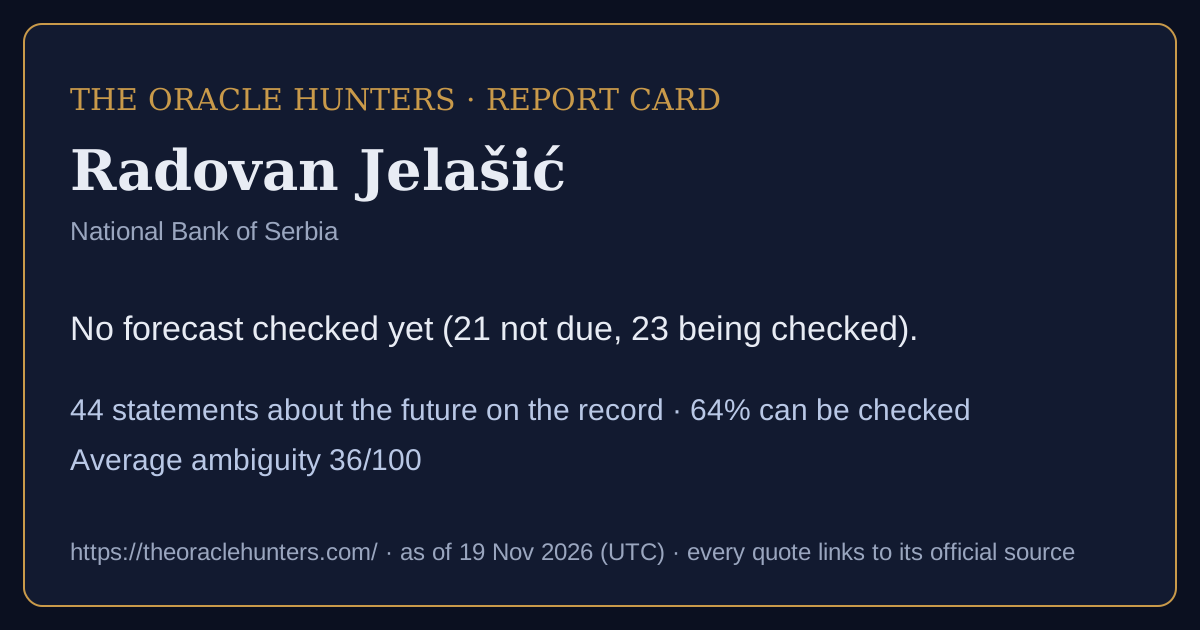
Track record: No forecast checked yet (21 not due, 23 being checked).
44forecasts & commitments on the record
64%can be checked as stated
36average ambiguity (0-100)
0goalpost moves recorded
0confirmed U-turns
Timeline
came true partly did not not due / being checked / too vague
Calibration score: shown after 10 checked forecasts with a stated likelihood (now 0).
How they speak about the future: based on data 29, stated on authority 8, educated guess 7.
Kinds of claim: forecast 29, mixed claim 8, scenario (if… then) 7. · Download this report card as a picture
In the nine words
πρόγνωσιςInference from evidence26 · 59%μαντείαInspired knowledge8 · 18%πρόνοιαPreparing for the future7 · 16%εἰκασίαConjecture2 · 5%πρόβλεψιςSeeing the signs1 · 2%
How to read this
Each box is one sentence a public figure or institution said about the future, word for word, with a link to the official text. Can be checked means it names what will happen, by when, and how likely - so it can be compared with official figures later. Too vague to check means it does not. Ambiguity (0-100) is how many different ways the sentence can be read. When the date passes, the forecast is compared with official data and marked came true, partly or did not come true. Labels judge the sentence, never the person. Full guide and glossary.On the record (44)
If banks pledge a part of their assets as collateral, the NBS could extend around RSD 70 billion in short-term loans to banks at an interest of at least 15.5% (key policy rate plus 1.5%) at a time when the rate of RPI inflation is around 10% April-to-April.
Despite global economic crisis which shall obviously have much more severe consequences on the countries in transition than on the developed economies, our banking system is not only solvent (capital adequacy ratio of 21%) but is also liquid as around RSD 120 billion is still invested in short-term securities of the NBS and RS.
Allow me to illustrate this idea by the following example: Even if the European Central Bank cuts its policy rate (which, at the moment, measures 1.0% only), that does not necessarily mean that banks will automatically have access to cheaper funding especially if the risk premium for banks is increased.
First, most CEE countries, including Serbia, greatly underestimated and are still underestimating the problems they will face in 2009 and 2010, as our economic models built on foreign direct investments, foreign borrowing and, for the regional members of the European Union, additional funds from Brussels - need a complete overhaul.
Looking at the macro level, we can see that after pursuing restrictive fiscal and monetary policies over the past few decades, all developed economies have recently opted for unprecedented relaxation of their policy stance (the US budget deficit, for instance, will be around 15% in the current fiscal year).
Lower economic growth implies lower income, and in case of no decline in spending, a higher than currently planned growth of 1¾% in consolidated budget deficit will automatically follow!
Any real growth in wages in the course of this year will be determined by the effectiveness of the government and the National Bank in terms of keeping inflation under control.
- -Full support of international financial institutions to Serbia will continue in 2009:
- -On 19 December this year, the IMF Executive Board is to approve an arrangement with Serbia, which will buttress macroeconomic stability in the country;
Global financial markets went into unprecedented turmoil, which has already affected Serbia and is likely to produce further effects in 2009.
It is only four weeks until the end of the year and we may safely say that 2008 to date has been more eventful than the past 2 or 3 years taken together!
We should finally understand that the current macroeconomic policy cannot be continued: it is completely unrealistic to expect that the time of a) cheap foreign funds and b) plentiful foreign investment will suddenly return to help us finance our current account deficit of 15 - 20%.
All of that has already been incorporated into the Budget for 2009 and will soon be made public.
When countries decide to increase the volume of insured deposits, nobody should calculate the impact such measure would have on the budget, since in case of some countries that could be as high as the country's GDP.
Still, I hope that the government understands that these cheaper dinar loans will be in larger supply only if inflation and inflation expectations are reined in, which will, in turn, lead to cuts in the NBS key policy rate.
It is important that all decision makers understand one thing: in the course of the next year or two, it will be impossible to be a popular and a responsible politician at the same time unless you are in opposition.
All projections currently under preparation as part of the 2009 budget must be as pessimistic as possible, on both the revenue and expenditure sides.
And if the entire economy can only borrow at double-digit interest rates, and even such borrowing is in short supply, how will this reflect on the country's economic growth?
- Payment of state taxes and duties in the Treasury Administration of the Ministry of Finance using payment cards (expected to be available from May 2009)
They will be thoroughly examined by experts from the European Central Bank and 17 partner central banks involved in the project over the next nine months, by the end of May of 2009.
He will be working as Chief Economist of the OECD in Paris from September this year.
NBS: this year, the National Bank will give three scholarships to final year students, who will be obligated to work for the NBS once they complete their studies.
This year, the National Payment Card centre will complete several major projects:
The support for low inflation will weaken if it is based only on memories of consequences of high and unstable inflation of the past.
By the way, if the exchange rate of the dinar were to be changed, would you, the exporters, be prepared to promise that you will achieve a significant increase in exports?
However, we could not estimate the effect of tighter monetary policy on: (1) increase in interest rates, without affecting the exchange rate, or (2) appreciation of the exchange rate, without affecting interest rates, or (3) appreciation, if at the same time interest rates are declining, or (4) depreciation, if at the same time interest rates are increasing.
Tight monetary policy was indispensable in order to keep inflation within the announced target range, which in this year is closer to the lower bound of the projected range, and at the same time, making sure that we will stay on targets announced for the next year as well!
Core inflation is down to 3.4% year-on-year and our inflation target set in August 2006 for this year at 4 - 8% will probably be at the level of 4 to 4.5% at the end of this year.
And recently we received a positive assessment of our decision - inflation has never been lower than recorded at end-May while economic growth has never been higher than recorded in the first quarter of 2007 when it reached as much as 8.0%.
This is exactly the domain of interest that the NBS is currently exploring and I hope to be able next year to inform you that we have not only established fast and efficient ways of money transfer but also that it will have become cheap, even several times cheaper than it is today.
In May this year, year-on-year, the rate of headline inflation equalled 4.4% and core inflation reached 3.o%.
The interchange rate to be applied in the DinaCard system will be 0.7 per cent of the purchase value for majority of trades people (and 0.25% for petrol) which shall be a temporary measure pending comprehensive agreement among banks to apply to all bank cards issued in Serbia.
Both the decline in inflation (and the key policy rate that led to a fall in the weighted average interest rate from 18.15% to 12.95% in the past seven months), and the rise in income from increased number of employees and new business units, will have a major influence on the commercial bank profit and loss account as early as …
Building on this, and primarily on the low inflation recorded in the final quarter of 2006, in 2007 the National Bank of Serbia will target the lower band of the 4-8% core inflation corridor, set already in August 2006.
- 2) First long term loans to finance domestic small and medium size enterprises and local government infrastructure projects were granted in 2002 from the first Financial Agreement on APEX Global Loan in the amount of RSD 1.6 billion granted by the European Investment Bank (EIB).
In late 2005 funds under this credit line became property of the Republic of Serbia and shall be disbursed over the next 10 years under the same terms and conditions (EUR 200,000 loans with five year maturity and one year grace period and annual interest rate down to 8.08%) and for the same purpose development of small and medium size …
We expect that disbursement of the second and the third tranche in the amount of EUR 10 million each will also result in the creation of a notable number of new jobs.
Six months ago, when monthly inflation stood at over 1.5% and the National Bank of Serbia, despite this, asserted that it was possible for this year's inflation to be at the projected single-digit level, a host of 'armchair critics' rushed to disprove this, proffering instead their own pessimistic forecasts of end2006 inflation.
Instead, we pursued a responsible, restrictive monetary policy, and, as a result, managed to substantially topple inflation, so that at the end of the year it should attain the projected single-digit rate of growth.
- Last but not least, I am also aware that if inflation comes down it will happen only 'thanks to the tough fiscal stance of the Government' but if it remains high it will be 'due to the not restrictive enough monetary policy'.
The wage fund this year has remained unchanged at the level from the year before, whereas any salary increases in 2005 will occur only with respect to a corresponding reduction in the number of employees!
Positive growth of all these indicators will continue this year as well; so, for instance, since 1 January until today, household savings rose by over EUR 100 million.
- For savings deposited in the course of the 'SAVINGS WEEK', banks will apply higher than usual interest rates, up to 2 percent annually, or a fixed bonus (one-off reward) as well as special privileges for certain population groups (newborns, newly married couples…) etc.
As regards a possible relaxation of the policy, it will depend primarily on the budget deficit realized until the end of the year, as well as by the wages policy of the Government.
Also said - not checkable as stated (12 newest)
Remarks about the future with no date, figure or likelihood that could be checked. They are kept on the record and shown here, but not scored.
Speech by Mr Radovan Jelaši ć , Governor of the National Bank of Serbia, at the Press Conference of the European Fund for Southeast Europe (EFSE), Belgrade, 26 May 2009.
Development finance must operate counter cyclically, which means fighting the credit crunch around the globe, in particular in emerging Europe including Southeast Europe, and that is exactly what EFSE does.
Local government bodies should have their own sources of income instead of relying on the 'transfer of funds' which can be received exclusively from state bodies; the laws need to be amended as 'states will be states' and our government can easily change its stance at one time or another, i.e. the amount of money it decides to transfer to …
Speech by Mr Radovan Jelaši ć , Governor of the National Bank of Serbia, at NALED National Alliance for Local Economic Development, Belgrade, 13 May 2009.
For example: 'remuneration for building plot development' would bring RSD 13.8 billion versus 'income tax' which would bring RSD 2.7 billion into the state coffers so the state needs to amend its laws and local government bodies to specify a different source of income as their main source of revenue;
But let me to prove to you that this issue is equally important to the NBS as it is to the local government bodies by saying that the NBS shall take all necessary measures within its sphere of competence to achieve maximum results to this effect.
Hence, it is not always necessary to think in terms of borrowing in foreign financial markets as we are awash with dinar liquidity which could be invested in high quality dinar securities at market interest rates.
Allow me to welcome you on behalf of the National Bank of Serbia, and to extend my appreciation for the magazine 'European Integration Challenges' whose very title points to the key challenges we shall be facing in the near future.
I have never doubted that, but when it comes to the European integration processes, nobody will nor anybody should do our job for us.
Whether we shall actually join the EU does not depend on us, because adoption of the so called 'European legislation' represents a necessary condition but in itself is not sufficient to guarantee our integration into the EU.
But here comes the main difference between theory and practice and the question arises whether we are going to apply our own measure to define 'independence', the term we adopted as the European norm and which is applied by their institutions, or we shall go on to make up our own definition of 'independence' and use it.
Instead we need a long overdue adjustment, with fiscal and structural reforms, including pension, healthcare and education reform for which IMF and WB should play a key role. 'Premature welfare states' as Janos Kornai would call it, based on now scarce and expensive foreign funding, nose-diving FDIs and reduced budgetary incomes, are going to face an abrupt end all over …