Rachel Reeves
HM Treasury · GBR
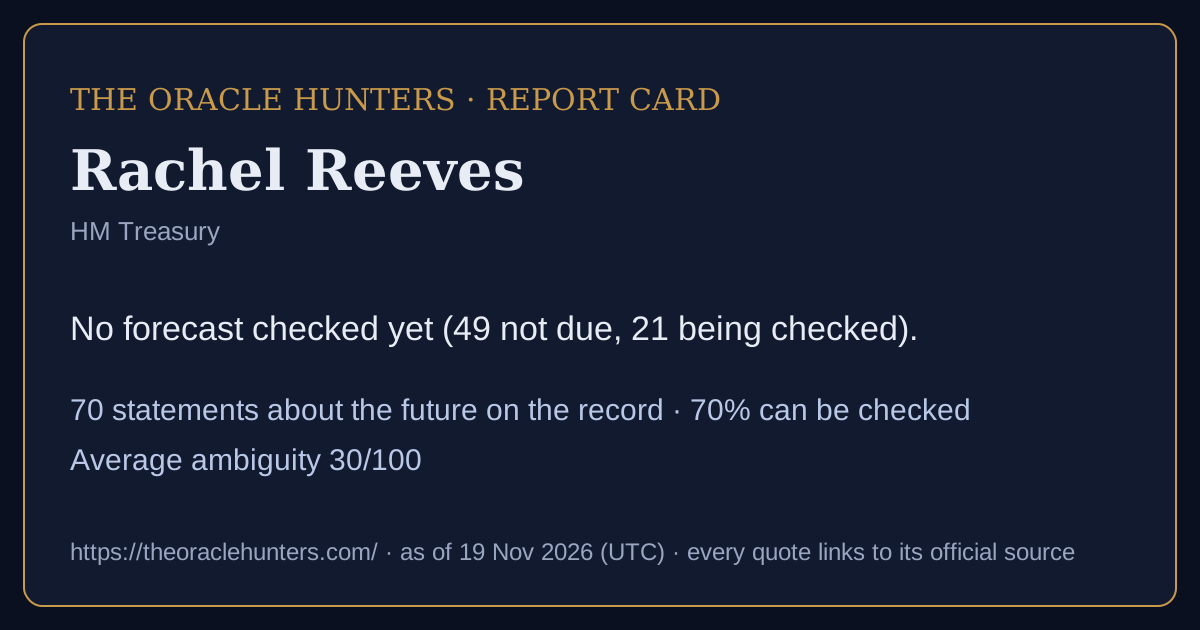
Track record: No forecast checked yet (49 not due, 21 being checked).
70forecasts & commitments on the record
70%can be checked as stated
30average ambiguity (0-100)
0goalpost moves recorded
0confirmed U-turns
Timeline
came true partly did not not due / being checked / too vague
Calibration score: shown after 10 checked forecasts with a stated likelihood (now 0).
How they speak about the future: based on data 48, stated on authority 22.
Kinds of claim: forecast 43, mixed claim 16, commitment 11. · Download this report card as a picture
In the nine words
πρόγνωσιςInference from evidence46 · 66%μαντείαInspired knowledge13 · 19%προαναγγελίαPublic pre-announcement10 · 14%φρόνησιςPractical wisdom1 · 1%
How to read this
Each box is one sentence a public figure or institution said about the future, word for word, with a link to the official text. Can be checked means it names what will happen, by when, and how likely - so it can be compared with official figures later. Too vague to check means it does not. Ambiguity (0-100) is how many different ways the sentence can be read. When the date passes, the forecast is compared with official data and marked came true, partly or did not come true. Labels judge the sentence, never the person. Full guide and glossary.On the record (70)
Lloyds, NatWest and Allica Bank have already confirmed that those changes will help them to provide £1bn each of SME lending over the next 3 years…
Last week, the British Business Bank will make a £150 million cornerstone investment into Playgrounds Deep Technology Fund, providing capital to help AI hardware firms scale, unlock private investment and building lasting capability here in Britain.
The OECD now estimates that AI could add between between 0.4 and 1.3 percentage points to UK productivity growth over the next decade.
We want to work with landowners where we can, but where people are holding our country back, this government is not afraid to use these powers to ensure our growth, and we will make sure authorities that want to use these powers have the guidance that they need to do so.
I have already extended the £3 bus fare cap to March 2027 and today I can confirm that bus travel across England will be free for children aged between 5 and 15 throughout August.
And because of the resilience of our economy, this week the International Monetary Fund upgraded Britain’s forecast for this year.
We beat the Office for Budget Responsibility’s forecast in the Spring, with economic growth at 0.6% in the three months to March.
First, fuel duty – I have already extended the 5p cut twice since the election and I can confirm today there will be no rise this year, recognising the pressure that the war has put on fuel prices.
Because of my tax choices made in my first budget, last June I could allocate an additional £50 billion per year to our public services by the end of the spending review period.
Later this year, I will convene business leaders for an AI Adoption Summit, bringing together leading tech firms with companies ready to adopt and scale AI to grow their businesses.
NHS waiting lists at their lowest levels in three years; more than half a million kids, and their parents, benefiting from 30 hours of free childcare; and, from next month, the two-child limit will be gone for good, lifting almost half a million children out of poverty.
And from next month, the energy price cap will be £117 on average lower, thanks to action I took at the Budget.
We will legislate to implement the Fingleton Review, to build nuclear faster, and – for business – we are expanding the supercharger discount from this April and launching our British Industrial Competitiveness Scheme from next year.
On capital, we reformed the mandate of the British Business Bank and put £5 billion behind British start-ups; we will launch our Sovereign AI unit next month, with a £500 million commitment for starting and scaling AI businesses; and we’re making government the first customer for innovative technologies through our procurement rules.
In their forecasts today, the Office for Budget Responsibility show that we are set to reduce borrowing by nearly £18bn compared to the Autumn.
…we will have £15 billion a year more for the priorities of working people and to make working people better off:
The forecast today shows that Public Sector Net Borrowing is set to fall from 4.3% this year, to 3.6% next year, then to 2.9%, 2.5%, and to 1.8% in 2029-30.
In today’s forecasts, unemployment is set to peak later this year and then fall in every year of the forecast period…
Already, because of the action I have taken we are expected to spend nearly £4 billion a year less on debt interest next year than was forecast in the Autumn…
So, GDP is forecast to grow by 1.1% in 2026, 1.6% in both 2027 and 2028, and 1.5% in both 2029 and 2030.
In the Spring, the OBR forecast that our economy would grow by 1% this year.
Taken together, my reforms to gambling tax will raise over £1bn per year by 2031.
At this Budget, I will find a further £4.9bn of efficiencies by 2031:
Our Net Financial Debt this year will be £2.6trillion: 83% of GDP.
We beat the forecasts this year and we will beat them again:
There is an impact on our public finances too – the OBR say that their productivity forecast will mean £16bn less in tax receipts by 2030.
At the Budget this year, I will continue to build the strong foundations to secure Britain’s future.
Our growth was the fastest in the G7 in the first half of this year – but I don’t expect anyone to be satisfied with growth of 1%.
Thousands of jobs thanks to the Crown Estate’s new project at Harwell East – unlocking £4.5 billion of investment for our economy.
We will go further to boldly regulate for growth…
Launching by October this year, it will provide a tailored service to companies considering setting up and expanding in the UK…
…I am futureproofing the regulatory regime and will publish draft legislation in early 2026.
And I welcome the announcement today, made by the Financial Ombudsman Service that will reduce the interest rate it applies before a decision from 8% to base rate plus 1%.
…that means tens of thousands more people could be able to get a mortgage in the next year alone…
Overall, I am providing a cash uplift of over £4.5bn a year of additional funding in the core schools budget by the end of the spending review;
…I can announce that funding of up to £280m more per year by the end of the spending review for our new Border Security Command.
Earlier this week, we announced that over three quarters of pensioners will receive the Winter Fuel Payment this year.
In this spending review, total departmental budgets will grow by 2.3% a year in real terms,
We will establish a Growth Mission Fund to expedite local projects that are important for growth…
…so that defence spending will now rise to 2.6% of GDP by April 2027…
Together the fiscal rules mean that, unlike our predecessors, we will not be balancing the books by cutting investment.
…where we will legislate to unlock up to £80 billion of investment into companies like yours…
…which we will legislate for next month.
The Universal Credit Standard Allowance will increase from £92 per week in 2025-26 to £106 per week by 2029-30…
Finally, Mr Speaker, we will provide £2bn of increased capacity for UK Export Finance…
We will establish a protected budget of £400m within the Ministry of Defence…
We will spend a minimum of 10% of the Ministry of Defence’s equipment budget on novel technologies …
… the OBR forecast that CPI inflation will average 3.2% this year…
… we will increase defence spending to 2.5% of GDP, reducing overseas aid to 0.3% of Gross National Income.
And today I can announce that we are investing £63 million into the Advanced Fuels Fund over the next year…
Showing the newest 50 - the ledger has all 70.
Also said - not checkable as stated (12 newest)
Remarks about the future with no date, figure or likelihood that could be checked. They are kept on the record and shown here, but not scored.
…so that as defence spending rises across the world, the benefits of that investment and those jobs will come here to Britain…
It will be crucial to our national security and to all our economic futures.
…and I can announce that by early next year, the UK is set to become the first G7 country to issue a Digital Sovereign Bond, with plans for future issuance to come.
In the age of insecurity in which we live, the economic strength of our country will rest on strategic alliances…
We are set to rejoin the EU’s Erasmus scheme from next year…
Together, these two complementary supercomputer resources will help boost British researchers and businesses right across the country, giving them access to advanced compute that they need to develop, test and scale AI.
And we will collaborate with citizens and businesses to explore further opportunities.
I can also confirm that we will soon be launching the tender process for the new national supercomputer in Edinburgh.
And later this month we will publish our National Cyber Action plan, setting out all of the actions that organizations can and should take.
In the Oxford to Cambridge Growth Corridor, our task is to remove the constraints that are holding back growth, that could be unlocked now — unlocking infrastructure, housing and investment so that world - leading innovation can scale and then stay in the corridor.
Second, I am announcing a major land acquisition by Homes England – buying the airfield in Cambridge East in partnership with Hill Group — that will allow us to align land, funding and planning levers and bring forward a key Cambridge growth site faster than the status quo would ever have managed.
The Growth Mission Fund will deliver improved connectivity with the town and better door-to-door connectivity for passengers and rail users.