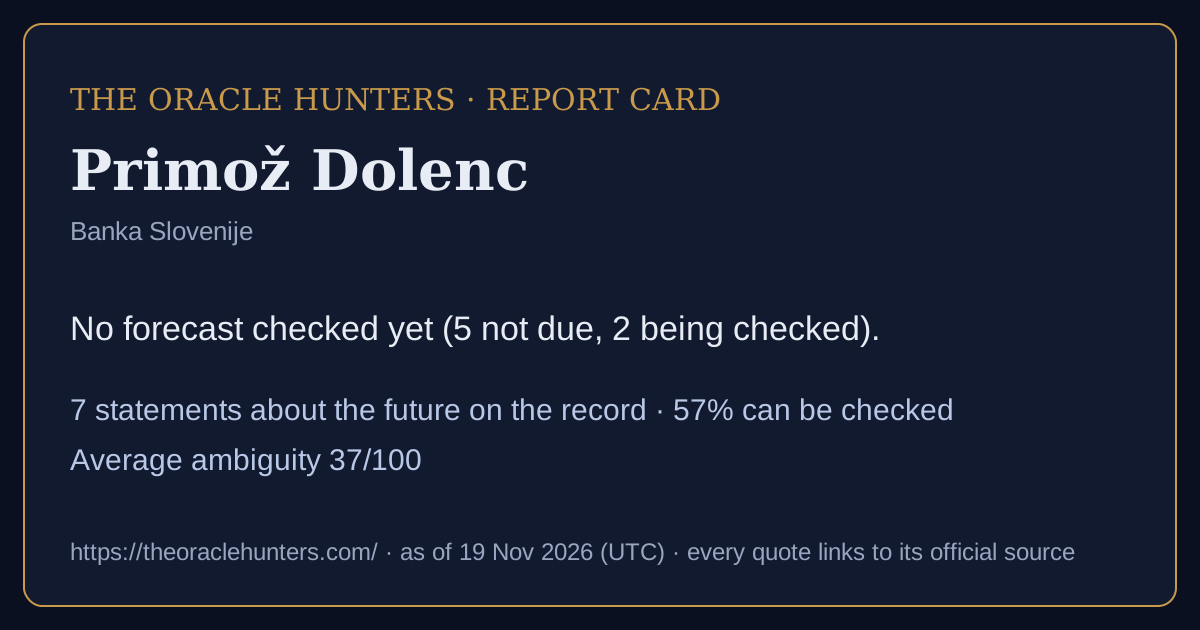
Primož Dolenc
Banka Slovenije
Track record: No forecast checked yet (5 not due, 2 being checked).
7forecasts & commitments on the record
57%can be checked as stated
37average ambiguity (0-100)
0goalpost moves recorded
0confirmed U-turns
Timeline
came true partly did not not due / being checked / too vague
Calibration score: shown after 10 checked forecasts with a stated likelihood (now 0).
How they speak about the future: based on data 5, stated on authority 2.
Kinds of claim: forecast 5, mixed claim 1, commitment 1. · Download this report card as a picture
In the nine words
πρόγνωσιςInference from evidence5 · 71%προαναγγελίαPublic pre-announcement1 · 14%μαντείαInspired knowledge1 · 14%
How to read this
Each box is one sentence a public figure or institution said about the future, word for word, with a link to the official text. Can be checked means it names what will happen, by when, and how likely - so it can be compared with official figures later. Too vague to check means it does not. Ambiguity (0-100) is how many different ways the sentence can be read. When the date passes, the forecast is compared with official data and marked came true, partly or did not come true. Labels judge the sentence, never the person. Full guide and glossary.On the record (7)
It is important to stress the dilemma of whether we will help shaping the financial infrastructure ourselves, or whether we will remain dependent on decisions made elsewhere.
We find investment activity in Slovenia to be weak, but expect it to increase slightly as the economy strengthens in 2026 and 2027.
Banka Slovenije will as usual unveil its latest projections at the end of the year.
Inflation will remain slightly elevated this year, albeit temporary, as a result of a rise in energy prices driven by rising prices of heat and fuels, and in reflection of the waning of a negative base effect in electricity prices.
Economic growth has slowed this year, which the IMF also finds, but is expected to gradually recover in 2026 and 2027.
Our baseline scenario nevertheless envisages that inflation will gradually slow next year to approach its medium-term target rate of 2%.
According to Mr Draghi's report and other studies, the EU will have to allocate amounting to around two percent of GDP annually by additional green investments 2030.
Also said - not checkable as stated (12 newest)
Remarks about the future with no date, figure or likelihood that could be checked. They are kept on the record and shown here, but not scored.
With an even more ambitious project, the so-called project APPIA, we will try to establish an infrastructure that would enable central banks to issue tokenized reserves and facilitate the direct settlement of digital assets in central bank money.
To do so, we will require close cooperation between regulators, central banks, the financial industry, technology firms and academia.
Its purpose is thus to ensure that the citizens of Europe will continue to have access to the safest form of money in the future, regardless of how technologies and payment habits evolve.
Such an infrastructure could significantly improve the efficiency of capital markets, cross-border payments and other financial services.
We want to establish a robust financial system that will be capable of harnessing the advantages of digital technologies, but at the same time maintaining trust, security and stability of both, the European and Slovenian economy.
But as the guardians of financial stability, we must ask ourselves this question: which money will these transactions be settled in?
We're investigating how central banks could directly issue digital reserves in token form, which would allow for the extremely quick and secure settlement of complex financial operations, from securities settlement to cross-border payments.
- For financial stability specialists, it means analysing new channels along which shocks could be transmitted between crypto markets and the traditional financial sector.
Stablecoins, tokenised deposits and other tokenised assets are above all a reminder that users expect faster and cheaper services.
Although the MiCAR allows the issuance of sound stablecoins, which can be denominated in euros, we must face the fact that the market is currently still gravitating towards the dollar.
At the same time we should be aware that despite the introduction of the MiCAR, a significant chunk of the crypto ecosystem remains outside the regulatory framework - for example the field of decentralised finance or DeFi.
The current indicators point to a gradual recovery in economic growth, although the difficulties seen at the halfway point of the year mean that it will remain sluggish in 2025, but positive.