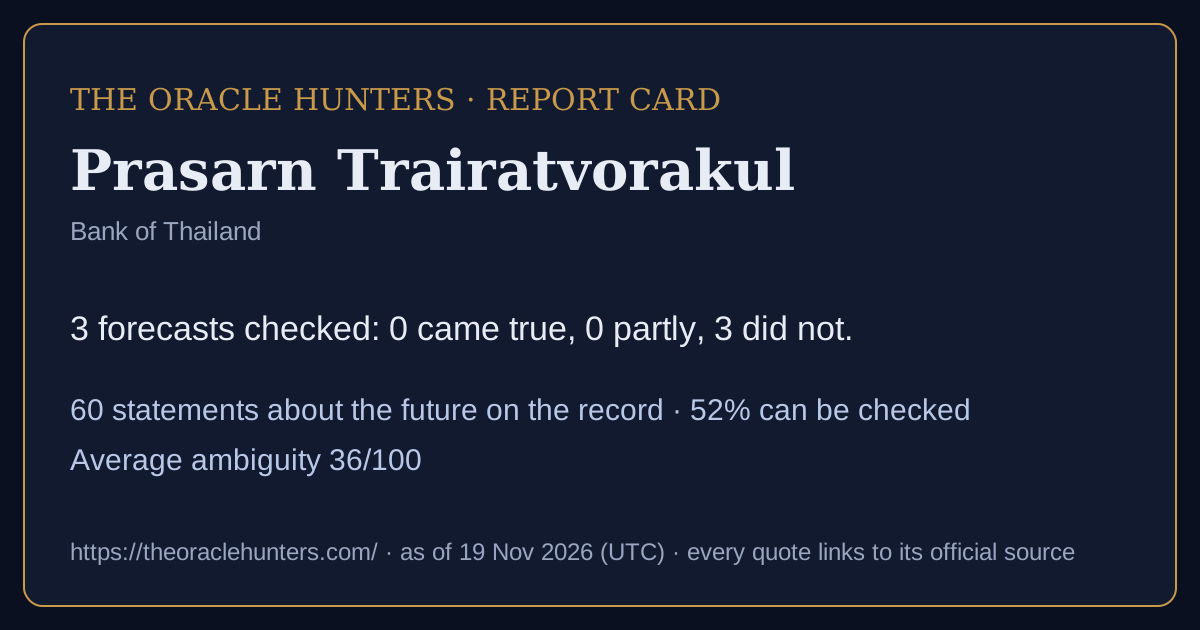
Prasarn Trairatvorakul
Bank of Thailand
Track record: 3 forecasts checked: 0 came true, 0 partly, 3 did not.
60forecasts & commitments on the record
52%can be checked as stated
36average ambiguity (0-100)
0goalpost moves recorded
0confirmed U-turns
Timeline
came true partly did not not due / being checked / too vague
Calibration score: shown after 10 checked forecasts with a stated likelihood (now 1).
How they speak about the future: based on data 37, stated on authority 20, educated guess 3.
Kinds of claim: forecast 51, mixed claim 4, scenario (if… then) 3, commitment 2. · Download this report card as a picture
In the nine words
πρόγνωσιςInference from evidence36 · 60%μαντείαInspired knowledge18 · 30%πρόνοιαPreparing for the future3 · 5%προαναγγελίαPublic pre-announcement2 · 3%φρόνησιςPractical wisdom1 · 2%
How to read this
Each box is one sentence a public figure or institution said about the future, word for word, with a link to the official text. Can be checked means it names what will happen, by when, and how likely - so it can be compared with official figures later. Too vague to check means it does not. Ambiguity (0-100) is how many different ways the sentence can be read. When the date passes, the forecast is compared with official data and marked came true, partly or did not come true. Labels judge the sentence, never the person. Full guide and glossary.Checked
Looking ahead, the Bank of Thailand anticipates GDP to expand by 4.8% next year.
Did not come true. Said: economic growth around 4.8% in 2015. Official figure for Thailand: 3.1% (World Bank open data). Missed. Off by 1.7 points. official data · checked 14 Nov 2026 · automatic check against official data (rules v3)
We have forecasted the GDP growth this year at 4.9 percent.
Did not come true. Said: economic growth around 4.9% in 2013. Official figure for Thailand: 2.7% (World Bank open data). Missed. Off by 2.2 points. official data · checked 14 Nov 2026 · automatic check against official data (rules v3)
Given the strong growth momentum and solid economic fundamentals, the Thai economic growth is expected to expand at 3-5 per cent this year.
Did not come true. Said: economic growth between 3% and 5% in 2011. Official figure for Thailand: 0.8% (World Bank open data). Missed. Off by 2.2 points. official data · checked 14 Nov 2026 · automatic check against official data (rules v3)
On the record (60)
It is important to note that such distributional bias, if not taken seriously, could hinder economic growth potential.
This is one area that ASEAN as a group has recognized and will tackle under its financial integration plan Post-2015 to accommodate AEC 2025 agenda.
Bearing in mind these challenges, the third Financial Sector Master Plan will guide financial developments up to 2020.
It is expected that by 2025, the number of older people in Thailand will account for 20% of the population and exceed the number of children under 15 years old.
However, Thai economy is expected to recover up to 3.8% GDP growth this year from a mere 0.8% last year.
If not properly addressed, these could restrain the country's growth potential in the medium term.
We are currently awaiting the official figure, but project that the economy in the second half of 2014 to have grown by 1.7%, which translates into an annual growth of 0.8% for 2014.
Key takeaway of my talk is that the growth outlook for this year is more positive than last year's growth.
As for 2015, we project that the Thai economy will continue to recover at an annual growth rate of 4%.
We project merchandise exports to grow mere 1% this year compared to 3-4 % expected by the market.
Once it begins operations in 2015, we hope to see a new wave of infrastructure financing that will enhance connectivity in the whole region.
It has already begun lending with a $ 25 million loan to finance power links in Indonesia last year and is expected to carry out about six projects each year throughout 2015 totaling $ 1 billion.
Looking ahead, the Bank of Thailand anticipates GDP to expand by 4.8% next year.
Did not come true. Said: economic growth around 4.8% in 2015. Official figure for Thailand: 3.1% (World Bank open data). Missed. Off by 1.7 points. official data · checked 14 Nov 2026 · automatic check against official data (rules v3)
We forecast Thailand to grow at around 4.8% next year, a rate that means steady recovery to normal levels of economic activity.
With the convincing results of the current plan which will end this year, the Bank of Thailand has recently set up a steering committee to look after the next phase, Financial Sector Master Plan Phase 3.
Indeed, our annual economic symposium this year, 'Rethinking Finance for Sustainable Growth', will discuss the links in detail.
We expect the recovery of domestic demand to gain more traction going forward, especially in the second half of this year.
For these reasons, exports may play a less active role in its contribution to growth this year.
The presence of a fully functioning government ensures that the budget for 2015 fiscal year could be prepared on time, eliminating the risk of a Thai-style 'fiscal cliff'.
The plan according to the AEC Blueprint, will see CLMV countries' tariffs being removed by 2015.
This conference takes place at an important juncture as we are on the eve of the ASEAN Economic Community which will be launched at the end of next year.
The Asian Development Bank estimates that the share of ASEAN's middle class is expected to increase to 65% by 2030. 3 Moreover, ASEAN continues to pursue closer integration into the global economy through various Free Trade Agreements.
In light of these factors, the Bank of Thailand projected GDP growth to be around 4 percent this year, a downward revision from a more bullish view we had earlier.
Infrastructural projects will also strengthen Thailand's position as a hub for our Greater Mekong Sub-region (GMS) neighbors, and is expected to accelerate the integration of these economies as we approach the 2015 ASEAN Economic Community.
The quota have also been doubled to THB 3,000 million for next year.
For this, I would expect the economy to return to its normal path in the third and fourth quarter of this year.
Without enough quantity and quality of growth, we will not be able to grow sustainably and it will be a long way until Thailand can get out of the middle-income trap.
economy especially with the large-scale infrastructure investment expected to phase in from the latter part of this year.
Growth in the first quarter at 5.3 percent compared to the same period last year was lower than what we had expected.
Inflation is expected to remain low, with headline inflation around 2.8 percent.
For this year, the Bank of Thailand will continue to make sure that overall economic conditions stay safe and sound.
We have forecasted the GDP growth this year at 4.9 percent.
Did not come true. Said: economic growth around 4.9% in 2013. Official figure for Thailand: 2.7% (World Bank open data). Missed. Off by 2.2 points. official data · checked 14 Nov 2026 · automatic check against official data (rules v3)
We are ready to work with all parties, public and private alike, to create a supportive environment conducive to sustainable growth.
This year, we will establish a licensing framework for foreign commercial bank subsidiaries, with a view to enhancing the competitiveness of the banking industry as envisaged in the Financial Sector Master Plan Phase 2.
This will be finalized this year, with timeline of liberalisation in 2014 to 2020, depending on country's readiness.
We expect that economy will grow at 5.7 percent this year and 5.0 percent next year.
We expect to reach conclusion by the end of this year, and for implementation to begin in 2014.
After industry consultation, we believe that Thai banks will be well placed to implement the Basel III framework as their capital positions are well above the minimum requirements of 8.5%.
The economy is expected to gather momentum and return to its potential from the second half of this year onwards.
Business confidence has also rebounded strongly and investment is projected to regain a firm footing by the third quarter of this year.
We project that economic growth will rebound to 5.7 percent in 2012 driven mainly by strong domestic demand.
In the final phase in 2014, additional new licenses may also be considered.
In 2013, momentum is expected to pick up, resulting in an expansion of 5.6 percent.
In 2013, economic growth is projected to gather momentum, expanding by 5.6 percent.
The growth rates I have mentioned for 2012 and 2013 are consistent with the medium-term trend, as strong fundamentals mean that Thailand's long-term growth trajectory remains intact despite the flood and volatile external environment.
The economy is projected to rebound in 2012, growing by 4.9 percent, boosted by private and public spending for post-flood restoration.
Thus, going forward, Thai and other ASEAN nationals need to put more emphasis on the growing ASEAN Economic Community or AEC, which will start officially in 2015 only a few years from now.
I would like to stress again that Thailand's fate will depend upon her success in reviving domestic demand, given that the problems in the U.S. and the Eurozone are still far from resolved and are expected to last well into the next year and beyond.
We expect private consumption to rebound as early as the first quarter next year, and investment to regain its firm footing by the second.
Despite the fact that we have less than two months to go for 2011, the Bank has just revised down its growth projection for the Thai economy this year, from 4.1 percent in July's assessment to only 2.6 percent in October's.
Showing the newest 50 - the ledger has all 60.
Also said - not checkable as stated (12 newest)
Remarks about the future with no date, figure or likelihood that could be checked. They are kept on the record and shown here, but not scored.
Speech by Dr Prasarn Trairatvorakul, Governor of the Bank of Thailand, at the Euromoney Greater Mekong Subregion Investment Forum, Bangkok, 28 May 2015.
First , we may already be aware that while regional integration brings about promising growth, it also entails greater external vulnerability which could dilute the effectiveness of the individual country's economic toolsets.
With promising prospects await, what I expect to see in a very fast-approaching future is the interplay between different facets of development to strengthen the health of the economy and keep it well in balance.
Firstly , in order to unlock the long-run potential growth, well-established infrastructure will be one of the crucial pillars that will sow a seed of a healthy investment climate conducive for growth .
Also, governments' clear focus on infrastructure upgrading will facilitate the growing cross-border trading activities.
But this is another topic that I don't think we will have time to cover today.
If our peers are driving the newest computerized hybrid cars, while we are driving a 10-yearold car, we will be slower, less safe, and consume more fuel.
Speech by Dr Prasarn Trairatvorakul, Governor of the Bank of Thailand, at the Association of International Banks (AIB) Dinner Talk, Bangkok, 21 May 2015.
The BSA is designed to be a backstop liquidity facility, which will help boost confidence of the private sector in using the local currency in trade and investment settlement.
As the advantage of low cost factor of productions is rapidly declining, China is facing an urgent need to re-orient supply chains through Thailand to enter ASEAN and the Greater Mekong Subregion (GMS) in particular.
And should inflows reverse abruptly, the resulting asset price and exchange rate swings could induce broad contagion effects that prove disruptive to economic activity.
Nevertheless, there are important reasons why capital flow volatility and exchange rate fluctuations may present more challenges for emerging market countries.