Poonam Gupta
Reserve Bank of India
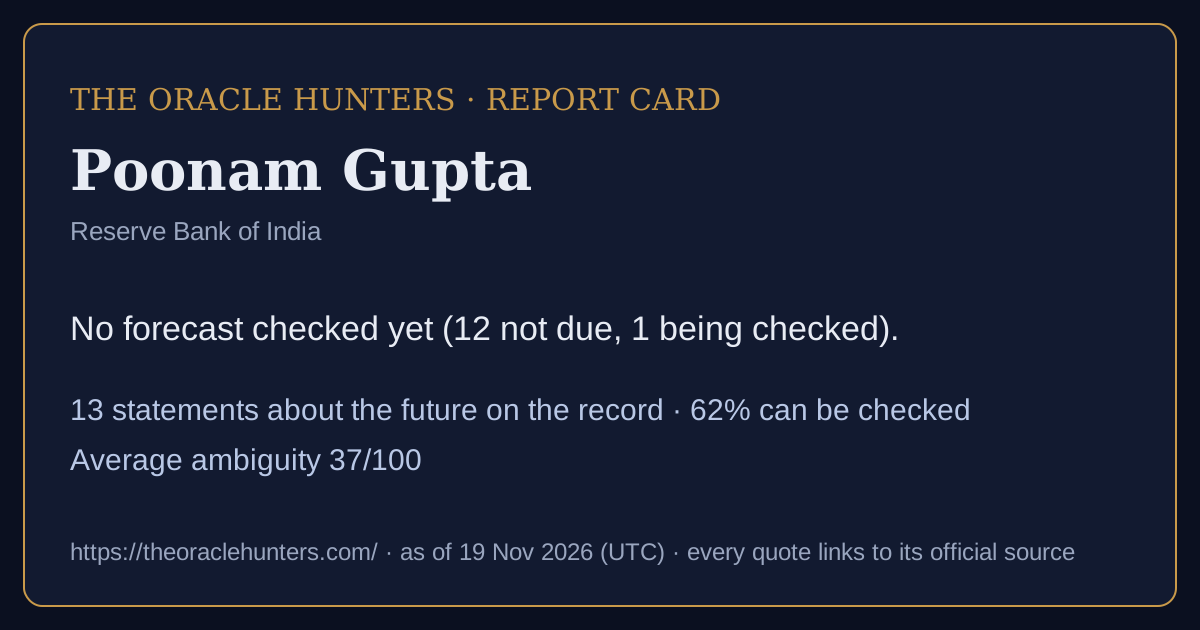
Track record: No forecast checked yet (12 not due, 1 being checked).
13forecasts & commitments on the record
62%can be checked as stated
37average ambiguity (0-100)
0goalpost moves recorded
0confirmed U-turns
Timeline
came true partly did not not due / being checked / too vague
Calibration score: shown after 10 checked forecasts with a stated likelihood (now 0).
How they speak about the future: based on data 12, educated guess 1.
Kinds of claim: forecast 10, mixed claim 2, scenario (if… then) 1. · Download this report card as a picture
In the nine words
How to read this
Each box is one sentence a public figure or institution said about the future, word for word, with a link to the official text. Can be checked means it names what will happen, by when, and how likely - so it can be compared with official figures later. Too vague to check means it does not. Ambiguity (0-100) is how many different ways the sentence can be read. When the date passes, the forecast is compared with official data and marked came true, partly or did not come true. Labels judge the sentence, never the person. Full guide and glossary.On the record (13)
The projection for 2026 is 0.1 percentage point higher than in July, and that for 2027 is unchanged.
The IMF’s latest World Economic Outlook (WEO, October 2026) projects the global economy to grow at 3.1 per cent in 2026 and 3.4 per cent in 2027.
Against these developments, the rupee has cumulatively depreciated by 13.0 percent (on a point-to-point basis) from March 31, 2025 to September 17, 2026. (#footnote-3-8Bwy87peIOdy-QWYep8khuVzxNv68JZTc5MyRZTdG1Q) The questions then arise: How long may the BOP stay in deficit?
In the latest edition of its Fiscal Monitor, the IMF (2026) projected that, in contrast to most other countries, India's public debt, as a proportion of GDP, would decline between now and 2031 by 5.7 percentage points. (#footnote-1-O4KAZXVHby5ZUKpQ-AVI9Jzv763G0u64ULH06k07MN4) This consolidation is attributed both to fiscal prudence as well as high GDP growth (both real and nominal).
If growth-inflation mix evolves as it has in the past ten years: robust growth, and lower and more stable inflation, one could perhaps consider tweaking the level of inflation and the tolerance band a bit (keeping in view the international experiences, it would point towards a slightly lower inflation and a slightly narrower band).
As a simple thought experiment, we calculate each state's average annual growth rate in per capita GSDP (in USD terms and again in constant INR) over the past decade (2013-14 to 2024-25); and use these to project income levels in 2046-47 assuming that the same rate of growth would prevail over the next two decades. 6
As per the forecasts in October 2025 World Economic Outlook (WEO) of the IMF, per capita income is projected to increase to US$ 2818 in 2025, US$ 3051 in 2026 and US$ 4346 in 2030.
Finally, I will draw some inferences and implications from these observations for our quest to attain the status of a much more prosperous economy by 2047.
Looking ahead, if growth trajectories of the past two decades are sustained, the average state per capita income could approach high-income thresholds by 2046-47.
Sustaining or exceeding recent growth trajectories to reach an even higher level of prosperity by 2047 will require extending our growth frameworks at the subnational levels.
If the past rates of growth are maintained, many states will become or come close to becoming 'rich' by 2047 (as per the prevailing international thresholds of prosperity).
As per October 2025 forecasts in the World Economic Outlook of the IMF, per capita income is projected to increase to US$ 2818 in 2025, US$ 3051 in 2026 and US$ 4346 in 2030.
Average annual CPI inflation in India has declined from close to 10 per cent in the 1990s to about 6 per cent a year in the subsequent two decades; to below 5 per cent in the last four years; and is likely to remain benign in the coming months (Figure 4, Panel A).
Also said - not checkable as stated (12 newest)
Remarks about the future with no date, figure or likelihood that could be checked. They are kept on the record and shown here, but not scored.
In fact, actual growth has turned out stronger than projected by the IMF in each of the past three years, even as shocks have accumulated and intensified.
All stress tests, published in the latest Financial Stability Report in June 2026, indicate that the financial sector is extremely resilient and will remain so under the harshest of conditions.
The relative strength of the market is due to the fiscal commitment of the government; and the projected sustained high economic growth rates that would make the fiscal outcomes even better going forward.
India's dependence on imported oil is set to decline, through alternative sources of energy and the quest to find its own oil reserves, both of which will further bolster the trend reduction in the demand for oil as percent of GDP. (#footnote-4-9HCl3Uqk8zzI9uSYoF_6ICpWJvhaAq1AANGzizpWaR0) This would be in addition to oil prices themselves stabilizing as soon as the conflict resolves.
Meanwhile, the rest of the trade basket is responding well to the new trade opportunities that are being leveraged, a strength that will continue with the positive impact of recent FTAs materializing, and a conducive exchange rate.
Much would depend on the combination of inflation and growth outcomes as they evolve during the next five years; and the shocks, especially the global ones, that the economy may have to weather meanwhile.
1 Speech by Dr. Poonam Gupta, Deputy Governor, Reserve Bank of India delivered at Joint Seminar and Discussion - 'India's Inflation Targeting Framework' and 'Regional Economic Outlook for Asia and Pacific', NCAER, New Delhi on May 5, 2026.
Inflation targeting was formally institutionalised with the amendment of the Reserve Bank of India (RBI) Act, 1934 in May 2016.
Section 45ZA of the RBI Act, 1934 mandates that ' The Central Government shall, in consultation with the Bank, determine the inflation target in terms of the Consumer Price Index, once in every five years'.
A concern sometimes raised about inflation targeting is that the single-minded pursuit of price stability may come at the cost of growth.
The topic that I have chosen for my talk today is on some of the salient features of India's economic growth in recent years and how they may be contextualised over the past four decades.
It is expected that the recently announced India-USA trade deal, India-EU free trade agreement (FTA) and the newly signed or prospective new trade agreements will further strengthen the current account.