Pongpen Ruengvirayudh
Bank of Thailand
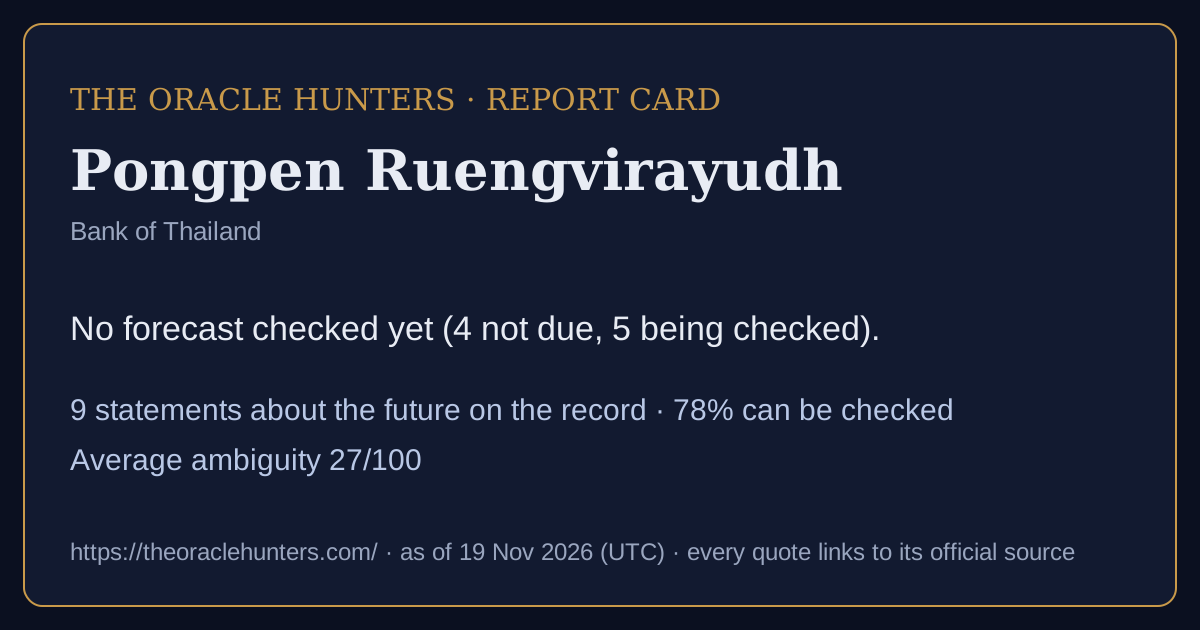
Track record: No forecast checked yet (4 not due, 5 being checked).
9forecasts & commitments on the record
78%can be checked as stated
27average ambiguity (0-100)
0goalpost moves recorded
0confirmed U-turns
Timeline
came true partly did not not due / being checked / too vague
Calibration score: shown after 10 checked forecasts with a stated likelihood (now 0).
How they speak about the future: based on data 5, stated on authority 2, educated guess 2.
Kinds of claim: forecast 7, scenario (if… then) 2. · Download this report card as a picture
In the nine words
πρόγνωσιςInference from evidence5 · 56%μαντείαInspired knowledge2 · 22%πρόνοιαPreparing for the future2 · 22%
How to read this
Each box is one sentence a public figure or institution said about the future, word for word, with a link to the official text. Can be checked means it names what will happen, by when, and how likely - so it can be compared with official figures later. Too vague to check means it does not. Ambiguity (0-100) is how many different ways the sentence can be read. When the date passes, the forecast is compared with official data and marked came true, partly or did not come true. Labels judge the sentence, never the person. Full guide and glossary.On the record (9)
While the US is expected to raise its policy rate, likely by the end of this year, recovery of the euro area economies and Japan remains unsteady, with ultra-loose monetary policies put in place for a longer period.
The MPC, in its last meeting, expressed concern over a number of structural issues, which, if not addressed, could restrain the country's potential growth in the long run.
However, the economy is expected to resume its normal growth in 2015.
The IMF, in their April report, projected that the global economy will grow at 3.6 per cent this year, which is an improvement from 3.0 percent growth last year.
The country's higher credit default swap, if left unchecked, could lead to higher funding costs in the financial markets and certainly constitutes another challenge going forward.
Set against this weaker-than-expected domestic demand, is relatively resilient exports which expanded more than 8 percent.
Notwithstanding a somewhat lackluster economic performance in the first quarter of this year, many of the supportive factors are expected to remain in place.
As projected by NESDB, by 2030 the working-age population will fall from the current rate of 68 percent to just over 60 percent, making Thailand's old age dependency ratio slightly higher than the Asian average.
The latest Monetary Policy Report released in January projected growth this year to be 4.9 percent, which will likely be revised up after the strong outturn of last year growth rate as announced by the NESDB.
Also said - not checkable as stated (12 newest)
Remarks about the future with no date, figure or likelihood that could be checked. They are kept on the record and shown here, but not scored.
It should also be noted that heavily managed exchange rate may discourage businesses from upgrading their technology, productivity, and competitiveness, so as to command more bargaining power in the global market and better withstand exchange rate volatility.
Therefore, public and private stakeholders must remain vigilant of any impacts they may have on real economy.
The Bank of Thailand (BOT) has been conducting monetary policy under 'Flexible Inflation Targeting' framework since May 2000.
This may potentially cause extremely large asset prices and exchange rate movements in response to capital flow volatility.
Active interventions under the inflation targeting framework regime may also have unintended consequences on policy framework credibility, as the central bank's commitment to safeguard the overall macroeconomic stability may be called into question by the public.
Opening remarks by Ms Pongpen Ruengvirayudh, Deputy Governor for Monetary Stability of the Bank of Thailand, at the Joint Foreign Chamber of Commerce in Thailand (JFCCT), Bangkok, 21 May 2014.
Mindful of imminent downside risks to growth, the policy rate was cut three times in the MPC meetings of May and November 2013, and again in March 2014.
Recent government's attempts in China to reform the financial sector should support sustained growth in the longer term, although with some impacts on short-term growth.
Moreover, should the current political situation persist, prolonged political instability will certainly have dire consequences firstly on the tourism industry but also eventually on our ability to maintain and attract the FDI flows.
However, with cooperation from all sides, I hope we shall be able to weather the upcoming storms with a common vision and readiness, and that a clear blue sky is beckoning in the distance.
This, combined with the likely additional delay in public spending, could have further dampening effects on growth.
Also, if your clients are engaged in intra-regional trade, recommending using a regional currency to reduce overreliance on the major currencies may be worth considerations.